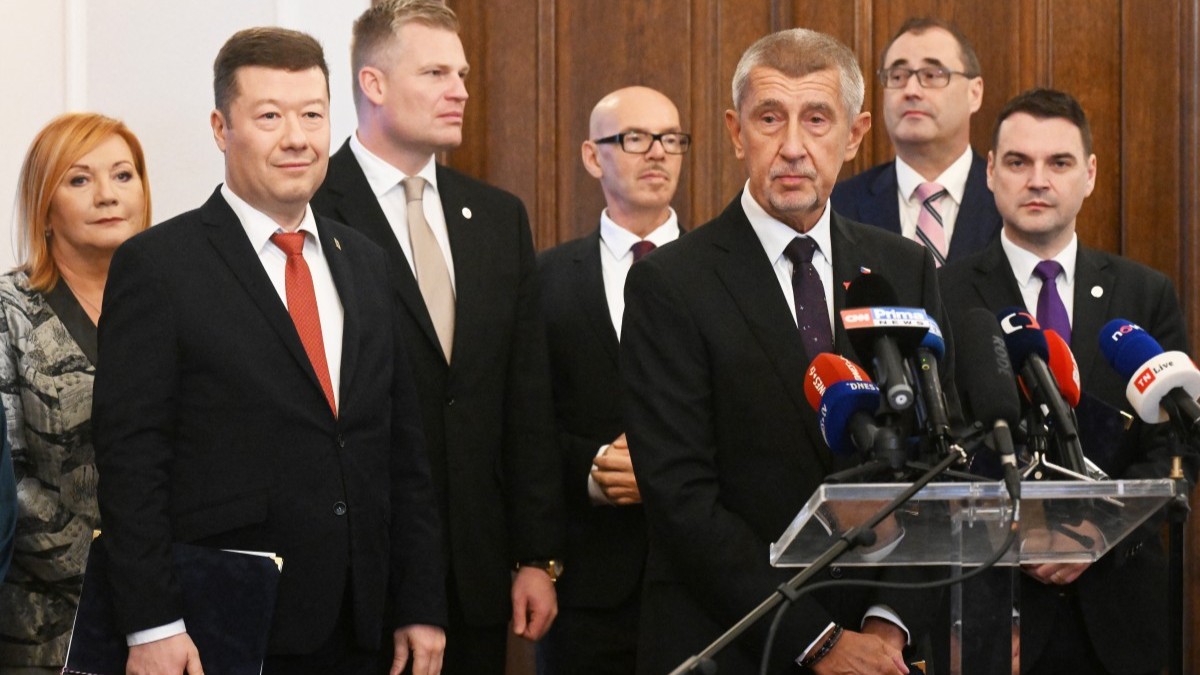
ANO party leader and Prime Minister-elect Andrej Babiš (3rd R) answers to journalists after signing a new coalition government agreement with the leader of SPD party Tomio Okamura (2nd L) and the leader of Motorists for Themselves party Petr Macinka (R) at the Czech Parliament in Prague on November 3, 2025.
Michal Cizek / AFP
The Czech Republic’s incoming right-wing coalition government has signalled that two of its earliest acts in office will be to reject the European Union’s Pact on Migration and Asylum and the planned ETS2 emissions trading scheme, in what marks a decisive shift in Prague’s relations with Brussels.
Tomio Okamura, chairman of the Freedom and Direct Democracy (SPD) party and newly elected speaker of the Chamber of Deputies, said on Friday, December 5th that the first session of Andrej Babiš’s new cabinet would include “rejecting the EU Migration Pact and the ETS2 emissions trading scheme.”
Na prvním jednání naší nové vlády odmítneme emisní povolenky ETS2 a Migrační pakt EU.👍🏻 pic.twitter.com/Ha4Pfz5RfN
— Tomio Okamura (@tomio_cz) December 5, 2025
The leader of the anti-immigration party added that a confidence vote in the lower house could take place on January 13, 2026, with the government expected to be appointed only days after Babiš becomes prime minister on December 9th.
The three-party coalition of ANO, SPD, and the Motorists’ party now commands 108 seats in the 200-seat Chamber of Deputies following October’s election. Okamura said the parties had planned “two to three sessions before Christmas” once ministers are appointed.
All three parties are strongly against the dictates of the EU on the forced acceptance of illegal migrants under the Migration Pact, as well as the EU’s Green Deal and its legislative burdens and taxes on European businesses and farmers.
Karel Havlíček, deputy leader of the ANO party, recently said that the new government would refuse to participate in the migration pact’s ‘solidarity mechanism,’ which obliges each member state either to accept a set number of migrants or make a financial contribution instead. He declared: “We will not be governed by the European Union.”
All three parties promised in their election programmes to challenge the European Union’s climate targets.
The coalition is also preparing to halt the Czech ammunition-for-Ukraine initiative, a flagship foreign-policy project of the outgoing government.
Okamura confirmed on Friday that all three ministers nominated by SPD for Babiš’s cabinet would oppose its continuation. “As regards the ammunition initiative, we do not want to continue it with Czech money,” he said after coalition talks in Prague.
Jaromír Zůna, SPD’s nominee for defence minister, said on Thursday that a “request to assess the ammunition initiative is legitimate,” responding to questions on whether support for Ukraine would be maintained.
Okamura stressed that his party’s ministerial candidates would “precisely respect the government’s policy statement,” noting that the document does not mention Russia or Ukraine.
Babiš, who led the Czech government from 2017 to 2021, has repeatedly criticised the arms initiative, saying the Czech Republic needs the money for its own people, not for arms traders.
After the election he reiterated that “from the budget we will not give money to Ukraine for weapons”, arguing that Czech support is already channelled through the EU and that domestic arms manufacturers can export “without problems.”
President Petr Pavel confirmed on Thursday that he would appoint Babiš prime minister on December 9, saying he wished to “acknowledge the general election result and the progress in talks on a coalition government.” He is expected to appoint the full cabinet shortly afterwards.
The incoming government’s stance marks a clear departure from the Europhile cabinet of Petr Fiala, placing Prague in closer alignment with like-minded Central European nations that have resisted Brussels on migration, questioned aspects of military support for Ukraine, and challenged the EU’s climate agenda.