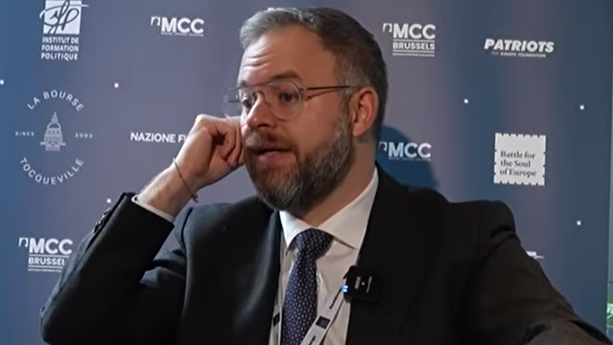
Balázs Orbán, political director of the Hungarian Prime Minister, speaks to GBNews at the ‘Battle for the Soul of Europe’ conference in Brussels on December 4, 2025.
Screenshot of the video interview, GBNews on YouTube, December 9, 2025
Hungary’s top strategist has warned that Europe is “trapped” in mass migration and an unwinnable proxy war in Ukraine because its leaders serve Brussels and liberal ideology instead of their own nations’ interests, telling GB News that only countries willing to defy the EU on borders, family policy, and the war can avoid civilizational decline.
In the interview recorded at the Battle for the Soul of Europe conference, hosted by MCC Brussels, Balázs Orbán, political director to Hungarian Prime Minister Viktor Orbán, mounted a sweeping defence of Hungary’s defiance of EU migration rules, its rejection of gender ideology in schools, and its calls for a negotiated end to the Ukraine war.
Orbán said Hungary’s decision to seal its borders in 2015 marked a turning point. At the height of the migration crisis, Budapest built a physical fence and rewrote its asylum laws to block illegal entry. Under the Hungarian system, asylum applications must be made from outside the country, and those who enter illegally are escorted out. “The entire Western legal system rewards those who break in,” he said, arguing that Hungary chose to dismantle that incentive structure altogether.
As a result, he said, Hungary now has the lowest foreign-born population in the EU. He rejected accusations that Budapest had abandoned humanitarian obligations, saying assistance should be delivered to people “where they are,” particularly to Christian communities in conflict regions, rather than through mass relocation into Europe.
Hungary is currently facing daily EU fines over its asylum regime. Orbán said public anger exists, but that most Hungarians accept the financial punishment as the cost of sovereignty. “From a long-term civilizational perspective, people are prepared to pay,” he said.
On domestic social policy, Orbán defended Hungary’s restrictions on LGBT and gender content in schools, saying the measures were approved through national consultations and referendums. He said the policy is a matter of child protection and accused the EU of transforming itself from an economic coordination project into an ideological authority driven by unelected bureaucrats. Despite this, he insisted Hungary has no intention of leaving the EU.
Orbán also outlined Hungary’s demographic strategy as an alternative to mass immigration. While Western states rely on imported labour, he said Budapest has redirected resources into family subsidies, housing support, and lifetime income tax exemptions for mothers with multiple children. The policy, he claimed, has raised marriage rates, reduced abortions, and produced an estimated 200,000 additional births.
On Ukraine, Orbán delivered a scathing verdict on Western strategy, arguing that military escalation has prolonged the war without producing victory. He said Hungary’s position is “not pro-Russian, not pro-Ukrainian, but pro-Hungarian,” and warned that Europe risks sliding into permanent confrontation with Moscow. He accused Western leaders, including Britain’s former prime minister Boris Johnson, of misleading the public by suggesting Ukraine could win outright with sufficient aid.
With national elections approaching next year, Orbán cast the contest as another showdown over sovereignty, claiming Brussels now openly backs Hungary’s opposition. He said the government believes that resisting EU centralisation remains the only path to security and national survival.