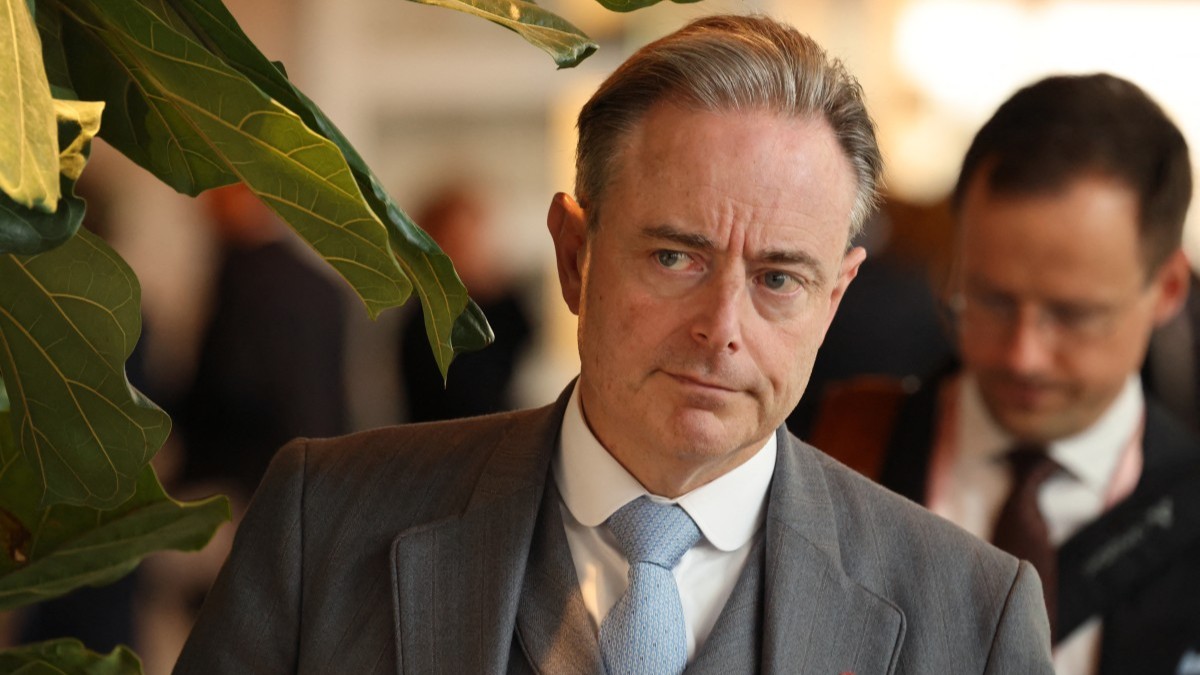
Belgium’s Prime Minister Bart De Wever at the 7th European Political Community (EPC) Summit at the Bella Center in Copenhagen, Denmark on October 2, 2025
Ludovic Marin / AFP
The European Union’s bid to unlock billions for Ukraine from frozen Russian central bank assets has run into resistance from Belgian Prime Minister Bart De Wever. PM De Wever described the proposal, to tap into €185 billion of Russian assets held on EU territory, as a “big gamble” and insisted on watertight guarantees that the risks would be shared equally among member states.
“Every country will have to guarantee proportionally in the case that this goes wrong,” De Wever told reporters on Thursday, October 2nd, during the European Political Community summit in Copenhagen:
The EU asset plan entails huge amounts of money, requiring guarantees for a very long time…. There’s no free money. There are always consequences.
The scheme, devised by the European Commission, would see Euroclear transfer the cash balances generated by frozen Russian securities into a central mechanism. The Commission would then issue a €140 billion ‘Reparations Loan’ to Ukraine, disbursed in tranches and subject to conditions. Kyiv would not repay until Moscow provides reparations, making Russia ultimately liable. To protect against legal claims, Brussels has floated a “tailored debt contract” with Euroclear at 0% interest, designed to ensure repayment to Russia in the event of a future settlement.
Commission president Ursula von der Leyen has repeatedly stressed that the plan is not confiscation. “Belgium cannot be the one who is the only member state that is carrying the risk, the risk has to be put on broader shoulders,” she said, adding that around €140 billion could be available immediately, with profits already being used to reinforce support for Kyiv.
The Belgian prime minister repeatedly underscored his conditions for backing the scheme:
I want the maximum of legal certainty. I want solidarity. And I want transparency on the situation in the other countries.
De Wever pressed his counterparts to sign onto shared liability, warning, “If we take Putin’s money, we use it, we’re all going to be responsible if it goes wrong.”
The PM likened the assets to “the chicken” and the profits to “the eggs.” While the EU has so far only used the eggs, the new plan would mean eating the chicken itself. “The question now is: can we eat the chicken?” he burbled.
The first problem, of course, is that you lose the golden eggs if you eat the chickens. If you put the chicken on the table and you eat it, then you lose a golden egg.
At Wednesday’s informal summit in Copenhagen, most EU leaders voiced support, saying momentum is building and concerns would be addressed. Yet De Wever warned that unresolved questions about arbitration cases, compliance with international law, the protection of the euro as a reserve currency, and the use of assets outside Belgium must be clarified before moving ahead.