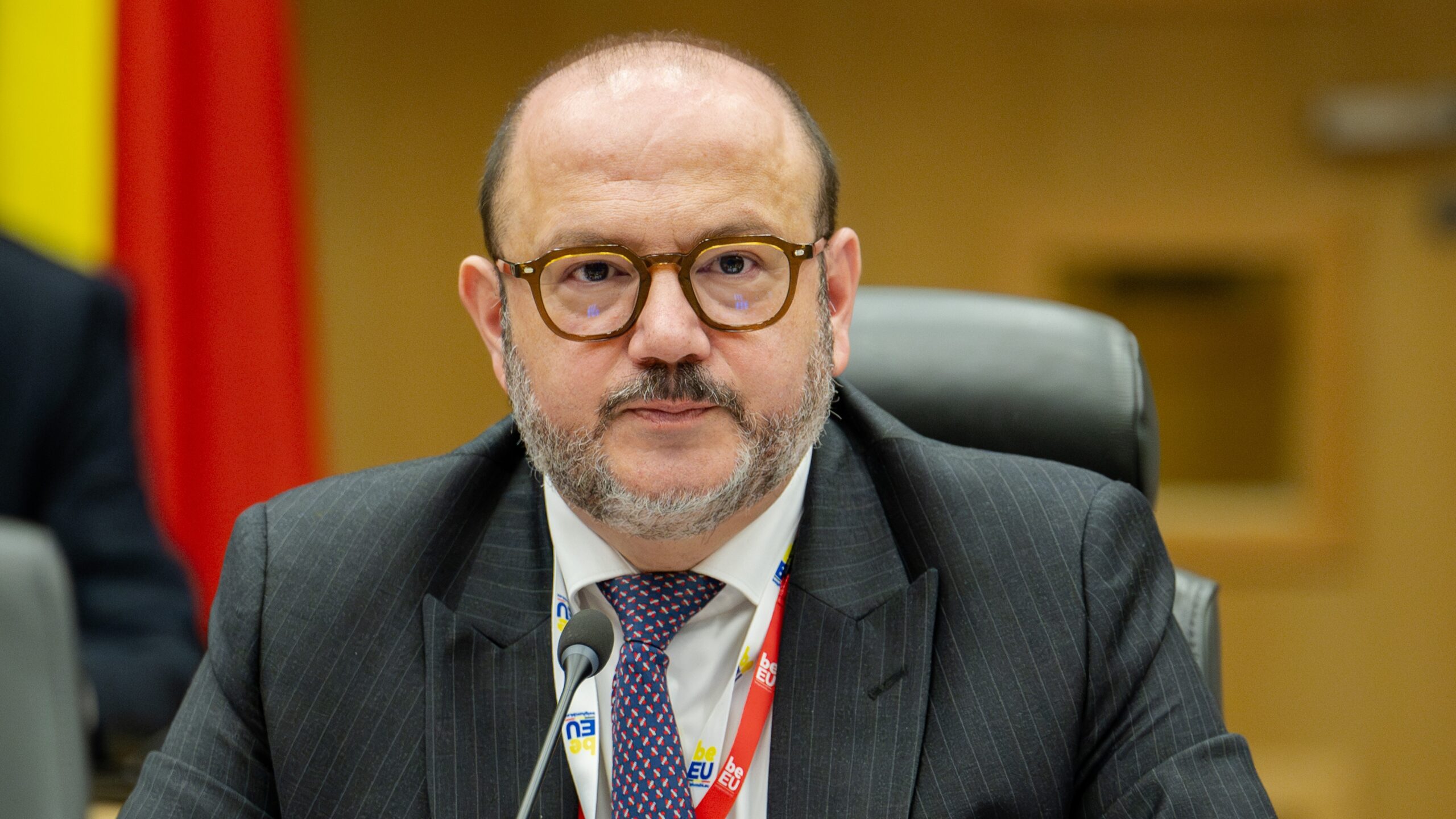
Belgian Minister of the Interior Bernard Quintin
By Belgian Presidency of the Council of the EU 2024 from Belgium – EU2024BE_240326_Conference on Trade Policy and Critical Raw Materials_Europa room_JNZT_0007, CC BY 2.0, https://commons.wikimedia.org/w/index.php?curid=146789576
Belgium’s Interior Ministry has announced a renewed focus on large-scale police operations, alongside a €20 million federal investment to upgrade public surveillance cameras in the country’s largest cities, targeting drug trafficking hotspots.
Interior Minister Bernard Quintin is set to present an overhauled ‘Plan for the Major Cities’ to the Council of Ministers, focusing primarily on tackling the consequences of drug trafficking.
The plan includes a significant increase in targeted operations by the federal police at known drug trafficking sites across Belgium’s major urban centres.
A €20 million budget has been allocated to replace malfunctioning public surveillance cameras and install new ones where needed. The initiative is part of the revised ‘Plan for the Major Cities,’ which itself builds on the decade-old ‘Canal Plan’—itself clearly a failure.
The focus has now shifted from counter-terrorism to combating organized drug crime, according to Minister Quintin. In an interview with L’Echo, he warned that Belgium’s largest urban centres—Brussels, Liège, Charleroi, Mons, and Ghent—are on a “slippery slope” when it comes to public safety.
Quintin stated that a stronger and more visible state presence is necessary. As part of the plan, the government will relaunch the so-called Fully Integrated Police Actions (FIPA) —large-scale, coordinated raids by federal and local police. Although this mechanism already exists, it has rarely been used in recent years. In theory, this is now set to change.
Quintin cited Place Bethléem in Saint-Gilles as an example, where residents have long complained that drug dealers operate openly, before declaring:
The days of the hooded dealer riding a scooter, setting up his little stool, and displaying his price list for everyone to see—those days are over.
The federal funding will also support the creation of a national CCTV camera registry, mapping which public surveillance cameras are operational, which need replacing, and where new ones should be installed. Although the priority is on larger cities, Quintin emphasised that small and mid-sized towns—which are also facing rising levels of organised crime—will not be neglected.
Amid the ongoing crisis in Belgium’s penal system, the Interior Minister also highlighted that 43% of inmates in Belgian prisons are foreign nationals, roughly double the European average, arguing
These people should be returned to their home countries to serve their sentences there.
The revided ‘Plan for the Major Cities’ also includes new training programs for identity verification to help combat fraud, as well as stricter inspections of businesses suspected of laundering drug money.
While many Belgians will welcome this campaign against white-collar crime, violence—not least the murder rate in Brussels—remains a key concern.