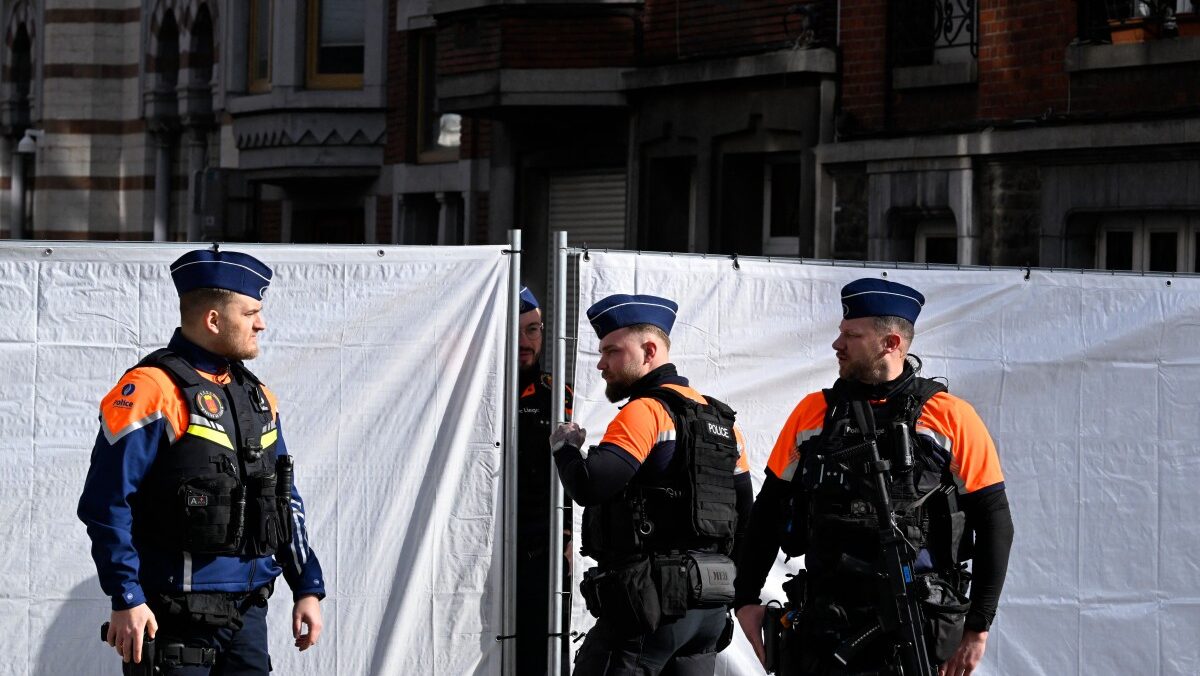
Belgian police secure a synagogue in Liège after an overnight blast on March 9.
JOHN THYS / AFP
The Belgian government has announced the deployment of Defence and Federal Police forces to protect synagogues and Jewish schools nationwide, following a series of antisemitic attacks in Belgium and elsewhere in Europe.
Interior Minister Bernard Quintin (MR) and Defence Minister Theo Francken (N-VA) confirmed that soldiers will work alongside police to strengthen security at Jewish sites, with operations to begin as soon as possible.
The decision comes after an early-morning explosion near a synagogue in Liège on March 9, which alarmed residents and underscored the ongoing threat to Jewish institutions.
Subsequent incidents were reported in the Netherlands, including arson at a Rotterdam synagogue and an explosion near a Jewish school in Amsterdam, while in Norway, a blast targeted the U.S. Embassy. Minister Quintin said: “Against the backdrop of rising antisemitism, the attack on the synagogue in Liège once again proves that the threat to the Jewish community in Belgium is very real.”
Belgian authorities said the deployment will be coordinated by the Federal Police in close cooperation with the military, though the number of soldiers involved has not been publicly confirmed, with reports suggesting more than 50 personnel may be deployed.
Minister Francken said Defence was ready to support national security in times of crisis, adding that the collaboration with police will reinforce protection for the Jewish community and contribute to overall public safety.
Calls for increased protection intensified after the Liège attack. MR President Georges-Louis Bouchez and Antwerp Mayor Els van Doesburg publicly urged immediate military presence, while the Coordination Committee of Jewish Organisations in Belgium (CCOJB) formally requested troops at Jewish sites.
This is not the first time Belgium has deployed soldiers to protect Jewish institutions. During Operation “Vigilant Guardian” in 2015, troops were sent to respond to heightened terrorism concerns.
Recent reports also indicate a rise in antisemitic attacks within Belgium. According to the European Union Agency for Fundamental Rights, antisemitic incidents recorded in Belgium increased from 57 in 2022 to 121 in 2023, and surged to 277 in 2024.
Survey data from 2023 further underscores the impact on daily life. The EU Agency for Fundamental Rights found that 84% of Jewish respondents in Belgium view antisemitism as a major problem in their lives, 83% believe it has increased over the past five years, and 97% reported encountering antisemitic behavior in the year prior to the survey.
The deployment is expected to cover 24 locations initially, including four Jewish schools in Antwerp and 20 synagogues. Soldiers and police are expected to operate in joint patrols, for as long as necessary.
Several political figures and Jewish community representatives have welcomed the move. Michael Freilich, a Jewish member of Belgium’s parliament, said: “It is good to finally see action following a series of attacks on Jewish institutions. Safety must come first.”