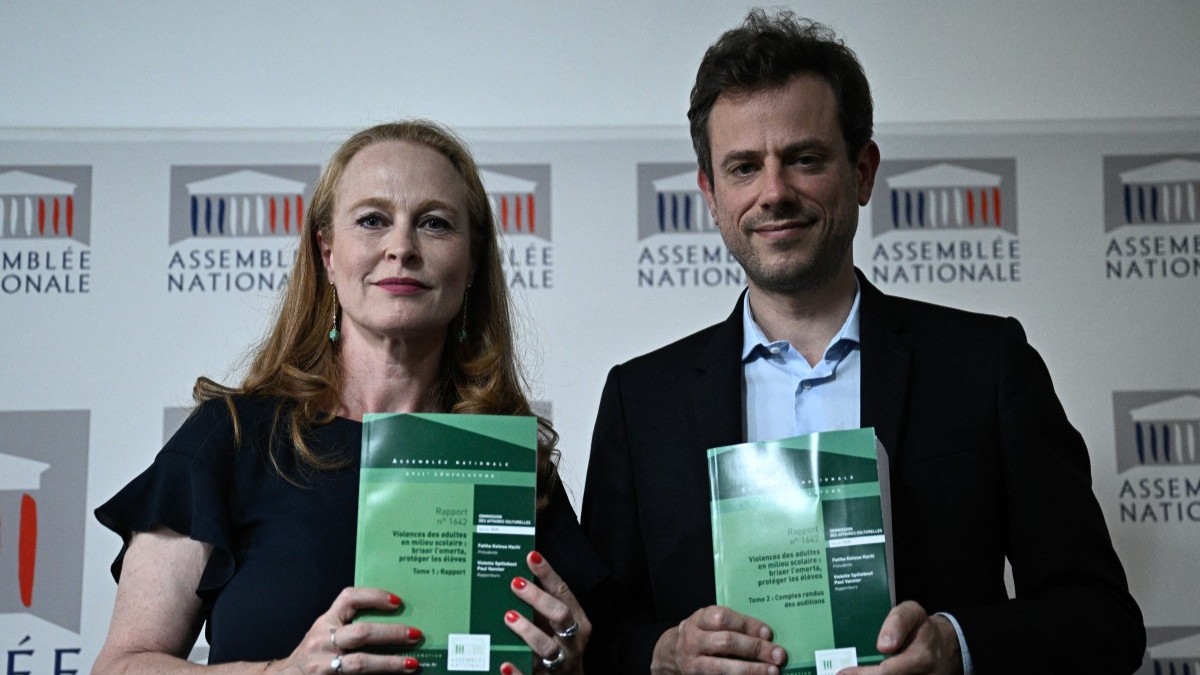
Commission rapporteurs Paul Vannier (R) and Violette Spillebout (L) with copies of their report on violence in schools following a press conference at the French National Assembly in Paris on July 2, 2025
Julien De Rosa / AFP
The Bétharram scandal, named after a Catholic school in the south of France where pupils for decades were victims of terrible abuse—sexual, physical and psychological violence—is poisoning the life of French Prime Minister François Bayrou. And with good reason: a native of the region, he knew the school very well, having sent his own children there, but maintains that he was never aware of what was going on. A parliamentary inquiry has weakened his position and undermined his narrative.
The case has been in the French public eye for a long time now. A renowned Catholic school in the Pyrénées-Atlantiques department, Notre-Dame de Bétharram was for decades the scene of acts of violence and sexual abuse against the children who attended it, perpetrated by priests and members of the teaching staff. The first court cases involving Bétharram date back to the 1990s. In 1998, Father Pierre Silviet-Carricart, the former headmaster, was charged with rape and sexual assault of minors. The case was closed due to the priest’s suicide in 2000.
In early 2025, Bétharram was back in the news after two left-wing newspapers, Mediapart and Libération, raised Prime Minister François Bayrou’s responsibility in sweeping the scandal under the carpet: according to their investigation, Bayrou had intervened on behalf of Father Carricart with the investigating judge.
Following the revelations, many victims broke their silence and formed a collective to make their voices heard. Among them is Bayrou’s own daughter, also a victim of violence, who claims she never told her father anything at the time. In spring 2025, she published her testimony in a book edited by Alain Esquerre, the former pupil who organised the main victims’ collective.
In total, more than 250 complainants have reported violence and abuse, some of which very serious, that apparently took place in the 1990s but continued until the end of the 2010s. Some cases date back even further, suggesting that a system of impunity existed for many years, causing suffering to hundreds of children.
The peculiarity of the case lies in the involvement of the current prime minister. Several consistent testimonies from teachers and parents undermine his official stance that he was not aware of anything. A parliamentary commission of inquiry has therefore been set up to try to shed light on the matter. The two rapporteurs reached different conclusions. One suggests it is clear that François Bayrou lied when he claimed ignorance: why, in that case, did he request an academic inspection in Bétharram in 1996, when the first scandals broke, given that he held the strategic position of minister of national education at the time? The other rapporteur believes there was “collective responsibility” in the denial of the atrocities—a stance that obviously protects the prime minister, whose image has already been seriously tarnished. The fact remains that on May 15th, during a hearing, Bayrou himself admitted to lying to MPs when he said he had no knowledge of the violence perpetrated at Bétharram.
The affair is one of the biggest scandals involving a Catholic educational institution in France. But Bétharram, unfortunately, is not the only one that has things to answer for and an interest in maintaining silence. Many other institutions, including public ones, have been the scenes of child abuse, the only difference being that, since they do not involve Catholic schools, these cases do not receive the same media attention.