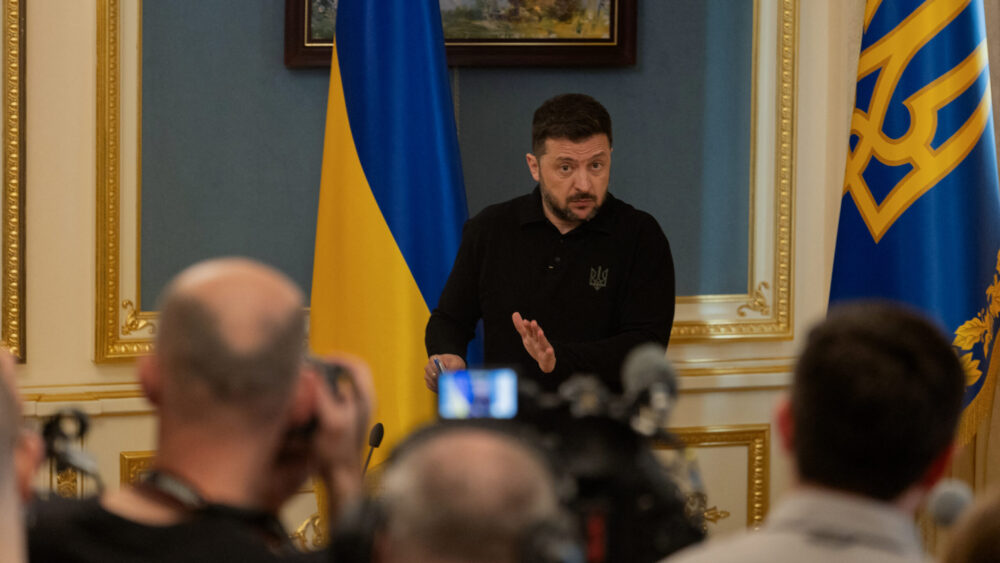
Ukrainian President Volodymyr Zelensky gives a press conference on April 22nd.
Photo: Tetiana Dzhafarova / AFP
After months of deadlock, the U.S.-led peace talks for Ukraine are finally gaining momentum, with both sides ready to make progress—while Brussels scoffs from the sidelines.
For the first time, Russian President Vladimir Putin indicated he might be willing to stop the invasion of Ukraine indefinitely along the current front lines. He also suggested he could give up claims to parts of the four annexed regions in Eastern Ukraine that Russia has not yet occupied. This statement came just hours after reports that the Trump administration could offer U.S. recognition of Russian sovereignty over Crimea—which has been under Russian control since 2014.
Ukrainian President Volodymyr Zelensky also expressed optimism about the peace process and said—also for the first time since 2022—that he was ready to negotiate directly with Moscow for a lasting peace as long as Putin does indeed agree to a full ceasefire.
“If the Russians are ready for a complete ceasefire, then after a complete ceasefire is established, we are ready for any format of negotiations with them,” Zelensky stated on Tuesday, adding that he wants to discuss the different options directly with Trump at the sidelines of Pope Francis’ funeral in Rome on Saturday.
However, when it comes to occupied Crimea, Zelensky stated that Kyiv will never accept Western recognition of Russian sovereignty. “There is nothing to talk about,” the Ukrainian president said. “This violates our constitution. This is our territory, the territory of the people of Ukraine.”
Nonetheless, White House Ambassador-at-Large Steve Witkoff is set to meet Putin for the fourth time later this week to hash out the details of the prospective ceasefire deal, while President Trump’s Ukraine special envoy, Keith Kellogg, will lead the U.S. delegation to London on Wednesday, April 23rd, to discuss the developments with European partners and Ukrainian Foreign Minister Andrii Sybiha.
In London, Kellogg replaces U.S. Secretary of State Marco Rubio after he pulled out from the talks at the last minute on Tuesday, but the White House insists that the switch is not a political choice and the peace process continues as planned. “The negotiations continue. We feel again we are hopefully moving in the right direction,” White House Press Secretary Karoline Leavitt explained.
And speaking of Europe, the EU’s foreign affairs chief, Kaja Kallas, warned against offering any premature ceasefire deal from Washington, arguing that Putin was only playing for time and did not really want the war to end. The EU will never recognize Crimea as Russian, she said, and neither should the U.S. because “then Russia clearly gets what they want.”
At the same time, Kallas offered no alternative to help reach a ceasefire deal, at least none that did not include escalating first by imposing large-scale U.S. economic sanctions on Russia, which could prove just as counter-productive as the EU sanctions throughout the past three years.