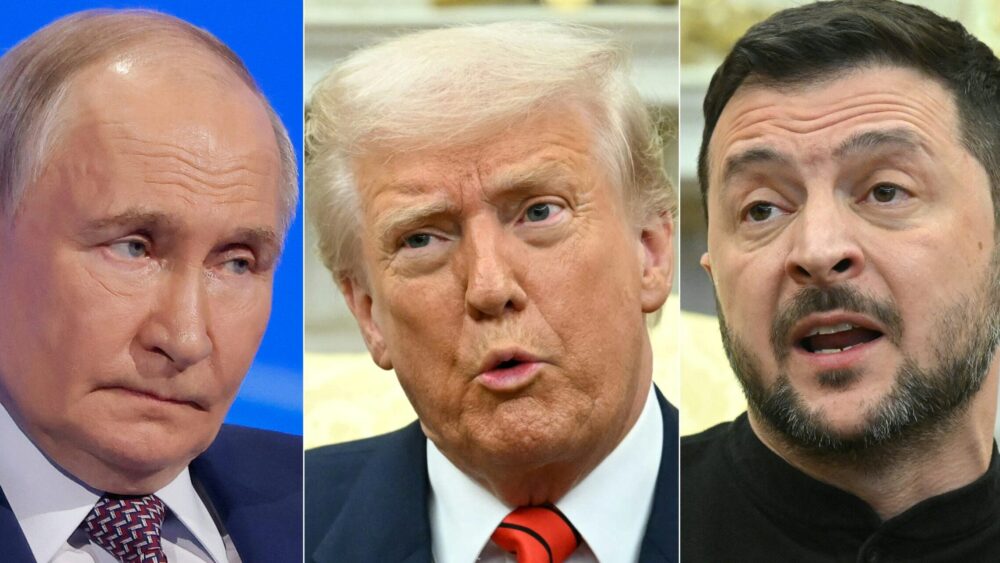
Russian President Vladimir Putin, U.S. President Donald Trump, and Ukraine’s President Volodymyr Zelensky
various sources / AFP
Following a failed Easter ceasefire and Washington threatening to withdraw from talks, Russian President Vladimir Putin has proposed direct bilateral peace talks with Kyiv for the first time since his invasion of Ukraine. Ukrainian President Zelensky replied that he’s also ready to negotiate, starting with discussing a thirty-day pause on hitting civilian targets.
Ukraine will also take part in the U.S.-European talks in London on Wednesday, which could prove to be a turning point in the peace process if EU countries finally begin cooperating with Washington in a bid to find a peaceful resolution to the war.
Speaking to a Russian TV on Monday, April 21st, Putin confirmed that the fighting has resumed in Eastern Ukraine after the 30-hour Easter ceasefire he announced on Saturday, which ended prematurely as both sides accused each other of violating the terms.
At the same time, the Russian president said Moscow was open to discussing “any peace initiative,” including direct talks with Kyiv for the first time since the early days of the war in 2022:
We have always talked about this, that we have a positive attitude towards any peace initiatives. We hope that representatives of the Kyiv regime will feel the same way.
After the interview, Kremlin spokesman Dmitry Peskov confirmed that Putin was indeed talking about the prospect of directly negotiating with the Ukrainians, “including bilaterally.”
While President Zelensky did not respond directly to the proposal, he did suggest that Kyiv was ready for the “conversation” to begin. “Ukraine maintains its proposal not to strike at the very least civilian targets. And we are expecting a clear response from Moscow,” Zelensky said on Monday evening. “We are ready for any conversation about how to achieve this.”
After months of talks, it seems the Trump administration’s efforts toward peace are starting to bear fruit.
Washington was beginning to lose its patience with Moscow, particularly after the Palm Sunday massacre in the Ukrainian city of Sumy, where Russian ballistic missile strikes killed dozens of civilians just one week before Easter.
Senior White House officials, including Secretary of State Marco Rubio and Ukraine special envoy Keith Kellogg, strongly condemned the strikes and urged President Trump to place more pressure on Moscow to begin negotiating with Kyiv.
Later, on Good Friday, both Trump and Rubio said Washington could abandon the peace talks if there was no progress within days. This ‘stick’—combined with the ‘carrot’ of “compelling commercial opportunities” between the U.S. and Russia—appears to have broken the impasse, and Trump is now “hopeful” that Moscow and Kyiv could come to an initial ceasefire deal as soon as “this week.”
This will also be the subject of the London talks on Wednesday, where both Ukraine and the U.S. will attend the meeting of the Franco-British-led ‘coalition of the willing’ to discuss the next steps.
For Zelensky, the primary objective of the London talks will be pushing for an unconditional ceasefire. “This must be the starting point,” the Ukrainian president said on Monday, “followed by the establishment of a real and lasting peace.”
At the same time, Ukraine maintains skepticism about Russia’s genuine willingness to negotiate, as many officials see Putin’s U-turn as just another stalling tactic—especially given the failure of the Easter ceasefire, which was unilaterally announced by Moscow.
According to officials on both sides, the one-day Easter ceasefire was violated thousands of times throughout Sunday and Monday morning. Ukrainian forces reported nearly 3,000 violations by Russian troops along the line of contact, while Moscow stated that the Ukrainians shot at Russian positions nearly 500 times and carried out 900 drone attacks overnight. It’s unclear which side broke the truce first.
“The nature of Ukraine’s actions will remain symmetrical: ceasefire will be met with ceasefire, and Russian strikes will be met with our own in defense,” Zelensky commented on Monday while cautiously floating the 30-day extension of the truce. “Actions always speak louder than words.”