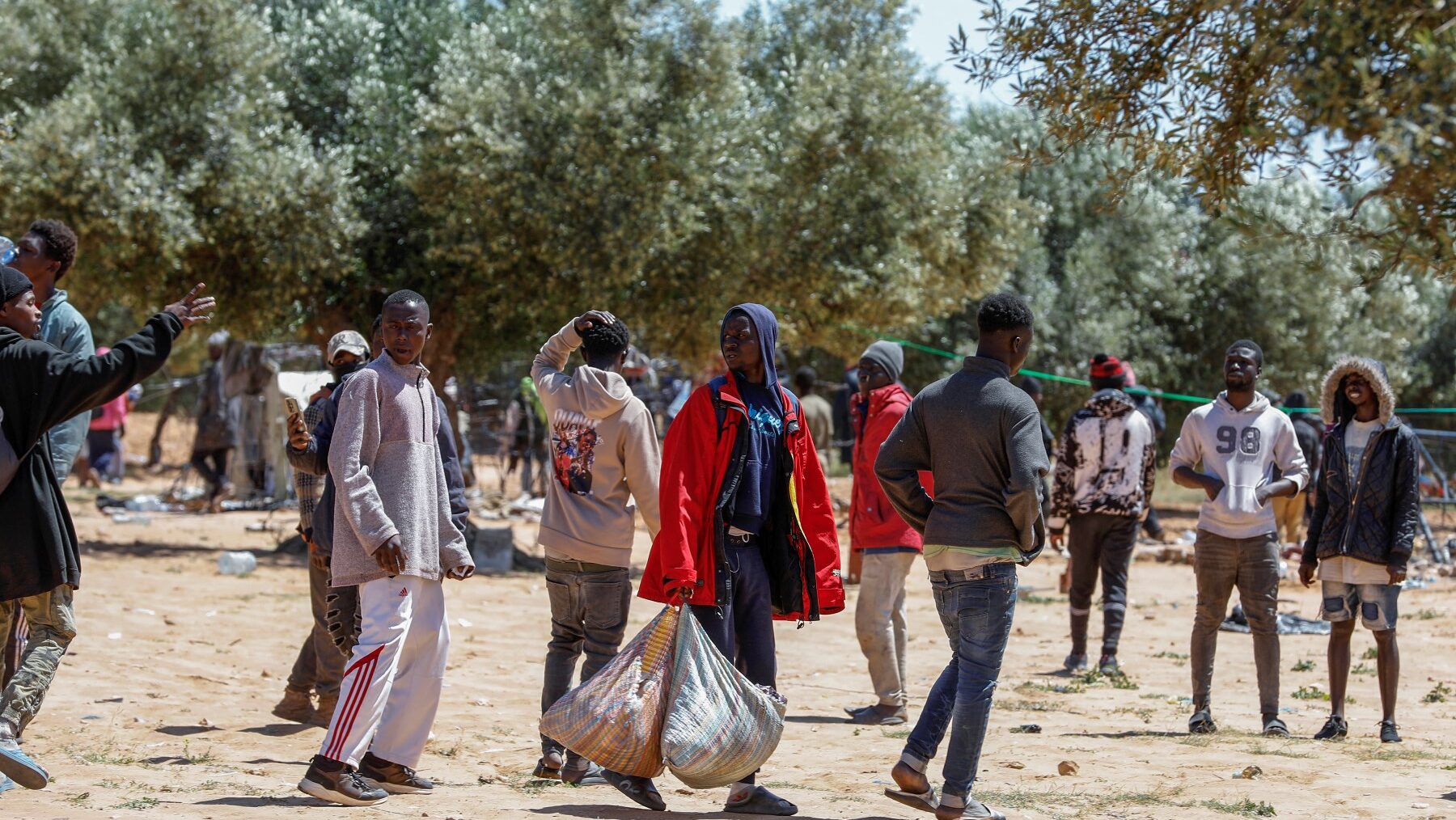
Migrants leave a makeshift camp as authorities dismantle it near Sfax, Tunisia, April 24, 2025.
Mohamed KHALIL / AFP
Brussels is once again pointing the finger at Vladimir Putin—this time blaming him not only for Europe’s migration crisis, but even for the wave of farmers’ protests sweeping the bloc.
The latest example came this week, when EU Migration Commissioner Magnus Brunner said the Russian president is the “biggest driver” of immigration towards Europe, while officials have also suggested that recent farmer protests were amplified by Kremlin-linked disinformation.
More striking is how rarely Brussels subjects its own decisions—from energy to agriculture and borders—to the same scrutiny.
In a recent interview, Brunner argued that Vladimir Putin has been the main driver of migration towards Europe over the past decade, citing the Syrian civil war, the invasion of Ukraine and conflicts in the Middle East.
According to the commissioner, in all these cases, Russian involvement contributed to large-scale population displacement towards the European continent.
While wars do drive displacement, Brunner’s explanation leaves out the EU’s own role in how those flows were handled. The 2015 crisis was not explained only by the war in Syria, but also by unilateral border openings in some member states, lack of coordination between governments, and an asylum system unable to cope with a sudden surge in applications.
Ten years later, several countries are still demanding emergency mechanisms to close borders in the event of new migration waves, which shows that the structural problem has not been solved.
While Brussels focused on dependence on Russian gas, far less attention was given to decisions taken within Europe—cutting domestic production, phasing out nuclear power in some countries, and accelerating the green transition without reliable alternatives in place.
The result was a historic surge in prices, loss of industrial competitiveness and inflation that hit the most vulnerable sectors hardest. Yet the political response largely framed the crisis as a consequence of war, rather than policy choices.
The most controversial example of this pattern has been the wave of farmers’ protests. Demonstrations across France, Germany, Spain, Belgium and the Netherlands were driven by concrete issues: rising costs, competition from imports, new environmental requirements and the feeling that Brussels legislates without understanding the reality of the sector.
Suggestions that disinformation played a role—often without clear evidence—have done little to convince those on the ground.
For many farmers, the protests stem from concrete decisions—not from social media or influence operations, but policies on agriculture, trade, and climate that directly affect farm profitability.
Europe faces real challenges, and Russia is undoubtedly an important actor in some of them. But treating Putin as a catch-all explanation risks obscuring a more uncomfortable truth: many of Europe’s crises are homegrown.