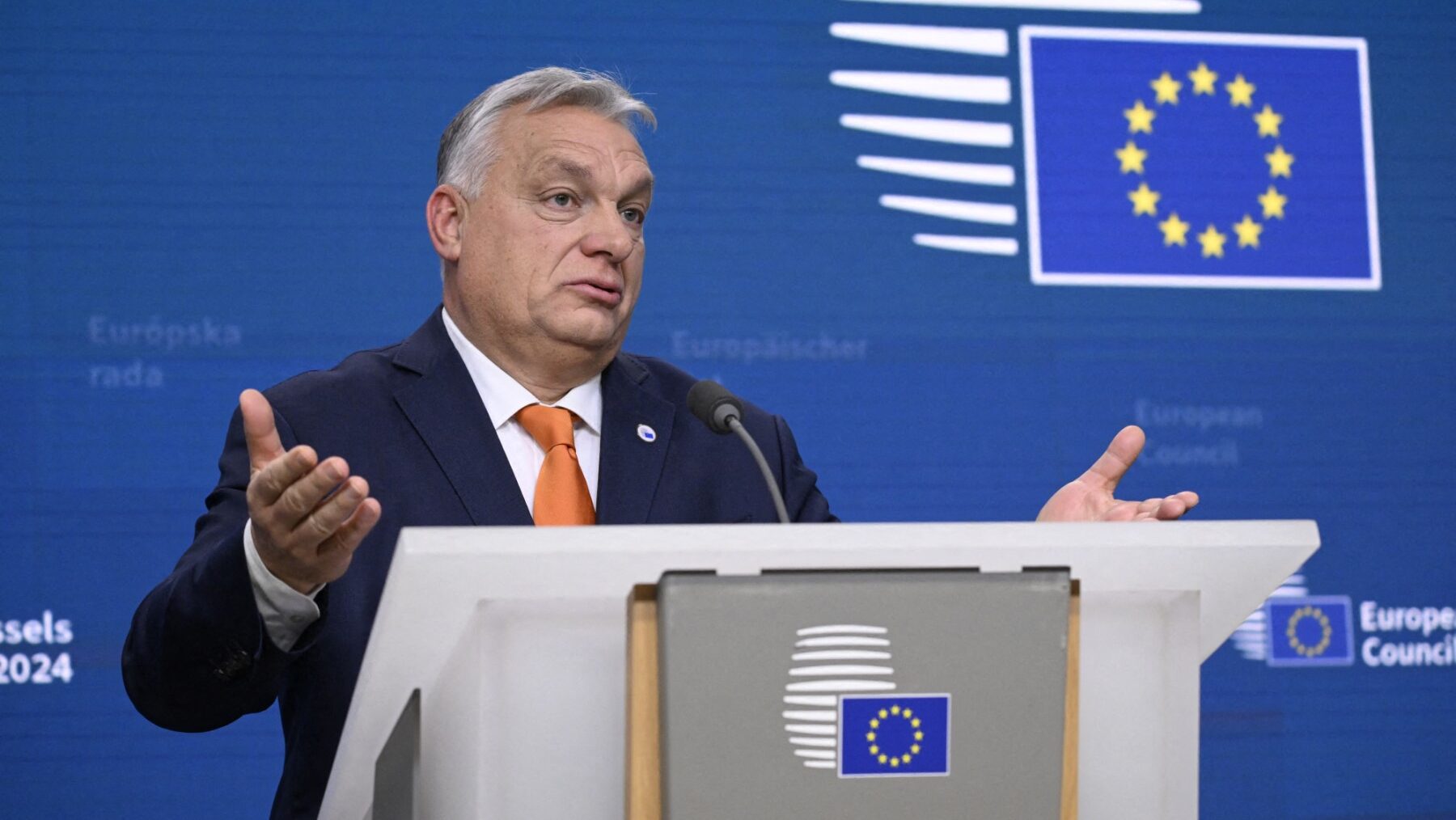
Hungary’s Prime Minister Viktor Orban gestures during a press conference following the European Council meeting at the EU headquarters in Brussels on December 19, 2024.
John Thys / AFP
In an increasingly blatant and politically motivated attack on Hungary, the European Commission has decided to continue withholding €18 billion in EU funds from the country.
This latest move dispels any doubts about Brussels’ true motives, which are not to defend “rule-of-law” principles, but to punish Hungary for its unapologetically conservative policies.
Hungarian government spokesman Zoltán Kovács called the report “the newest chapter in an ongoing effort by the European Commission to dismantle the key achievements of Prime Minister Orbán’s governments and impose foreign political control over Hungary.”
Prime Minister Orbán’s governments have consistently defended Hungary’s independence—from resisting forced migration quotas to safeguarding economic sovereignty. These new moves from Brussels are a blatant attempt to replace Hungary’s democratically chosen direction with policies dictated from abroad.
🛡️ Hungary will not become a puppet state of Brussels
— Zoltan Kovacs (@zoltanspox) July 8, 2025
📄 Brussels has unveiled its latest Rule of Law Report, a document that reads more like a political manifesto authored by Péter Magyar’s team than a legal assessment.
📚 In truth, this is just the newest chapter in an… pic.twitter.com/aEwzML2ucC
The withheld funds comprise approximately €8.4 billion in cohesion payments and €9.5 billion in post-COVID recovery grants.
The justification, according to the Commission, is Hungary’s alleged failure to fully comply with EU requirements on judicial independence, corruption, and media pluralism—as stated in Brussels’ 2025 Rule of Law Report, released by the Commission on Tuesday, July 8th.
Presenting the report, Michael McGrath, the European Commissioner for Democracy, Justice and Rule of Law, said:
I wish it were otherwise and I wish that those funds could be made available and that the people of Hungary, who are very significantly pro-EU, would be in a position to benefit from those funds, but that requires compliance with the rule of law.
While the Commission has portrayed the freeze as necessary to uphold European democratic ‘values,’ it is difficult to ignore the political context: Hungary has consistently taken a different path from the federalist, progressive agenda dominant in EU institutions.
It has pushed back against open-border immigration, enacted protections for traditional family structures, resisted pressure from LGBT lobbyists, advocated for a diplomatic instead of a military resolution in the Russo-Ukrainian war, and emphasized national sovereignty over EU centralisation. For this, it finds itself financially punished.
Hungary is also being fined €1 million a day for protecting its own borders—the EU’s external southern borders—against the influx of illegal migrants.
The latest move to have angered Brussels was the decision by Viktor Orbán’s government to ban Pride parades and public events promoting LGBT identities—a measure intended to protect children from being influenced by harmful ideologies at an early age.
Michael McGrath on Tuesday criticised the ban on the Pride parade—which was nonetheless held in Budapest at the end of June—and a draft law on transparency for foreign-funded NGOs, whose adoption has been delayed by the Hungarian parliament.
The latest Rule of Law Report echoes the ones from previous years: regularly lambasting Hungary and other EU-critical countries, while praising those that conform to EU demands.
The attacks against non-compliant EU member states will only intensify in the future as the Commission aims to push through its new ‘cash-for-reforms’ model, which would tie EU funds to specific milestones for each country and open the door for political and ideological blackmail.
Despite efforts by some member states, such as Denmark, which now holds the rotating EU presidency, to sanction Hungary and take away its EU voting rights under the so-called Article 7 procedure, there is no political majority among member states to do so.