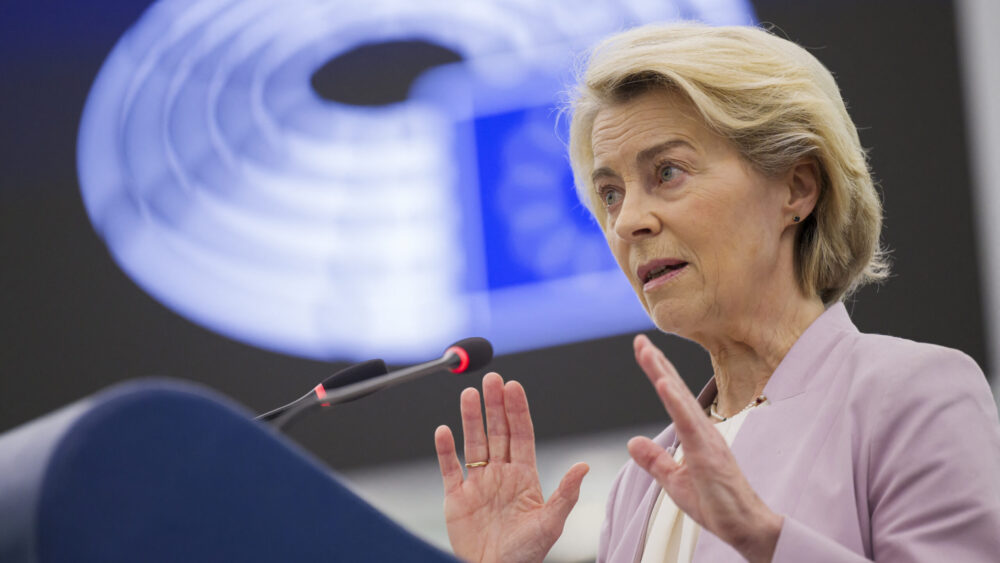
European Commission President Ursula von der Leyen
Jean-Christophe VERHAEGEN / AFP
Brussels wants to slap a new tax on big companies—not based on what they earn in profit, but simply on what they take in. A leaked report by the European Commission, obtained by europeanconservative.com, proposes a sweeping reform of how the bloc funds itself. At the centre of the scheme is the so-called Corporate Resource for Europe (CORE), which would force large companies—including foreign ones that operate in the EU—to hand over a chunk of their annual turnover to Brussels, regardless of whether they made a profit or not.
The proposal, classified as “sensitive” and for restricted circulation, states that this new resource would apply to companies with a net annual turnover of more than €50 million, including subsidiaries of third-country companies operating within the EU. According to the text, “the CORE would be established as an annual lump-sum contribution differentiated per companies’ turnover.”
This means companies could be taxed even if they’re barely breaking even—or losing money.
The Commission justifies the measure by stating that “the corporate sector, operating in the world’s biggest single market with more than 450 million consumers, must contribute to the EU budget.” It also claims it would be a “fair contribution,” and that “small and medium-sized enterprises would be excluded from the scope,” as well as non-profit entities, governmental bodies, and international organizations.
In other words, this new tax is a way of targeting the most successful companies, while exempting NGOs (many of which are publicly funded, as this outlet has reported on multiple occasions) and all public entities. The European executive would be attacking the private sector in order to extract funds to continue with its expansionist plans.
At the core of this initiative lies the increasing financial pressure on the EU. The bloc faces growing demands in areas such as defense, green transition, migration, and digitalization—not to mention repayment of the debt incurred to fund the COVID-era recovery package. The Commission says its current way of funding the budget is running out of road, so new sources of income are needed.
That is why CORE is being added to other proposed sources of income, such as a levy on uncollected electronic waste, a tobacco excise duty, and increased charges on unrecycled plastics and CO₂ emissions.
The leak has set off alarm bells in business and financial circles. “This is fiscal madness that punishes companies simply for existing, not for making profits,” said a financial analyst who asked to remain anonymous. The message to international investors is devastating: Europe is no longer a reliable place to do business.
Industry insiders warn that this measure would be yet another blow to European competitiveness, already seriously eroded by excessive regulation, the energy crisis, and national tax pressures. Taxing revenues instead of profits means punishing efficiency and reinvestment. For many companies in low-margin sectors, this could be a direct path to ruin.
The leaked document says the new tax could come into force on January 1 of the year after it gets final approval from the EU Council—likely in 2027 or 2028—if all Member States ratify it according to their national rules.
The Commission is using the excuse of budget sustainability to push a federal Europe, giving Brussels its own funding streams beyond the direct control of Member States. Moreover, the document states that Member States would collect the CORE tax for the EU, with enforcement and oversight handled by the Commission. This could be seen as a direct threat to national fiscal sovereignty.
Although still a draft, the fact that the text is based on Article 311 of the Treaty on the Functioning of the EU—which allows for new resources to be introduced through Council unanimity and national ratification—shows the Commission is serious. In the current climate, with a more skeptical European Parliament after the June elections and national governments increasingly critical of Brussels bureaucracy, the future of this “super tax” is far from guaranteed.
Nevertheless, the mere proposal already amounts to a political tsunami, increasing legal and fiscal uncertainty at a time when Europe urgently needs to attract productive investment, not drive it away. Brussels seems intent on building a new political order by burning down what’s left of Europe’s entrepreneurial spirit.