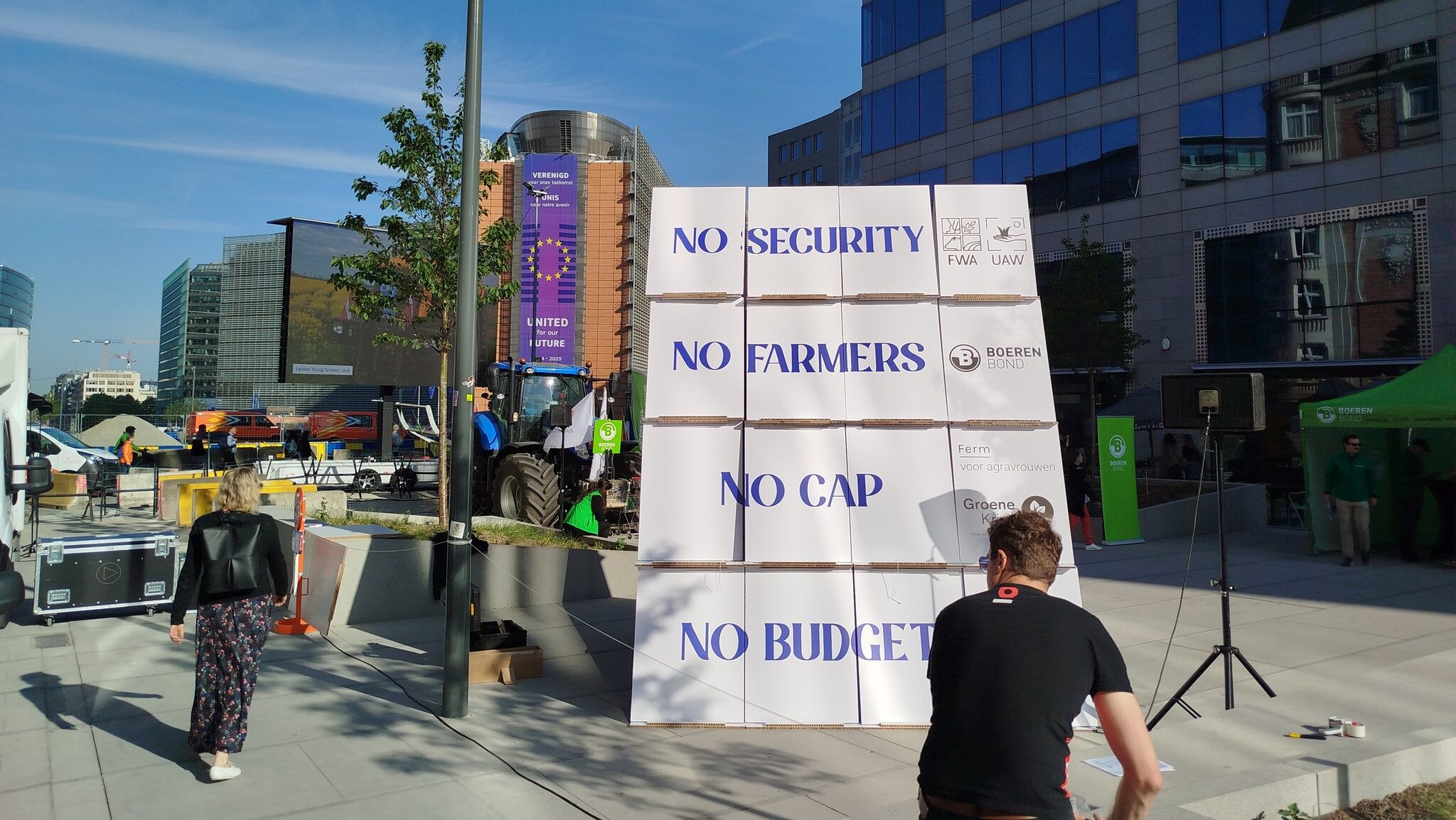
Farmers’ union COPA-COGECA protests the CAP reforms outside the EU Commission.
COPA-COGECA on X, 20 May 2025
Due to unprecedented mobilization from farmers’ organizations and resistance from the majority of member states, the European Commission has reportedly given up on its plans to eliminate the independent CAP (Common Agricultural Policy) funds under the budget reforms that are set to be unveiled next week.
However, this is only a bittersweet victory for European farmers, whose financial security relies on having a dedicated EU cash pot for farming subsidies, as Brussels still plans to cut the CAP’s overall budget by around 15-25% starting in 2028.
According to the initial proposals, the Commission wanted to merge nearly all lines of EU funding—including both the CAP and the cohesion funds, the EU’s biggest and oldest funding mechanisms—into a single national cash-pot, and change the current region-based automatic allocation mechanism to a centralized ‘cash-for-reforms’ model.
The idea was to give member states the flexibility to redirect funds from the agricultural subsidies to ‘strategic goals’ (such as defense or cybersecurity, for instance), at any time during the next seven-year budgetary period.
Critics immediately saw this as a stealthy power grab to hollow out the CAP and make room for Brussels to pressure member states into spending less on farmers and more on what it sees as the priority—especially given the reform prerequisites that would be tied to every payment, which could be easily used by the Commission to blackmail capitals.
While the same danger still looms over the cohesion funds, the CAP is now officially safe from this restructuring, largely thanks to the relentless push from farmers’ lobbies and member states who feared the massive backlash if they let it happen.
Within the last few months, nearly 3,200 farmers’ organizations united by signing an unprecedented petition so far to save the CAP, which was launched by COPA-COGECA, Europe’s largest umbrella organization representing over 22 million farmers and their families.
🚨 The momentum is growing! Over 2⃣,0⃣0⃣0⃣ organisations from across 🇪🇺 have already signed our petition to say NO to the 'Single Fund' and NO to the dilution of the #CAP in it.
— COPA-COGECA (@COPACOGECA) July 2, 2025
🙏 Huge thanks to everyone who has signed — and especially for the powerful messages you’ve shared.… pic.twitter.com/NCceV2hSJw
Simultaneously, the agricultural ministers of 20 member states—including major players like France, Spain, Italy, and Poland—joined in the EU Council to also oppose the CAP reforms in late June, sending a clear signal to the Commission that it would risk a deadlock on the entire budget if it were to proceed with its initial proposal.
Interestingly, the two countries with the highest number of signatories—Sweden and Germany—did not join the initiative, suggesting they would have been glad to tap the agricultural subsidies to speed up rearmament, for example, even at the expense of having to face a major domestic backlash.
At the same time, the EU Commission still plans to significantly reduce the size of CAP, which currently makes up almost a third of the entire EU budget at nearly €400 billion, in the next seven-year financial framework.
The exact figures are still being debated, but it’s estimated that the July 16th proposal will include one-fifth to one-quarter of that money reallocated to other goals—such as financing the EU’s common debt left over from the pandemic recovery funds which will kick in in 2028—meaning slashing it by up to €100 billion.
Unless member states can negotiate a better deal for their farmers within the next year or so, this cut could easily rekindle another giant wave of farmers’ protests across the continent.
The new protests could be even bigger than last year, when the square in front of the EU Parliament was in flames as a reaction to misplaced green policies, Ukraine’s preferential access to EU markets, and the EU-Latin America free trade agreement (Mercosur) which was unilaterally agreed on by the von der Leyen Commission, although national governments still need to approve it in the Council.
“If the Commission is serious about its vision for agriculture and wants to strengthen European agriculture and make it fit for the future, rumors of a drastic budget cut cannot be a serious option,” said Bernhard Krüsken, general secretary of the German Farmers’ Association.
“Anything other than an increased and earmarked agricultural budget will not do justice to the challenges of the time.”