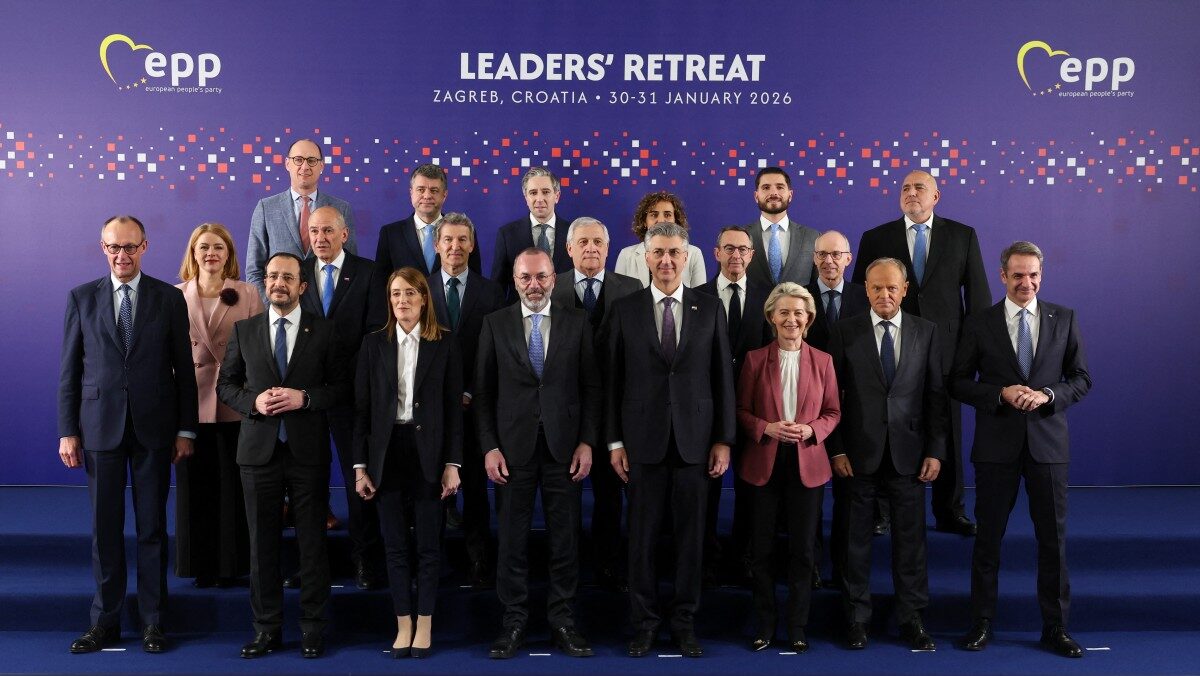
EPP leaders pose for a ‘family photo’ during the Zagreb meeting, on January 30, 2026.
MARKO PERKOV / AFP
The European People’s Party (EPP) congress held this weekend in Zagreb produced a proposal with major consequences for how the EU works. Party leaders Manfred Weber and German Chancellor Friedrich Merz argued openly for ending national veto rights and expanding majority voting—especially in foreign and security policy.
They presented the idea as a practical response to a more dangerous and unstable world. In reality, it would mark one of the clearest steps yet towards shifting power away from national governments and concentrating it in Brussels, by limiting the ability of individual states to block EU decisions.
Against the backdrop of global tensions and war on Europe’s borders, centre-right leaders met in the Croatian capital to set the EPP’s priorities for the coming years. The gathering included prime ministers and party leaders and was led by Weber, the EPP’s president, alongside Merz.
Although the official agenda focused on competitiveness, security and immigration, institutional reform quickly became the central issue. According to participants, both leaders argued that unanimity is now a “burden” on the EU’s ability to act abroad.
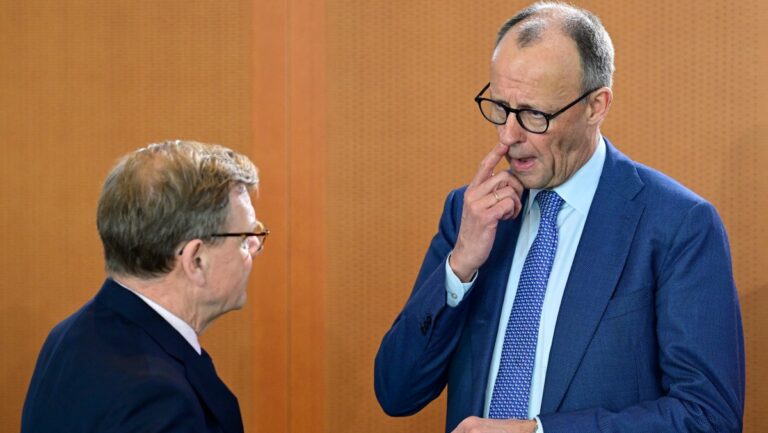
Merz was particularly direct. “It cannot be that the last one in line always sets the pace,” he said, defending the replacement of national vetoes with qualified majority voting. Weber echoed the argument, suggesting that groups of EU capitals should be able to move ahead without being held back by others.
Since the EU’s early days, the national veto has been a key safeguard. It was designed to protect smaller states from being overruled by larger and more powerful countries. In sensitive areas such as foreign policy, defence and sanctions, unanimity has ensured that no major decision is taken against the clear will of a member state.
The approach promoted in Zagreb breaks with that logic. In the name of speed and efficiency, it would allow the objections of one or more countries to be overridden if they cannot form a large enough blocking minority.
In practice, this would favour the EU’s biggest states—above all Germany, the bloc’s most populous country and one of its most influential players. It is not insignificant that Weber, Merz and the President of the European Commission all come from the same country.
Supporters of majority voting often describe it as a limited fix for specific deadlocks. Yet the Zagreb congress showed how this “exception” is increasingly becoming the standard approach.
The final declaration pointed to the December decision on Ukraine, when several countries pushed ahead despite veto threats from others. In Zagreb, that episode was effectively held up as a model: the EU should be able to act through “coalitions of the willing,” even on core strategic questions.
This marks a serious shift in Europe’s political system. Unanimity is no longer treated as a safeguard, but as a problem to be overcome. The veto, once a tool for balance, is reframed as an obstacle standing in the way of action.
Removing it would not just change how decisions are made—it would change who has a say. Policies could be adopted that voters cannot block, governments cannot stop, and national parliaments barely debate, even when the consequences fall directly on individual countries.
The EPP itself acknowledged in Zagreb that the EU’s governance is overly complex and often slow. But simplifying decision-making is not neutral. It redistributes power—deciding who gets to act, who must comply, and how much democratic control remains at the national level.