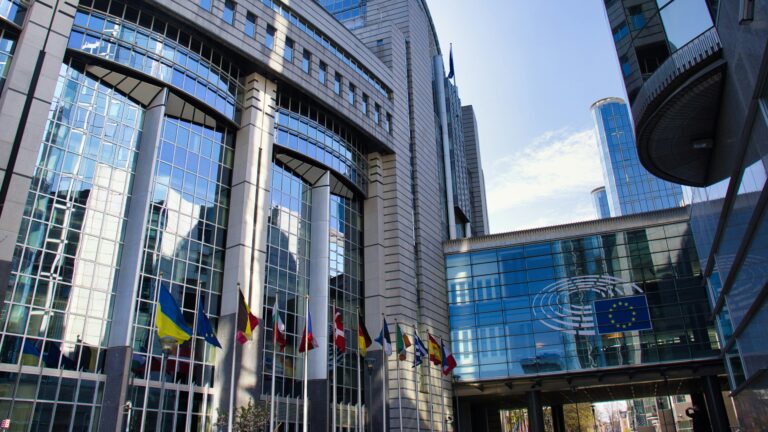
Journalists’ microphones at the European Council Building in Brussels on October 21, 2022.
Ludovic Marin / AFP
The European Commission has admitted that it channeled more than €600,000 of taxpayer money to the U.S.-founded Organized Crime and Corruption Reporting Project (OCCRP), sparking outrage among critics who accuse Brussels of financing leftist, biased journalism designed to discredit Eurosceptic and conservative voices.
In a written answer to a parliamentary question from German MEP Petr Bystron (AfD), Commission Vice-President Henna Virkkunen confirmed that OCCRP had received €604,269 in EU “co-financing” since November 2024 through a project, which funds training and tools for “investigative” journalists.
While the Commission insists the grants are transparent and tied to strict professional standards, opponents see the payments as proof of institutionalised propaganda.
Speaking to europeanconservative.com, Petr Bystron said the timing of the support was unsurprising:
We knew that [U.S. President] Donald Trump stopped the funding of the OCCRP through USAID, and it was quite clear to us that they would be looking for other sources of money. I was surprised that it was done in such an obvious way, that the EU paid them right after the European elections.
He added that Brussels had made no effort to cover up the fact that it was financing media that had attacked EU-critical forces during the European election campaign, claiming the move revealed the depth of the Commission’s entanglement with sympathetic outlets.
Bystron stressed that the AfD and its allies in the Patriots for Europe group have already begun exposing these financing channels via a public database of subsidised NGOs, warning that the EU is using such organisations as proxies to shape public opinion and interfere in national politics.
Journalist and author Thomas Fazi, who recently published an explosive report for MCC Brussels on EU media funding practices, told europeanconservative.com that the OCCRP case fitted squarely into a wider pattern:
As I show in the report, the EU channels vast sums of public money into media projects across Europe and beyond—to the tune of nearly €80 million per year (at least), or close to €1 billion over the past decade—with the clear (and often explicit) aim of promoting pro-EU narratives.
Fazi noted that OCCRP’s investigations, often lauded for exposing scandals such as the “Panama Papers,” tend to focus on official adversaries such as Russia, Kazakhstan, or offshore tax havens, while failing to scrutinise misconduct inside EU institutions.
In effect, EU-funded “investigative journalism” platforms—including ones involving the OCCRP—seem largely aligned with the priorities of Brussels: focusing on official adversaries and foreign regimes, while showing little appetite for holding EU institutions to account—and, in some cases, reinforcing the EU’s geopolitical messaging.
Reports by German journalists John Goetz and Armin Ghassim in late 2024 already raised doubts about OCCRP’s independence, revealing that the network had relied heavily on U.S. government money, particularly from USAID, before the Trump administration cut off the flow.
French outlet Mediapart later claimed that OCCRP had received nearly $50 million from U.S. sources, alongside $14 million from European nations including Sweden, and $1.1 million from the EU directly. The money was partly used to exercise influence over editorial and staffing decisions.
The conservative think tank MCC Brussels recently documented how the EU spends at least €80 million annually on media subsidies, ranging from direct promotional campaigns to “anti-disinformation” projects and cross-border journalism networks.
The study found that the massive effort to amplify pro-EU narratives is often hidden behind fashionable buzzwords, such as the promotion of “European values,” fighting “disinformation,” or fostering “citizen engagement” and “media pluralism.”
Fazi argues this amounts to the creation of “a propaganda machine.”
Democracy depends fundamentally on a genuinely free, independent, and pluralistic media—a media that holds power to account, scrutinises official narratives, and reflects a broad spectrum of societal views. The EU’s ever-expanding system of media financing actively undermines these conditions. It creates financial dependencies, incentivises narrative conformity, and fosters an ecosystem in which dissenting voices are marginalised.
Bystron went further, warning that Brussels was already interfering in electoral politics:
The EU is interfering in national elections in a massive way. They are funding NGOs with millions and millions of euros. They are acting against certain politicians and political parties. They are funding media that are spreading their propaganda. The manipulation of the elections through the EU and through their proxies is already huge.
As the controversy grows, pressure is mounting for Brussels to explain why taxpayers’ money is being used to subsidise outlets accused of serving partisan agendas rather than defending media independence.