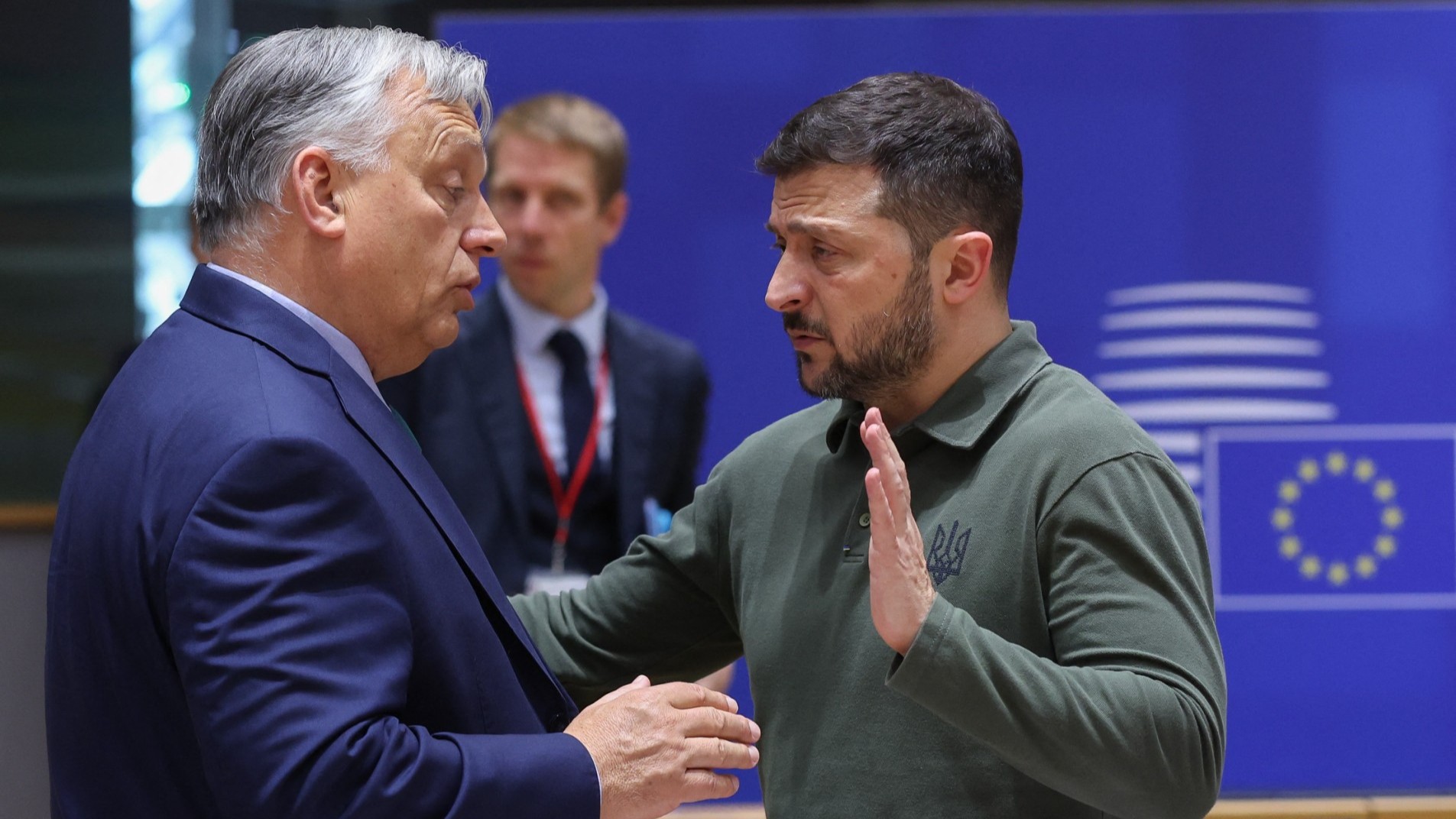
Hungarian Prime Minister Viktor Orbán (L) talks with Ukraine’s President Volodymyr Zelensky during the European Council Summit at the EU headquarters in Brussels on June 27, 2024.
Olivier Hoslet / AFP
Prime Minister Viktor Orbán announced on Monday, January 26th, that he instructed Foreign Minister Péter Szijjártó to summon the Ukrainian ambassador in response to attacks and threats from Ukrainian political leaders against Hungary and its government. The Hungarian PM said Ukraine is trying to interfere in the country’s upcoming elections to sway voters for a pro-Ukraine candidate.
In a video published on his X page, the prime minister said Hungary is responding to developments from last week, during which Ukrainian political leaders, including the president, sent what he called “grossly insulting and threatening messages” toward Hungary.
Response to Ukrainian threats against Hungary and its government.
— Orbán Viktor (@PM_ViktorOrban) January 26, 2026
We will not allow anyone to endanger Hungary’s sovereignty or the integrity of our elections. Today, I instructed @FM_Szijjarto to summon Ukraine’s ambassador to Hungary for a meeting at the Ministry of Foreign… pic.twitter.com/qTcUjFBjaS
The current political tensions follow overt insults by Ukrainian President Zelensky in Davos last week, which prompted a response from Orbán social media. In that post, the prime minister contrasted their positions, stating that while he is a free man serving Hungary and Hungarians, the Ukrainian president is “a desperate man.”
“You are a man in a difficult situation who has been unable or unwilling to end a war for four years. Despite the President of the United States giving him every help he can.” the prime minister said.
Orbán also made clear that the Hungarian government will not support Ukraine’s war efforts. At the same time, he emphasized that Hungary’s assistance to the Ukrainian people would continue, stating that Ukraine can still count on Hungary to supply electricity and fuel, and that Hungary will continue to help refugees arriving from Ukraine.
In his Monday announcement, the prime minister said Hungary’s national security agencies analyzed last week’s events and concluded that the attacks were part of a coordinated series of Ukrainian measures aimed at interfering in the Hungarian election.
One of the core messages of ruling Fidesz’s campaign ahead of the elections set for April 12th is the pledge to ensure that Hungary stays out of the war in Ukraine. The prime minister and the government have repeatedly stressed that Hungary will not be drawn into the conflict.
In contrast, the opposition Tisza Party, led by Péter Magyar, is taking a different approach. Magyar’s party would be willing to give in to demands from Brussels and finance the war, marking a sharp divide between the government parties and their main challengers on the issue of the conflict in Ukraine.
Recent polling data by Hungarian social research institute Magyar Társadalomkutató, known to have predicted the most accurately the results of the 2022 election, indicated that the ruling conservative Fidesz-KDNPcoalition maintains a clear lead. According to the survey, 51% of active party-choosing voters still support Fidesz-KDNP, giving the governing parties a stable advantage. The Tisza Party stands at 41%, with its support having grown minimally since last November, primarily at the expense of left-wing DK and the anti-establishment Two-Tailed Dog Party. According to the poll, if elections were held “this Sunday,” three parties would enter the National Assembly: Fidesz-KDNP, the Tisza Party, and radical right-wing Mi Hazánk (Our Homeland).