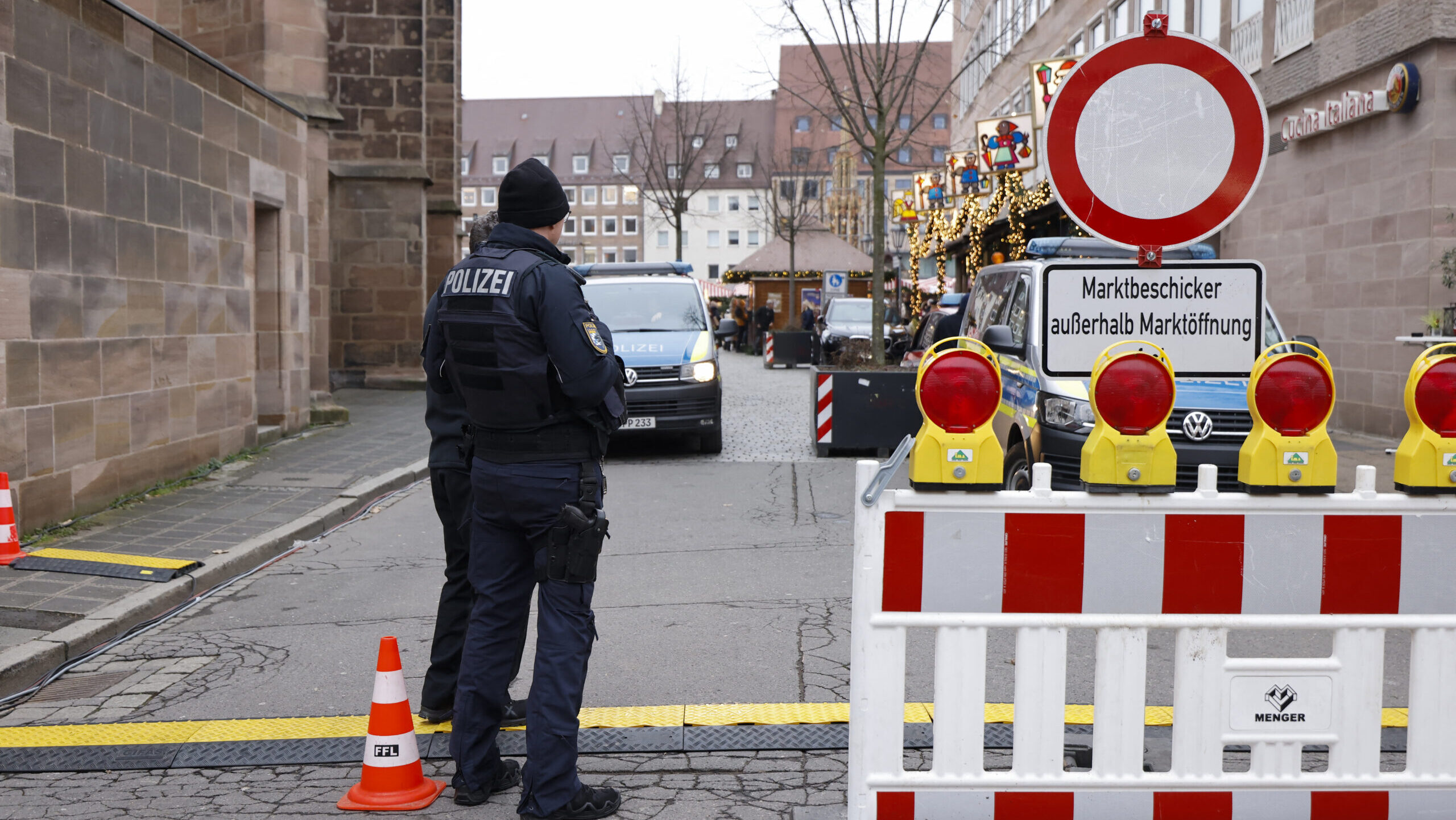
Police block a street leading to Nuremberg’s Christmas market ahead of its November 28, 2025 opening.
Alexandra BEIER / AFP
Europe’s Christmas markets—joyful symbols of Christian heritage—are entering the 2025 season under the heaviest security presence the continent has ever seen. What should be a celebration of peace has become a demonstration of fear, with cities across Europe forced to transform festive squares into fortified zones. Years of irresponsible political decisions have left Christian cultural events increasingly vulnerable to extremist violence.
After last year’s Magdeburg massacre—where a Saudi migrant drove his car into festive crowds, killing six and injuring over 300—Germany and the rest of Europe were forced into a complete security overhaul. The suspect, 51-year-old Taleb Jawad al-Abdulmohsen, is now on trial in a temporary courthouse in Magdeburg, built specifically to accommodate the hundreds of witnesses, victims, and relatives involved in the proceedings. Courts now describe the suspect’s ideology as anti-Islam rather than jihadist, but security officials stress that Christmas markets have long been prime targets for Islamist attackers.
It was the deadliest Christmas-season attack since Berlin’s Breitscheidplatz massacre in 2016. Two years later, an Islamist killed five people and injured 11 more at a market in Strasbourg, France, armed with a knife and a revolver. The Magdeburg attack triggered a complete reassessment across Germany, home to more than 2,500 Christmas markets.
Security consultant Will Geddes warned that “every city in Europe that puts on a Christmas market will be adjusting their approach this year. If they don’t, they are irresponsible.” Stefan Bisanz—former advisor to the German Ministry of Defence—admitted the bitter truth: “Anyone can hide weapons or explosives. Unless you have airport-style checks, you can’t guarantee safety.”
In Germany, cities from Hannover to Osnabrück have rewritten their security concepts from the ground up, adding new concrete and steel vehicle barriers, expanded camera networks, and full street closures modelled on post-Magdeburg risk assessments.
Oldenburg and Salzgitter are deploying mobile anti-vehicle systems for the first time, similar to the moveable bollards now used in Augsburg, where heavy metal barriers are rolled into place between tram movements to seal off pedestrian zones.
Göttingen has taken the extraordinary step of banning all daytime vehicle access through its market area. Meanwhile, Hamburg now positions security tanks—disguised as oversized Christmas presents—around public squares.
The financial burden is also severe. Dresden is spending nearly €1.7 million, while Frankfurt am Main has allocated roughly €4 million for security alone. Some towns, like Overath and Kerpen, have cancelled their markets entirely because they cannot afford the protective measures.
Across Europe, the same story repeats: Salzburg is monitored by 33 cameras, Prague has installed massive concrete blocks, and Budapest has deployed additional plain-clothes officers into crowds.
If this were not enough, Brussels offered another disturbing scene. Opening night of the city’s Christmas market—usually a postcard moment of lights, music, and families—collapsed into panic. Videos showed masked protesters waving Palestinian flags, rushing through the market, and setting off smoke devices. Thick smoke choked the pathways as parents grabbed their children and fled.
Eyewitnesses described it as “chaos.” One visitor wrote: “The Christmas market in Brussels looked like absolute chaos this year and was completely ruined. Pro-Palestinian rioters stormed the place with smoke bombs in the middle of families and children, who fled in panic.”
In Toulouse, France, reports of Islamic celebrations and Arabic music being performed directly outside the Christmas markets have sparked outrage among locals.
Austria faces the same reality. FPÖ leader Herbert Kickl warned on the First Sunday of Advent that “the threat of terrorism is omnipresent and remains high in Austria—especially during the Christmas season.” He accused the country’s establishment parties of downplaying the danger while continuing open-borders policies that have allowed individuals into Austria “who hate and oppose our Western values.”
In his statement, Kickl wrote: “Recent surveys show that a large portion of the Austrian population feels uneasy when visiting our Christmas markets. The established political parties are primarily to blame…Therefore, I say it clearly and decisively: My asylum cap is ZERO.”
Islamist extremism is increasing within Europe itself. German officials estimate 32,500 foreign extremists living in the country, many openly aligning with Hamas. Germany recorded over 1,500 Islamist-motivated crimes in 2024, while Austria saw a 41.5% rise.
Geert Wilders, leader of the right-wing, anti-immigration Party for Freedom, responded sharply on X: “Christmas markets elsewhere in Europe are being extra guarded. The consequence of decades-long open borders. We must stop the Islamization of the West. Freedom instead of terror. Islam does not belong with us.”