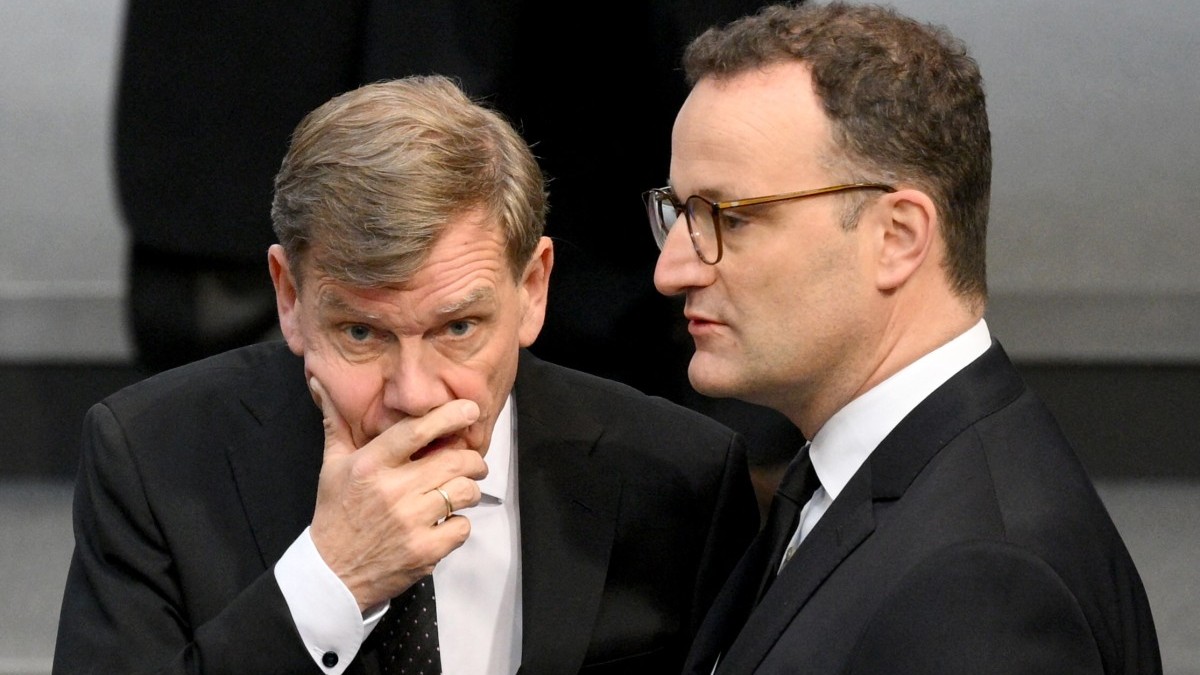
German Foreign Minister Johann Wadephul (L) with CDU parliamentary group leader Jens Spahn in the Bundestag on May 8, 2025.
Photo: Ralf Hirschberger / AFP
Germany’s ruling center-right party has teamed up with the left to block the populist Alternative für Deutschland (AfD) from holding any leadership roles in parliament’s most powerful committees—even though the AfD is now the country’s second-largest political force.
Jens Spahn, a senior figure in the Christian Democratic Union (CDU)—the leading party in Germany’s governing coalition—has joined efforts long pushed by the center-left Social Democrats (SPD) and Greens to exclude the AfD from power. His latest move: blocking the AfD’s access to chair and vice-chair positions in the Bundestag’s parliamentary committees at all costs.
After several days of ambiguity, Spahn announced that his group would not vote in favor of any AfD candidate, not even for deputy roles. This means that the six committees allocated to the AfD—among them key ones like Interior, Finance, and Budget—will be left without any leadership representation from this political force, which enjoys the backing of millions of voters. Such a blanket exclusion is highly unusual in postwar German parliamentary history.
The most alarming aspect is Spahn’s inconsistency: just a month ago, he claimed the AfD should be treated like any other opposition party in parliament. Now, it seems he is prioritising political conformity over democratic fairness.
As a pretext, the CDU invokes the recent report from the Verfassungsschutz (Federal Office for the Protection of the Constitution), which labeled the AfD a “confirmed far-right extremist” party. However, they carefully omit that this classification has been provisionally suspended by the courts and that respected constitutional scholars have strongly challenged its validity. Nevertheless, Spahn and his allies wield this report as justification for reinforcing the marginalization of a legitimately elected parliamentary group.
The move is especially grave because committee chairs wield real power: they set the agenda, grant speaking rights, and manage internal proceedings. Without a majority in any committee, the AfD is unable to compete for these roles. In cases where the rules would normally give the acting chair to the oldest committee member, the CDU has said this cannot apply if that person is from the AfD. To close off any remaining loopholes, vice-chair positions will also be locked down during the next parliamentary session. Democracy? Only when the establishment allows it.
The result is a parliament in which over five million citizens—those who voted for the AfD—are left voiceless in key bodies. Neither Ulrike Schielke-Ziesing, the AfD’s candidate for the Budget Committee, nor the party’s other candidates stand any real chance.