Kirill Kudryavtsev / AFP
Germany’s Federal Criminal Police Office (BKA) has reported a sharp rise in cases of people being investigated for insulting politicians online.
The figures, released in response to an enquiry from MP Martin Renner from right-wing opposition party Alternative für Deutschland (AfD), show a rapid increase in the number of comments being flagged and passed on to prosecutors.
The BKA’s internet reporting office (ZMI) was set up in February 2022 to fight what the government calls ‘hate and incitement’ online.
It works closely with organisations such as HessenGegenHetze and REspect!, which forward suspicious posts to the authorities. The ZMI then decides whether these online posts are actual crimes.
According to the latest data, 468 cases of ‘politician insults’ were forwarded (under Section 188 of the Criminal Code) in the first quarter of 2024. By the first quarter of 2025, that number had jumped to an astonishing 1,690 cases. In the second quarter of 2025, there were another 1,528 cases.
These cases now make up almost half of all reports, compared to just 16% a year earlier.
By contrast, cases of hate speech or the use of banned extremist symbols have gone down.
Between 2021 and 2025, the vast majority of posts flagged to the ZMI were—unsurprisingly—classified as ‘right-wing’ (22,957 cases), while only 233 were categorised as ‘left-wing.’Nearly 19,000 were put into the ‘other’ category.
Martin Renner, a lawmaker for the AfD party, said that the huge gap between right-wing and left-wing cases does not correspond to reality and shows a deliberate one-sidedness.
He also pointed out that two reporting offices dominate the system: HessenGegenHetze (which made 45.8% of the reports) and REspect! (38.5%).
HessenGegenHetze was the organisation that reported a post by pensioner Stefan Niehoff, who had his house raided and was ultimately fined €825 after retweeting a meme that branded then-Economy Minister Robert Habeck a “professional moron.”
HessenGegenHetze was also the one responsible for getting right-wing journalist David Bendels into trouble. Bendels was sentenced to seven months’ probation for mocking former Interior Minister Nancy Faeser.
These developments suggest a troubling trend. The sharp rise in cases of ‘politician insults’ and the heavy reliance on a few reporting bodies raise serious questions about whether Germany is still fully committed to free speech.
Police raids across Germany recently targeted 170 individuals over social media posts. Authorities are prosecuting alleged ‘hate speech.’
It is no wonder that a report by the U.S. State Department says Germany’s human rights record has worsened over the past year, with restrictions on freedom of expression cited as an example.
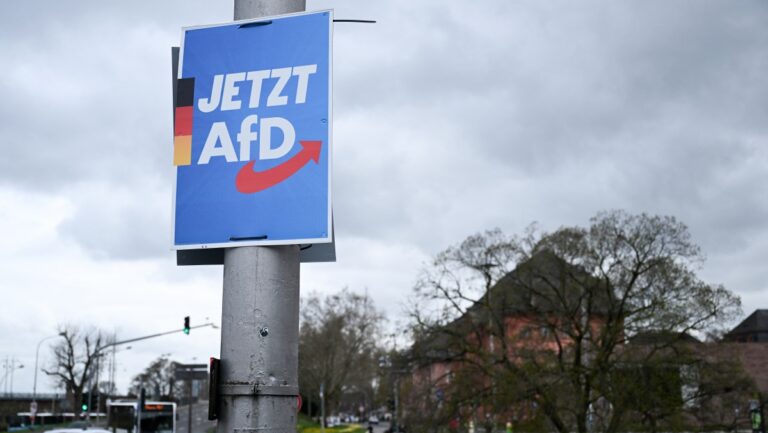
The German ruling elites’ attempts at suppressing right-wing voices it deems unsuitable are in line with their efforts to ban the most popular opposition party, the AfD.