Photo: Notre-Dame de Chrétienté on X, June 8, 2025
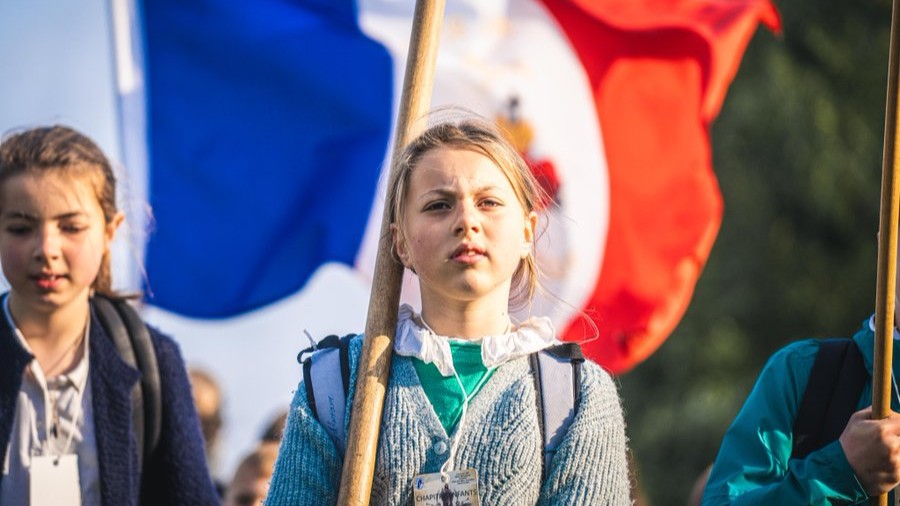
The Chartres pilgrimage, which every year at Pentecost brings together the faithful attached to the traditional liturgy of the Catholic Church, broke a new record this year, mobilizing nearly 20,000 pilgrims on the roads leading from Paris to Chartres Cathedral.
Founded in 1983, the Notre-Dame de Chrétienté pilgrimage aims to revive a tradition dating back to the Middle Ages, a route that led the pilgrims from Paris to the Marian shrine in Chartres. In the 19th century, the Catholic poet Charles Péguy was one of the ardent promoters of renewed interest in this centuries-old pilgrimage, which had fallen into disuse.
For several years now, the pilgrimage has been growing in popularity and organizers have been struggling to cope with the influx of participants. This year, it took just a few days for registrations to fill up, despite an increase of 3,000 spots compared to last year.
Numerous rumors marred the days leading up to the pilgrimage. One of its original features is that it exclusively uses the traditional Latin liturgy according to the missal in use in the Catholic Church before the Second Vatican Council (Vetus Ordo)—a liturgy that has never been banned, but which has been the subject of vigorous attacks under Pope Francis, who sought to considerably restrict its use.
The faithful may have wondered whether the pilgrimage would eventually be banned, or whether the use of the old missal would deny them access to Chartres Cathedral, the destination of the pilgrimage. Fortunately, this has not been the case. A request was made to the pilgrimage organizers to allow priests who wished to follow the pilgrimage while celebrating the new Mass (Novus Ordo) to do so. The prelates who had made this condition known as essential for the smooth running of the pilgrimage intended to make a political gesture to ‘break’ the community effect they feared among the participants of the Chartres pilgrimage. But in reality, almost no priests have expressed a desire to celebrate Mass according to the Novus Ordo during a pilgrimage that was never intended for that purpose.
For many of the participants, the election of Pope Leo XIV was seen as a form of encouragement, given the signals sent by the new pontiff of his deep desire to ensure peace and unity among believers—including on liturgical issues.
In a sign of the goodwill of the French ecclesiastical hierarchy, the bishop of Chartres was present on the last day of the pilgrims’ march to welcome them to his cathedral, and delivered the homily at Mass on Monday, June 9th, while conveying Pope Leo XIV’s warm thoughts and prayers to the walkers.
Once again, the Chartres pilgrimage was a resounding success, demonstrating its ability to mobilize large numbers of young people thirsty for ideals, for the sacred, for silence, and eager to promote their Catholic identity rooted in tradition. The 100-kilometer walk and the demanding physical conditions of the pilgrimage are seen not as an obstacle, but as a wonderful and exhilarating opportunity to surpass oneself. As every year, the French chapters were joined by pilgrims from all over Europe, but also from America and even Oceania.
This appeal of ‘Chartres,’ as the pilgrimage is simply known in traditional circles, reveals a growing generation gap, analyzed by sociologist Yann Raison du Cleuziou, a specialist in Catholicism and its evolution. According to the academic, younger generations are painfully aware of the marginalization of Christians in Western societies. Aware that they are becoming a besieged minority, they find comfort and a reason to hope in a deeply rooted and identity-based practice of their faith, which is not understood by the previous generation, who were lulled into the illusion of a faith that had abandoned its traditional markers in order to speak to the world, without success. In the newspaper La Croix, he explains this misunderstanding:
The older generation grew up in a culturally dominant Catholicism, even if it was weakened. Their strategy to perpetuate its appeal was to tone down its burdensome aspects, to propose rather than impose. This has resulted in a kind of desacralization of rituals, a more symbolic reading of the Scriptures, and greater autonomy in private life, particularly in matters of sexuality. Young people, on the other hand, are growing up in a landscape where their faith is the exception. Their response is the opposite: to assert their religious identity, strengthen coherence, and claim their difference.
The pilgrims of Chartres can be found on other occasions, such as the festival of Paray-le-Monial, held every summer in the town of St. Margaret Mary Alacoque, a visionary nun who was at the origin of the cult of the Sacred Heart of Jesus, where the liturgy in the Novus Ordo is much more informal, and the atmosphere is a world away from that of Chartres. “And so what?” is their creed.
Several voices of well-known figures in the traditional Catholic world have spoken out in defense of this right to liturgical diversity among the faithful—a diversity that was denied them by Pope Francis in his motu proprio Traditionis Custodes published in 2021. The previous pontiff considered the use of the traditional missal to be nothing more than a remnant of a bygone era, doomed to disappear, and was unable to perceive the appeal of the old liturgy, especially to young people who grew up far from the Catholic faith and are rediscovering it through a rite that speaks to them, touches them, and fascinates them.
Next year, the organizers of the Chartres pilgrimage have announced a major logistical restructuring of the march in order to better manage the dynamics and allow an ever-increasing number of pilgrims to join the movement.