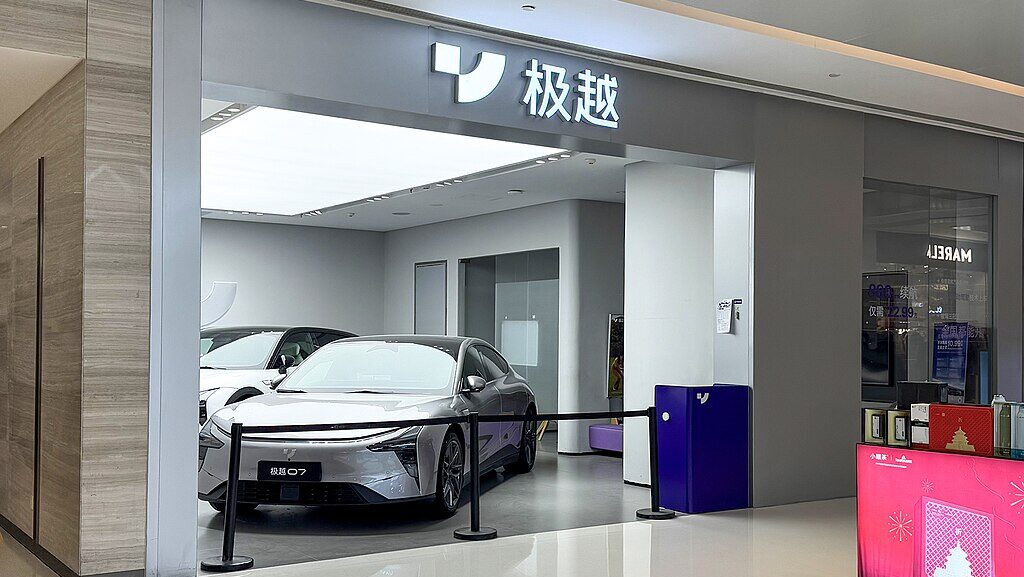
Ji Yue showroom at Grand Emporium, December 2024. EU officials admitted that the bloc’s 2024 tariffs on Chinese electric vehicles helped escalate the situation.
Windmemories, CC BY-SA 4.0, via Wikimedia Commons
The European Union is planning a response to China’s recent restrictions on the export of rare earth elements, a move Brussels describes as an “explosive” threat to the foundation of its strategic industries. The dispute marks a significant escalation in trade tensions, with the European automotive sector now caught in the crossfire, suffering immediate production disruptions as a direct result.
The escalation of trade regulations is already having effects. A recent case involving Nexperia, a Dutch chipmaker owned by a Chinese firm, illustrates how geopolitical interventions are rippling through European factories. After the Dutch government, under pressure from the U.S., took control of the company, China responded by banning the export of Nexperia’s chips. This has left Volkswagen, a cornerstone of German industry, unable to secure essential microchips.
With no ready alternative supplier, VW has been forced to warn employees of upcoming production disruptions. Multiple models are at risk, potentially impacting major plants in Wolfsburg, Emden, Hanover, and Zwickau. The situation is so dire that VW is reportedly in talks with the German government to utilize Kurzarbeit, a temporary work scheme, to avoid mass layoffs.
China’s broader rare earth bans now threaten to compound these existing issues, directly targeting sectors central to Europe’s green and digital transitions. Industry leaders warn of systemic supply risks for battery and semiconductor manufacturing, extending far beyond the current automotive crisis.
In response, the EU is considering deploying its newly enacted anti-coercion instrument to retaliate. If a majority of member states endorse the plan, the European Commission could impose punitive tariffs on Chinese companies operating within the EU, with the stated objective of forcing China back to the negotiating table.
One Brussels diplomat said, “The EU must therefore act quickly to protect its strategic interests.” With China putting on the pressure, the fragile and divided European economy cannot afford to threaten the Chinese economy for too long.
EU officials themselves acknowledged that the bloc’s own decision to impose additional tariffs on Chinese electric vehicles in 2024 contributed to the escalation. The Nexperia case further demonstrates how Western actions, driven by security concerns, can inadvertently cripple European manufacturers, revealing a critical vulnerability in the bloc’s supply chain strategy.