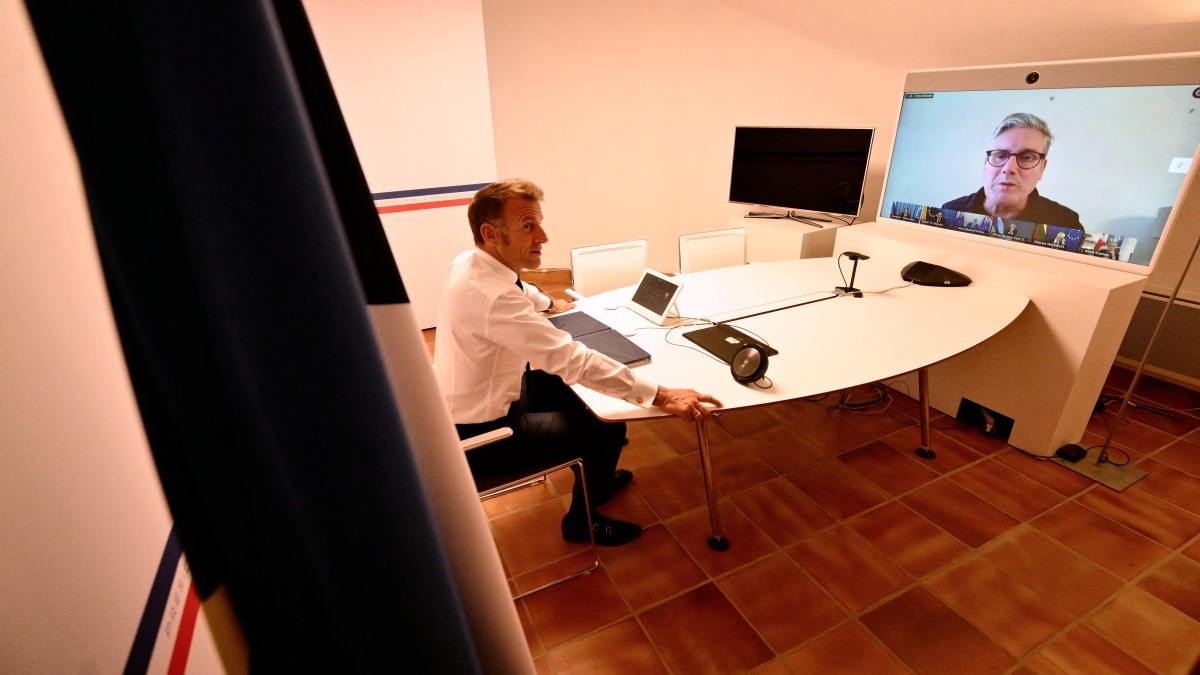
Emmanuel Macron talks with Keir Starmer during a video meeting of the ‘Coalition of the Willing’ to discuss next steps for Ukraine on August 19, 2025.
Christophe Simon / AFP
European leaders are buzzing about what they say are new and firm U.S. security guarantees for Ukraine. Especially France’s Emmanuel Macron and UK Prime Minister Keir Starmer, whose ‘coalition of the willing’ has barely been mentioned since its inception in February.
During a day of various talks with European officials, Volodymyr Zelensky and Vladimir Putin, Donald Trump agreed to what Starmer—and, to be fair, U.S. special envoy Steve Witkoff—described as a “Article 5-like” guarantees covering Ukraine, referring to NATO’s principle that an attack on one member is an attack on all. London said this was a “real breakthrough.”
But as before, the actual guarantees—that is, the boots on the ground—are to be provided (somehow) by Europe, simply with Washington’s “coordination.” And that’s despite German Ambassador Miguel Berger’s warning back in March that peacekeeping forces in Ukraine would rely on “full U.S. involvement.”
And despite murmurs that other European countries are preparing to throw their hats in the ring of those willing to put boots on the ground, no more have confirmed their intentions. It is even being suggested that Germany might be willing to get involved, despite Foreign Minister Johann Wadephul saying on Monday that the country doesn’t have the capacity to send troops.
Neither do Britain or France, which has been the crux of understanding the futility of these offers since the start.
Even a proposed supply of U.S. weapons worth more than €85 billion will supposedly be financed by Europe, according to a document seen by the Financial Times, which is bound to trigger a whole fresh wave of continental bickering.
Defence officials will meet this week in an attempt to iron out further details relating to the ‘coalition,’ but as before, Europeans would be unwise to hold their breaths for major breakthroughs.