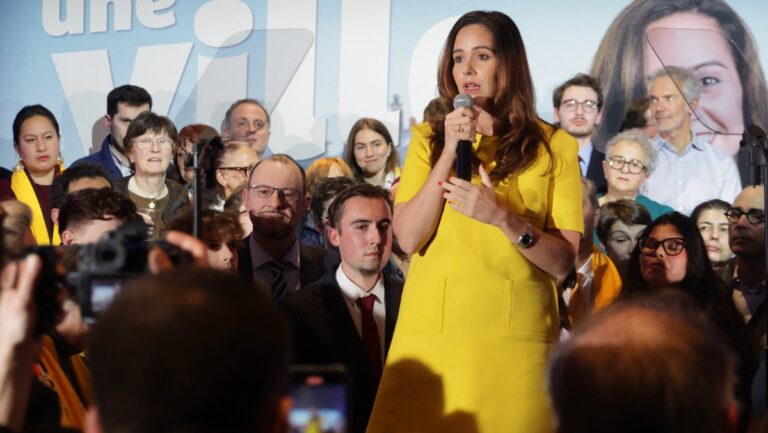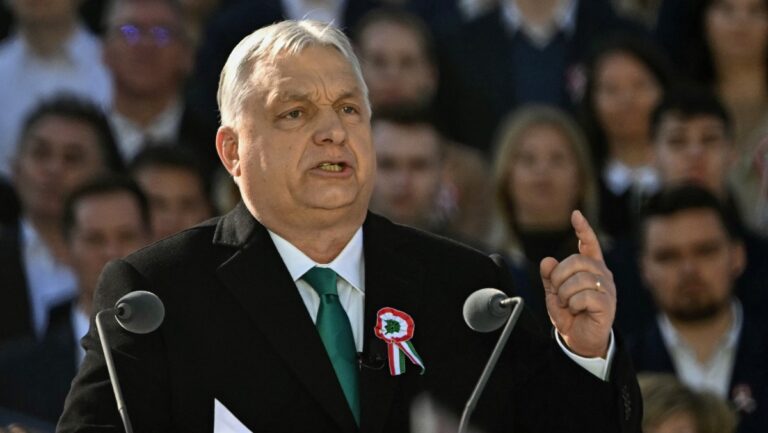
AI-generated image / europeanconservative.com
According to leaked documents, a senior Hungarian EU Commission official allegedly developed a secret political strategy aimed at removing Hungarian Prime Minister Viktor Orbán as early as 2019. The plan is attributed to Márton Benedek, who at the time served as the EU’s International Coordinator within the Directorate-General for Migration and Home Affairs, and who currently heads Brussels’ cooperation with Libya.
According Zerohedge, the documents, reviewed by The Grayzone, indicate that in January 2019 Benedek authored a “project proposal” aimed at “developing a permanent coordination forum to organize resistance against the Orbán regime.” The initiative reportedly sought to consolidate opposition forces and translate protest activity into a sustained political movement capable of challenging the Hungarian government.
Benedek wrote that the early stages of the plan managed to group about 30 political, trade union and civic leaders to coordinate their activities and agree on a set of minimum objectives and funding principles and jointly plan future action. This, he argued, gave rise to “an ad hoc coordination forum… which could develop, over time, into an incipient political coordinating body that could credibly challenge” Orbán’s rule.
Zerohedge says that the project was designed not only to organize protests but to build a broader political structure. In the longer term, this structure was envisioned as a parallel political force, potentially functioning as a shadow government. In the document, Benedek stated that “in the longer run, the proposed non-profit entity could also… develop the policy foundations (and shadow cabinet) of a united political front against the Orbán regime.”
The proposal emphasized the need for substantial financing to “deliver results,” noting that organizing a single “large demonstration in Budapest” cost roughly $11,000. Benedek proposed establishing “a non-profit entity, registered in Hungary (for operational activities) and a financial vehicle potentially registered in Austria,” overseen by a board including representatives of political parties, trade unions, and NGOs.
The leaked files highlight the involvement of non-governmental organizations, many of which have been accused of receiving funding from George Soros’ Open Society Foundations. OSF relocated its Hungarian office to Berlin in April 2018 following measures by the Orbán government aimed at curbing the influence of foreign-funded NGOs. The most recent available figures cited indicate that Soros’ network directed $8.9 million into Hungary in 2021 alone.
The revelations have triggered sharp reactions from the Hungarian government. Foreign Minister Péter Szijjártó addressed the reports in his recent X post. “Well, yes, that’s how it works! Brussels needs governments that say yes to it: yes to war, migration and gender,” he underlined.
Szijjártó further stated: “Brussels has been trying to wipe us out of the game for many years. They interfere in every election, and now we can expect even harsher interference than ever before, as the stakes are higher than ever: they want to drag us into war and they want to bring migrants here.” He concluded: “And they know that only a puppet government in Brussels will say yes to all of this.”
Well, that’s how it goes! Brussels wants governments that always say yes — yes to war, migration, and gender.
— Péter Szijjártó (@FM_Szijjarto) January 14, 2026
Hungary’s sovereign national government, however, says no to Brussels: we say no to war, migration, and gender.
For many years now, Brussels has been trying to… https://t.co/4HTSsNxctb
Political commentator Mario Nawfal stated in a recent post on X “This is not a metaphorical resistance. This is a real structure. NGOs, unions, funding channels, election schedules. The whole starting kit.” He warned that despite the plan used for previous political movements in Hungary failing in previous elections, it might still be in use for the currently largest opposition party, Tisza. Nawfal remarked that the campaign of the recently formed party is suspiciously well coordinated.
“The EU doesn’t just put pressure on governments. It actively bypasses them if they don’t cooperate,” Nawfal concluded.