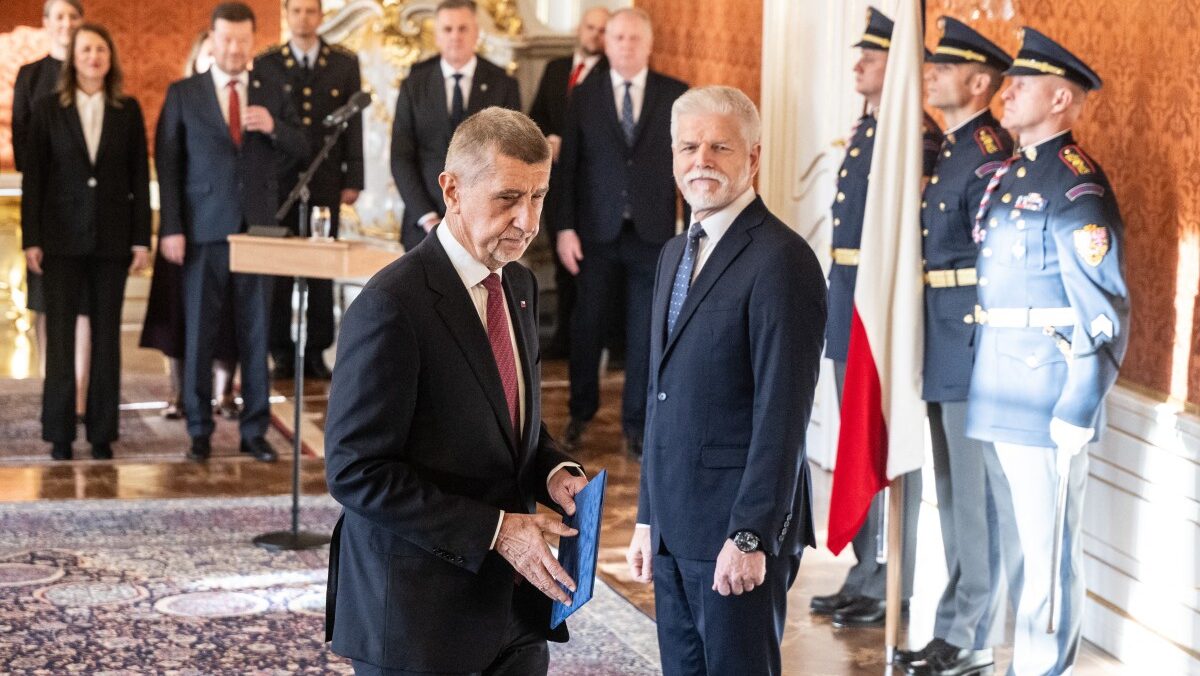
Czech President Petr Pavel (R) looks at Andrej Babis (L), leader of the ANO party, as he is appointed as the country’s new prime minister on December 9, 2025 at the Castle in Prague, Czech Republic.
MICHAL CIZEK / AFP
The Czech opposition has moved to trigger a vote of no confidence in Prime Minister Andrej Babiš’s government following a political scandal involving text messages sent by Foreign Minister Petr Macinka to President Petr Pavel.
On Wednesday, January 28th, representatives of all five opposition parties announced they had gathered the required 81 signatures to convene an extraordinary session of the Chamber of Deputies.
Speaker Tomio Okamura confirmed the debate would take place next Tuesday.
The opposition argues that Andrej Babiš has failed to adequately condemn Petr Macinka’s conduct or clarify whether the foreign minister still enjoys his confidence.
The controversy erupted a day earlier after President Pavel accused Macinka, who also leads the right-wing Motorists for Themselves party, of attempting to blackmail him over a disputed cabinet appointment.
The president said he had received “extremely serious” text messages via his adviser, Petr Kolář, pressuring him to appoint Motorists politician Filip Turek as environment minister—a nomination Pavel has repeatedly refused due to Turek’s involvement in past scandals.
The president’s office subsequently published screenshots of the messages on social media. In them, Macinka warned of “serious consequences” should the appointment not go ahead, stating that the president’s opportunity to reverse his decision would “run out on Wednesday.”
In one exchange, he said he would “burn bridges” if Pavel did not comply, adding that the president would be “surprised” by developments following his trip to Brussels.
President Pavel described the messages as “absolutely intolerable in our democratic conditions” and said he had submitted the correspondence to lawyers and reported the matter to the police for assessment of whether it constituted criminal blackmail.
Macinka has rejected that interpretation, insisting the exchanges amounted to legitimate political negotiation.
He argued that the president was acting outside the constitutional framework by blocking the ministerial appointment.
He also said that, during meetings in Brussels, he intended to inform NATO officials that the Czech delegation to July’s NATO summit should be led by Prime Minister Babiš rather than the president.
The affair triggered uproar in parliament, with opposition parties condemning what they described as “mafia-style political practices” and demanding Macinka’s immediate dismissal.
They also sought a parliamentary resolution calling for a government apology—a proposal rejected by lawmakers from the ruling coalition.
Prime Minister Babiš acknowledged that the foreign minister’s messages were “poorly worded” but said he did not consider them blackmail.
He told MPs that he had not been aware of the texts at the time they were sent, while reaffirming his support for Macinka’s position on Turek’s appointment.
“Our government has no interest in a trench war with Prague Castle,” he said, urging calm and calling for disputes between constitutional actors to be resolved behind closed doors.
Současný konflikt mezi prezidentem Petrem Pavlem a ministrem zahraničí Petrem Macinkou není správný. Rád bych oba pány pozval ke společnému jednání, u stolu se to vždy vyřeší lépe a rychleji než silnými vzkazy přes média na tiskových konferencích.
— Andrej Babiš (@AndrejBabis) January 27, 2026
Opposition leaders dismissed the prime minister’s response as inadequate, arguing the affair had caused serious damage to the country’s international reputation.
Although the five opposition parties together hold only 92 seats—short of the 101 required to bring down the government—they argue the no-confidence vote is necessary to force accountability and public debate.
The clash reflects deeper tensions within Czech politics, pitting Babiš’s Eurosceptic, sovereignist coalition against President Pavel, a former NATO general known for his strong pro-Western stance.
Babiš’s sovereignist ANO movement, Tomio Okamura’s anti-immigration SPD, and Macinka’s Eurosceptic Motorists for Themselves have been sharply critical of Brussels on issues ranging from the Green Deal to migration and military support for Kyiv.
Tensions have been further aggravated by recent disagreements over foreign and defence policy, including the president’s pledge of military equipment to Ukraine without prior consultation with the government—a move the prime minister later contradicted by ruling out the transfer of Czech L-159 aircraft, citing domestic defence needs.
The entire affair seems to have been blown out of proportion by an angry president frustrated by repeated clashes with a government whose political direction he fundamentally opposes.