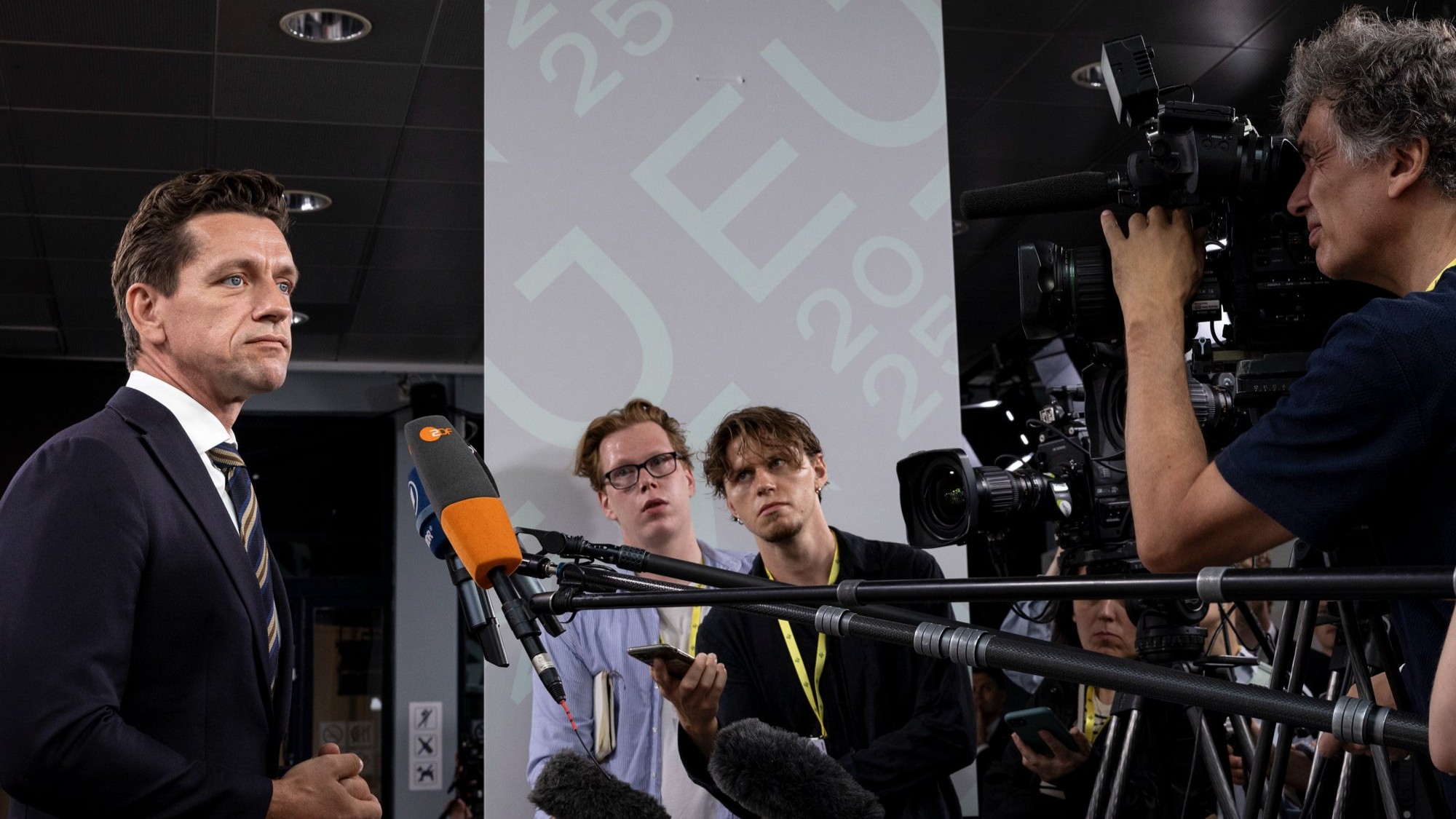
Danish Migration Minister Kaare Dybvad
@eu2025dk on X, 22 July 2025
The EU’s “dysfunctional” asylum system needs radical reforms, and the Council’s current Danish presidency is ready to drive the change, Migration Minister Kaare Dybvad and Justice Minister Peter Hummelgaard said on Tuesday, July 22nd, after meeting their EU colleagues in Copenhagen.
Apart from the legislative work ahead, the EU also needs to change its overall perspective on mass migration and realize that what it has been doing for the past ten years is “economically unsustainable,” regardless of the humanitarian responsibilities, Dybvad argued.
“I don’t believe that the sort of ‘Wir schaffen das’ mentality has done anything good for the European continent,” the minister said. “We’ve been told at that moment that there will be a lot of very highly skilled people coming into our labor market, and what we’ve seen is that it’s really not the case.”
Dybvad gave the example of Denmark, where the 40,000-strong Syrian community has an income of less than half a billion euros, but costs the taxpayers over €1.5 billion. That’s why Denmark has been offering €27,000 for every Syrian who voluntarily returns to their country, even though only 120 of them took the deal in the past six months.
“It’s a huge deficit for our nations, economically speaking,” the minister said.
First day of the Informal Meeting of Justice and Home Affairs Ministers 🇪🇺 pic.twitter.com/a3LBG64puY
— Danish Presidency of the Council of the EU 2025 (@eu2025dk) July 22, 2025
Therefore, the presidency has outlined three priority areas in which the Migration Pact needs to be amended: streamlining deportations (as less than a quarter of rejected asylum seekers actually leave Europe); making return agreements with third countries (including for hosting off-shore deportation centers, similarly to Italy’s Albania Protocol); and implementing effective border controls, especially when it comes to the ‘hybrid warfare’ we see at the EU’s eastern borders.
The fourth priority, not part of the EU asylum policy but closely linked to it, is the fight against organized crime, which Denmark also wants Brussels to get a lot tougher on.
However, there seemed to be a slight discrepancy in how Denmark and the EU Commission imagine the third-country deportation centers, or so-called ‘return hubs,’ as proposed in the latest Return Directive. When asked, Migration Commissioner Magnus Brunner only said that the current proposal will allow member states to make bilateral agreements with third countries for hosting Albania-style deportation centers, nothing more.
A minute later, however, Dybvad expressed hope that soon there will be a possibility of setting up facilities that work both as deportation and reception centers to prevent those who are ineligible for asylum to even set foot on EU soil—something that Italian judges blocked four times, citing EU law—and that they would be set up and operated both individually by member states, as well as together at the EU level.
This version is clearly what the majority of EU member states have been pushing for over a year now, yet the von der Leyen Commission remains reluctant to sign off on it. At least, it seems, the Danish presidency is not afraid to do its job and represent the Council’s will as it is.
In the end, Hummelgaard added that these reforms should not be viewed as purely strategic or financial decisions, but instead as a democratic responsibility.
“The people of Europe are asking their governments and the EU to take more responsibility for mass migration, because it’s intertwined with many different economic and social problems,” the justice minister said.
“We see it here in Scandinavia that the welfare model is not socially sustainable with open borders and free access to benefits,” he said, adding that curbing mass migration is “the will of the people,” and therefore these reforms are “very positive, from a democratic point of view.”