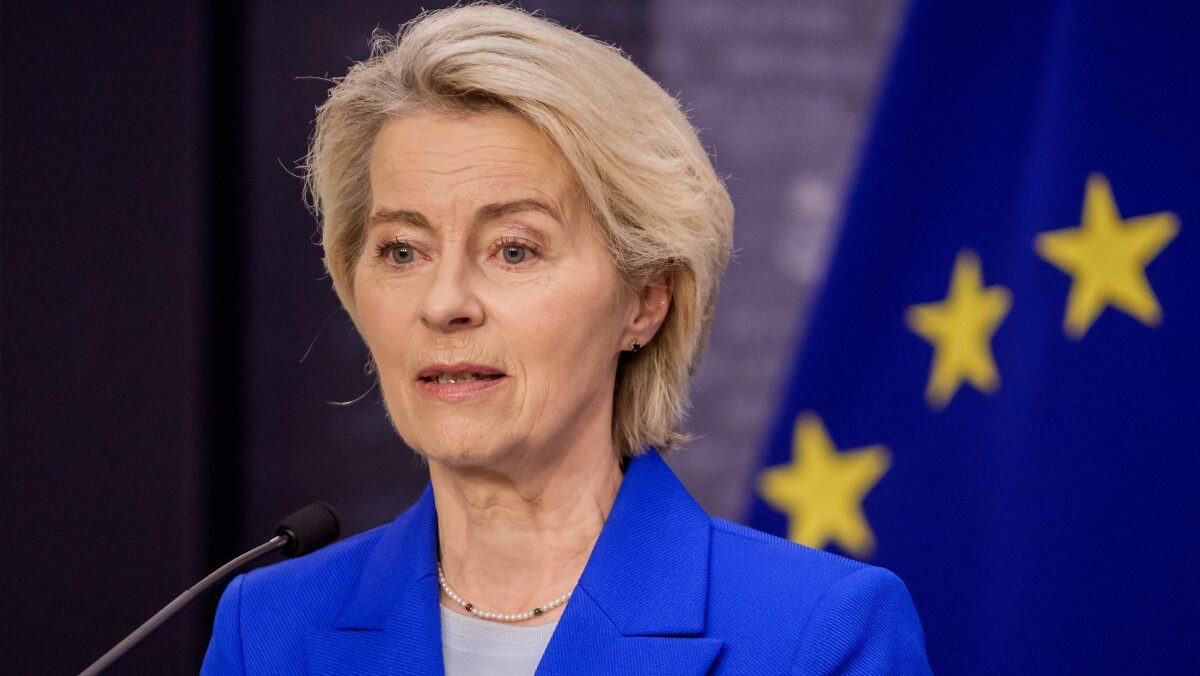
European Commission President Ursula von der Leyen speaks during a joint press conference with the Latvian Prime Minister in Riga, Latvia on August 29, 2025.
Gints Ivuskans / AFP
Europe’s leaders are once again struggling to present a united front on Ukraine, with conflicting messages about potential troop deployments exposing deep divisions across the continent.
European Commission President Ursula von der Leyen insisted at the weekend that the EU and its partners were working on “pretty precise plans” for a multinational deployment to Ukraine once a peace deal is signed.
She told the Financial Times that “security guarantees are paramount and absolutely crucial” and that European capitals already had “a clear road map” with U.S. backing. “President Trump reassured us that there will be [an] American presence as part of the backstop,” she said.
Yet German Chancellor Friedrich Merz told German television that “nobody is talking about ground troops in Ukraine at this point,” stressing that Kyiv’s best security guarantee was a strong national army.
The mixed messaging is symptomatic of Europe’s struggle to agree on a coherent strategy.
While France prepares to host a summit in Paris on Thursday—co-chaired by Emmanuel Macron and Britain’s Keir Starmer, and attended by Ukrainian president Volodymyr Zelensky—officials are still divided over how far Europe can and should go.
The Élysée says leaders will discuss “security guarantees” for Ukraine and review Russia’s refusal to negotiate, but the agenda ranges from diplomacy to financial pledges to vague talk of peacekeeping forces.
Von der Leyen has been travelling through eastern Europe, urging higher defence spending and insisting on the urgency of preparations. “It’s moving forward. It’s really taking shape,” she said.
But many in Europe remain unconvinced, not least because the continent lacks both the manpower and the political will to deploy “tens of thousands” of troops, as Brussels has hinted.
Public appetite for war is low, recruitment numbers are falling, and governments are already struggling to meet NATO readiness commitments.
For some, such as Poland and the Baltic states, Russia is an immediate threat requiring firm deterrence. For others, including Germany, the idea of sending soldiers to Ukraine remains politically toxic.
The United States, meanwhile, has been pushing ahead with direct diplomacy. Donald Trump met his Russian counterpart, Vladimir Putin, in Alaska last month, an encounter that produced no breakthrough but underscored Washington’s role as the only actor capable of engaging both sides.
Days later, Trump hosted Volodymyr Zelensky and senior European leaders at the White House to press for a framework that could lead to peace. He has made clear that while the U.S. will provide intelligence and technological support, American troops will not set foot in Ukraine.