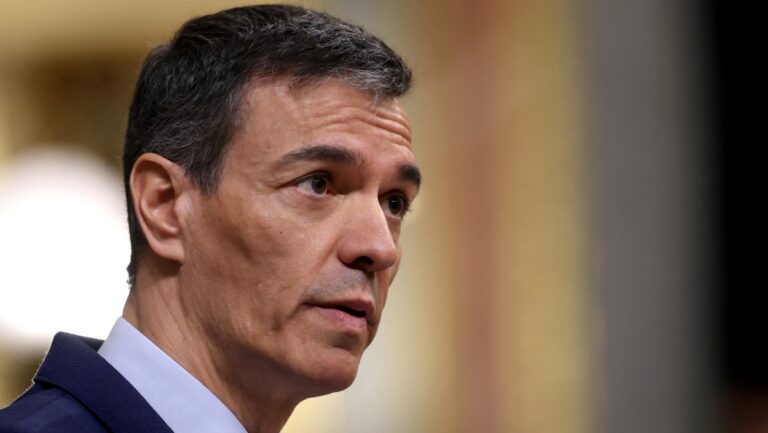
Sahra Wagenknecht
Ronny HARTMANN / AFP
A vote-counting blunder in the mayoral run-off in Mülheim an der Ruhr has reignited debate over the reliability of German elections, prompting the Bündnis Sahra Wagenknecht (BSW), a left-wing nationalist party, to demand a nationwide recount of February’s Bundestag vote—a move that could strip Chancellor Friedrich Merz of his majority.
In Mülheim, an initial declaration of victory for Social Democrat (SPD) challenger Nadia Khalaf was overturned when officials discovered that votes had been misattributed between the candidates. The corrected tally handed victory back to incumbent Marc Buchholz of the centre-right CDU.
The incident has put the spotlight back on February’s national elections, whose results the left-wing nationalist BSW wants to contest.
In February’s federal election, the BSW fell just short of the 5% threshold required to enter the Bundestag, missing it by just 9,529 votes and finishing on 4.98%. Had it crossed the line, it would have won enough seats to deny Chancellor Friedrich Merz’s CDU/CSU–SPD coalition its majority, forcing him to bring the Greens into government as well.
The incident raises the question: if in a city of around 170,000 people, vote counts were mixed up so badly that the outcome changed entirely, how reliable are election results elsewhere?
In a recent article, political scientists Eckhard Jesse and Uwe Wagschal argued that there were “indications that speak for a different result” in the Bundestag elections.
They cited miscounts, invalid ballots, and potential confusion with the similarly named Bündnis Deutschland, which appeared next to the BSW on ballot papers. In some districts, the smaller Bündnis Deutschland outpolled Wagenknecht’s movement, despite being far smaller nationwide, with barely a fraction of BSW’s support.
Even partial recounts have added votes for the BSW. Between the preliminary and final results, more than 4,000 extra ballots were attributed to the party—more than any other. Such patterns were found in 145 constituencies in which the small Bündnis Deutschland outpolled the far larger BSW, an outcome many analysts suspect was due to voter confusion.
Sahra Wagenknecht has seized on the academics’ criticism of the federal result:
Friedrich Merz is very probably not a democratically legitimate chancellor. … It cannot be that a party is denied entry to the Bundestag which was in fact chosen by more than five per cent of voters. This is not just about the BSW, but about a fundamental question of democracy.
Friedrich #Merz ist sehr wahrscheinlich kein demokratisch legitimierter Kanzler. Es gab bei der Bundestagswahl belegbar systematische Zählfehler und Unregelmäßigkeiten zulasten des #BSW. Allein durch Überprüfung eines verschwindend geringen Bruchteils der Wahllokale wurden… pic.twitter.com/mZzgznswv5
— Sahra Wagenknecht (@SWagenknecht) September 25, 2025
Her party colleague Fabio De Masi called on the Bundestag to instruct the state returning officers to provide information on how many polling districts were recounted or whether other corrections were made between the provisional and final result—and why. The fact that this data has not yet been made available is “constitutionally extremely questionable,” he said.
The Bundestag’s election review committee, which only began work in June, has received over 1,000 complaints, including one from the BSW. It has pledged to treat the case with priority, but if the committee rejects the challenge, Wagenknecht has vowed to take the matter to the constitutional court.
The outcome could have seismic consequences. A recount admitting the BSW would not only strip the government of its majority but also force Merz into a coalition with the Greens, shifting his agenda sharply to the Left.