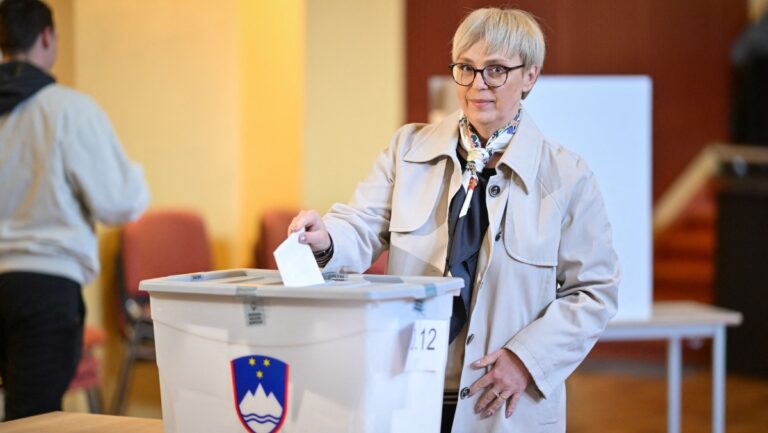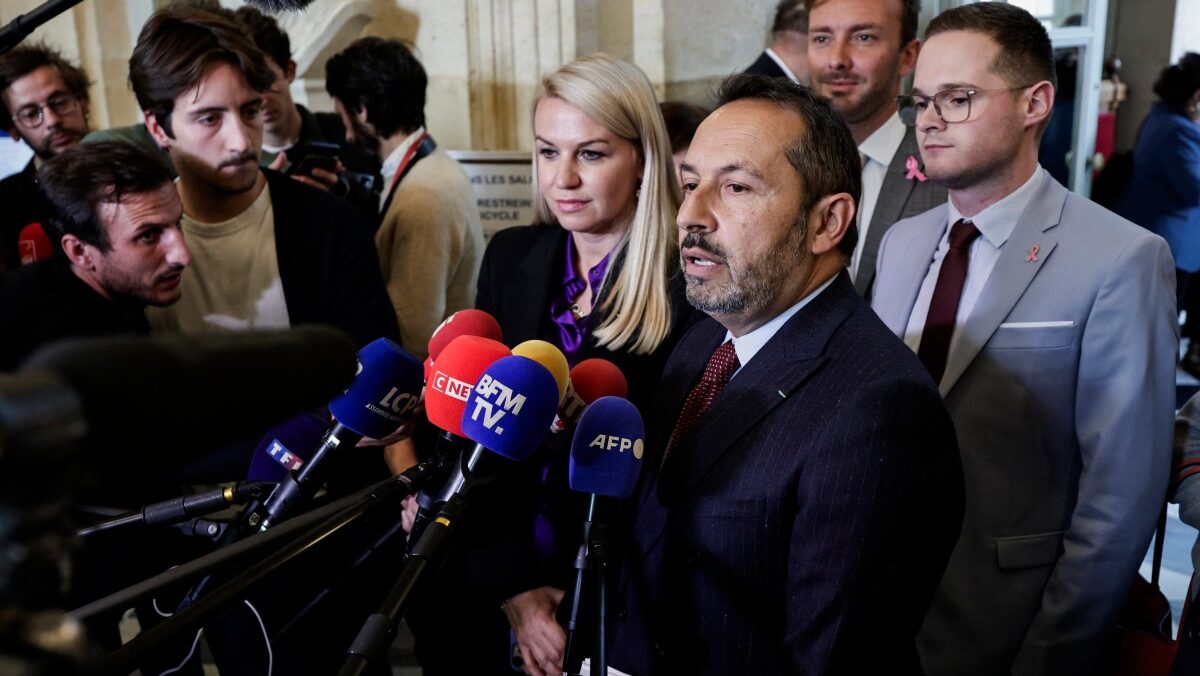
Newly elected Vice-President of the National Assembly Rassemblement National’s MP Hélène Laporte and Rassemblement National’s MP Sébastien Chenu speak to the press following the elections for members of the National Assembly office and committee chairmen, at the National Assembly, France’s lower house parliament, in Paris on October 1, 2025.
Stephane de Sakutin / AFP
At the beginning of October, the opening of the new session of the French National Assembly was accompanied by a series of votes to determine the key roles for parliamentary debate. After being excluded from administrative positions for a year, the Rassemblement National (RN) is making a comeback—and the Left is losing ground.
On Wednesday October 1st, elections were held for the members of the National Assembly’s bureau. Six vice-presidents and three questeurs, in charge of financial administration, were elected following an amicable agreement between the Right and the Centre, which allowed the RN to recover two of the six vice-presidential posts. For the president of the assembly, Yaël Braun-Pivet, of the Renaissance party, it was important that the parliament’s executive bureau reflect the plurality of the Assembly’s political landscape. It was therefore her priority to end the exclusion of the RN from leadership positions, which had been made possible last year by an agreement between the Left and the Centre. RN MPs Sébastien Chenu and Hélène Laporte were elected alongside two MPs from La France Insoumise (LFI) and two centrist MPs.
On Thursday October 2nd, it was the turn of the secretaries and committee chairmen to be appointed.
The RN obtained two secretaries, and its ally, the Union of the Rights for the Republic (UDR), obtained one. In total, including the vice-presidents, the RN and its allies obtained five representatives in the bureau, out of a total of 21 positions. The Left, which until then had held the majority of positions in the bureau, retained only seven.
The committee chairmanships are also key positions, as it is within these small committees that all the preparatory work for the examination of laws in plenary session is carried out. The election of the eight committee chairmen also marks a clear decline for the Left.
While the RN failed to win any committee chairmanships, the Republican Right group (comprising members of the Les Républicains party) won three committees. Of particular note is the election of Alexandre Portier as chair of the education committee. Portier distinguished himself a few months ago with his assumed conservative positions within the ministry of national education—before being dismissed.
Of the eight chairmanships, the Left retained only that of the finance committee—a position traditionally held by the opposition and until now held by La France Insoumise (LFI) MP Eric Coquerel, who was reappointed.
At the end of these two days of voting, anger remains high among the Left, who feel betrayed by the presidential camp—a camp that chose to ensure the election of RN representatives rather than maintain a ‘republican front.’ It remains to be seen whether this new balance of power will also be at work in the government’s choices—when France happens to get one, at last.