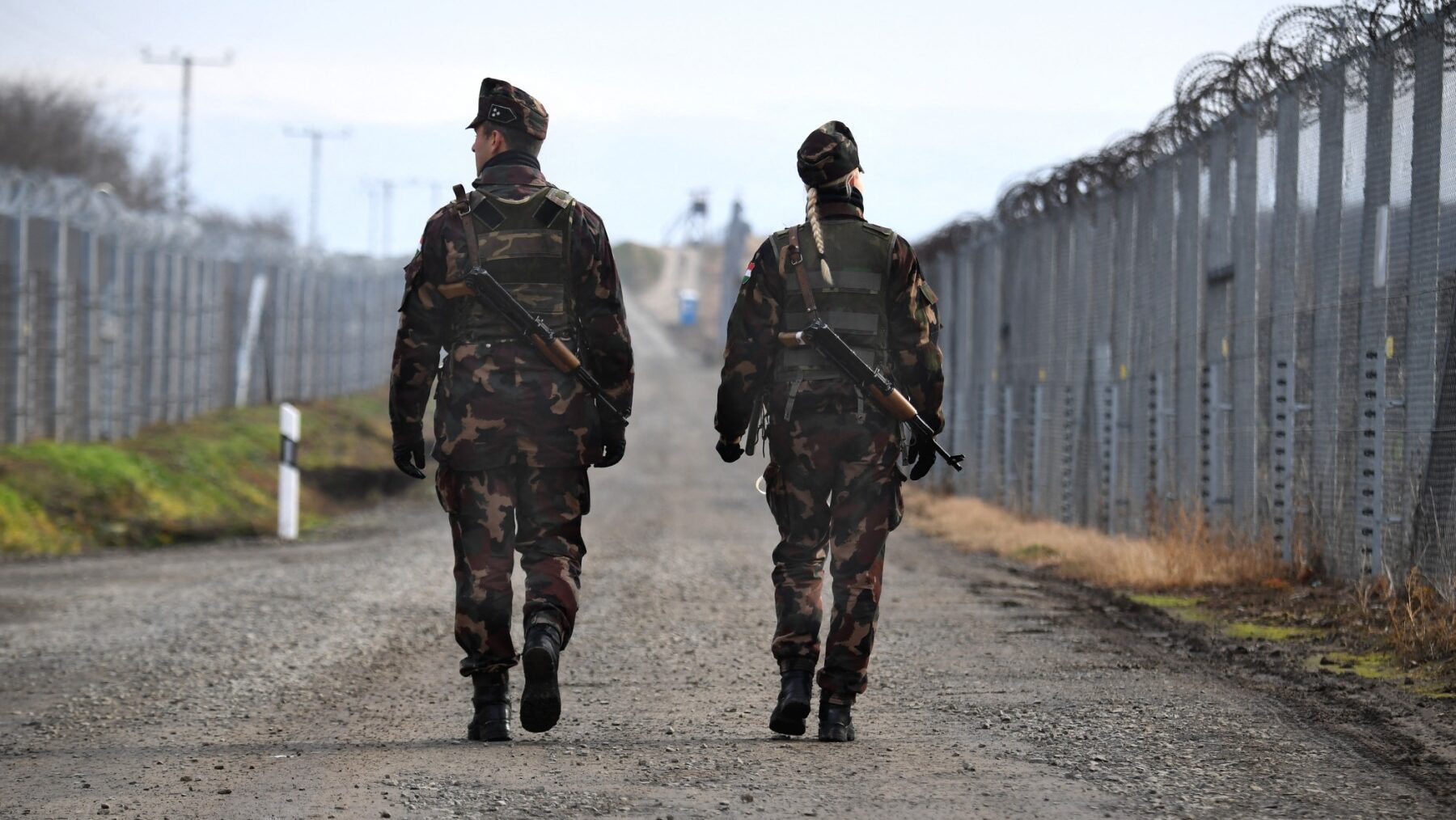
Border soldiers patrol along the border fence at the Hungarian-Serbian border near Hercegszanto border station on December 14, 2017. Since July 2015 Hungary secured the more than 300-km-long border to Serbia with the construction of a fence and 24 hours a day security patrol tasks. Several thousand soldiers participate in search and sweep operations securing the surveillance of the area with UAVs and rotary-wing aircraft.
Photo: Attila Kisbenedek / AFP
The so-called center-right forces within the European People’s Party (EPP) must be seriously afraid of the rise of their national conservative competition, because a leaked draft resolution on migration at the party’s Vienna congress is unlike anything we’ve seen before from Brussels’ dominant political force.
The document, introduced by Spain’s Partido Popular—the group’s second largest member party—outlines several migration policy proposals that until now were mostly championed by national conservative groups. Most of these ideas were previously blocked from the EU’s Migration Pact because the EPP prioritized keeping its traditional alliances with left-leaning parties.
Most strikingly, the document demands the same asylum and entry procedure that Hungary has already unilaterally implemented on its border. This is despite the fact that the European Commission imposed unprecedented fines on the country for adopting the measure.
Judging by the paper alone, it seems that Brussels’ largest group, which de facto controls all three EU major institutions (the Commission, the Parliament, and the Council), is ready for a real migration U-turn. But this move is driven by political strategy, not a real desire to fix the migration crisis. The EPP simply wants to claim the anti-migration stance from the Patriots before all their voters defect, as is already happening in Germany and Austria.
Also, given the EPP’s track record in betraying its voters, it’s wise to remain skeptical until these proposals are actually adopted and implemented.
The toughest proposals in the draft resolution involve disincentivizing illegal migration by processing asylum requests outside of the EU’s borders. To achieve this, the document calls for several major reforms to the EU asylum system. Giorgia Meloni’s ECR or the Patriots for Europe groups had already previously proposed these, yet, at the time, the EPP only scoffed.
The most striking example is the call to ban entry into the EU from safe third countries unless asylum has already been granted. As the resolution argues:
Illegal migrants from non-European countries should, as a rule, have their asylum claims processed in a safe third country, outside of the European Union. This will decrease incentives for illegal migration.
In practice, this would be a carbon copy of what Hungary implemented years ago on its border with Serbia. This required migrants to submit their asylum requests at any Hungarian embassy or consulate and wait for approval outside.
This approach—despite being enshrined in law by the Hungarian parliament, and being in line with member state obligations to protect the integrity of the external borders— prompted the European Commission to impose an unprecedented €200 million fine on Budapest as well as an additional €1 million per day until the law is revoked. By now, the total figure has grown to about €420 million.
Yet, now the EPP is not only endorsing this policy, it is going even further. The draft resolution wants to expand the “safe third country” concept by “abolishing the so-called connection criterion,” which would facilitate deportations to countries that are neither the migrants’ countries of origin, nor countries where they have personal connections.
Another major point in the EPP resolution is the explicit support for establishing offshore “reception centers” outside of EU soil—where illegal migrants intercepted at sea can stay while their asylum requests are processed. This would make sure that rejected asylum seekers cannot escape deportation by disappearing in the EU.
If this sounds familiar, it’s because this is the so-called Albania protocol established by Giorgia Meloni’s conservative Italian government. Its implementation has been sabotaged by leftist judges four times in a row, who forced Rome to use its two facilities in Albania merely as deportation centers until the EU Court of Justice decides on the legality of their original purpose.
The resolution has several other proposals that have been controversial in Brussels until now and regularly rejected by the left-leaning ‘Ursula coalition,’ headed by the EPP. For instance, the document calls for the “full utilization” of EU funds to help frontline countries secure their external borders with additional patrols, drones, and satellites. There is no explicit mention of physical barriers, but the idea is that paying for technical support makes wiggle room in national budgets for countries to build border walls on their own.
The paper also calls for diplomatic pressure on third countries that refuse to accept their deported citizens, explicitly suggesting the withdrawal of international aid and development funds, and even suspending existing visa agreements.
These proposals, if adopted by the Valencia congress as official EPP policy, are definitely a major step in the right direction. However, as stated above, there’s nothing to indicate that the EPP has suddenly begun to take Europeans’ concerns about the migration crisis seriously; it’s much more likely that the goal is preserving their spot at the top of the Brussels hierarchy.
At least the EPP has finally recognized that mass migration is the biggest topic in Europe, and that voters can no longer be gaslit with endless accusations of racism and Islamophobia, nor sidelined with empty promises.
Still, this doesn’t mean that the ‘center-right’ suddenly deserves Europeans’ trust and votes; quite the contrary. The EPP would likely never have reached these conclusions without their power being challenged by national conservative groups, particularly the Patriots, which has risen to become the third largest bloc in Brussels.
This U-turn, if it does translate to real change, will have been made possible by having a strong opposition in the European Parliament. Even under undemocratic cordons sanitaires both in Brussels and their capitals, the Patriots showed that with a strong enough popular mandate, you can influence politics from opposition, and therefore they need even more support to keep those on top in check.