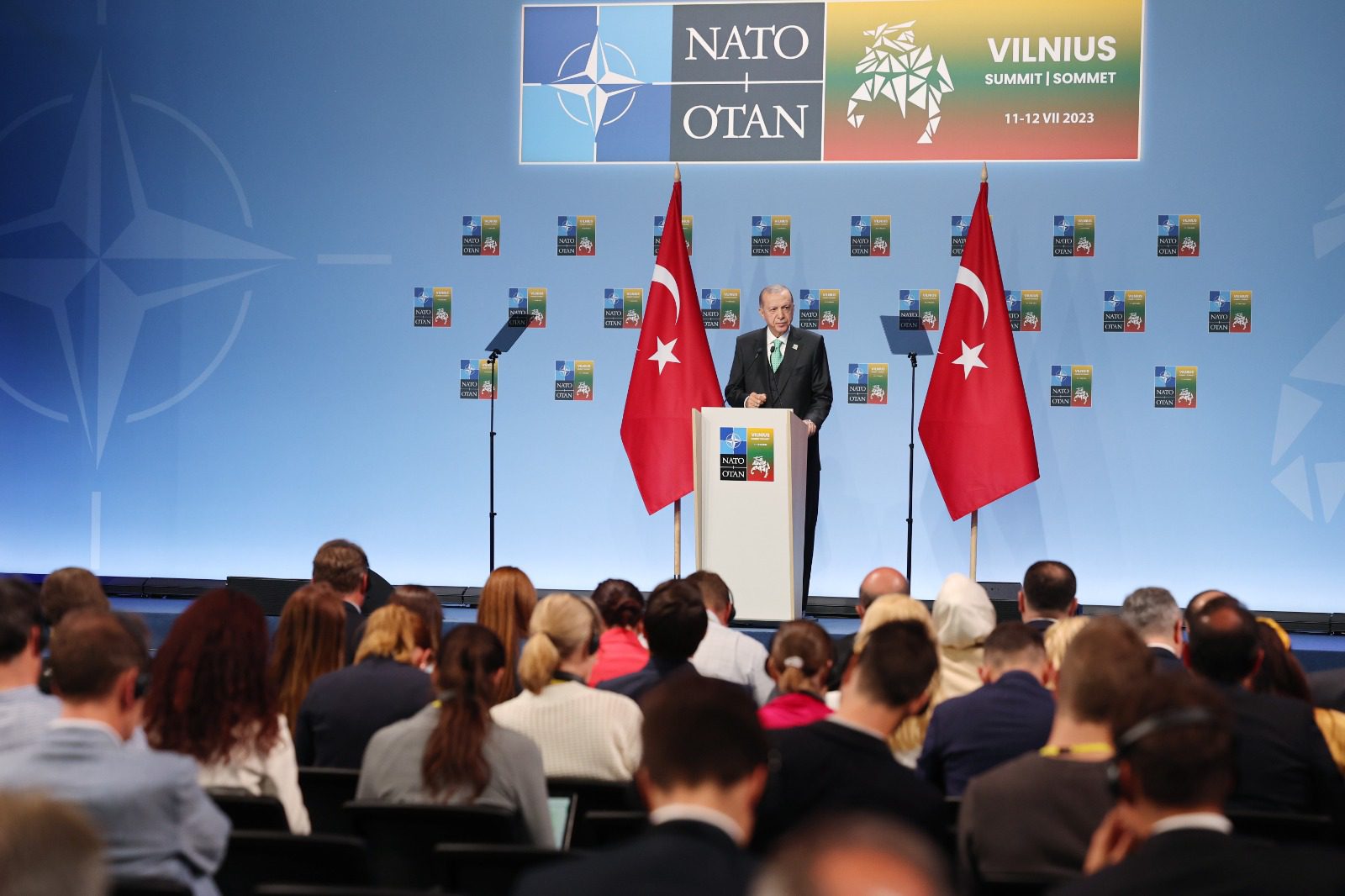
Turkish President Recep Tayyip Erdoğan giving a post-summit press conference in Vilnius, July 12th.
Ankara and Stockholm finally reached an agreement on lifting the Turkish veto on Sweden’s NATO accession bid but the Turkish Parliament will not ratify the application until the end of its summer recess, President Erdoğan said at a press conference on Wednesday, July 12th. Erdoğan clarified that, in the meantime, Sweden still has to implement the ‘extra requirements’ that are now driving a wedge between members of the government coalition, since the deal struck between Turkey and Sweden was agreed upon by the moderate PM Kristerssen—without the consent of the conservative Sweden Democrats (SD).
There was much rejoicing when President Erdoğan announced his support for Sweden’s NATO membership bid on Monday, ahead of the two-day NATO summit in Vilnius, suggesting that parliamentary ratification is imminent. But at his after-summit press conference, Erdoğan casually dropped an important caveat: the Parliament is at recess until October 1st.
“The parliament is not in session for the upcoming two months,” the Turkish President said, “but our target is to finalize the matter as swiftly as possible.” The unspoken target, of course, is to keep milking the Swedes for political concessions as long as it can.
We already knew that Turkey submitted extra requests in exchange for ratification and that Swedish Prime Minister Ulf Kristerssen agreed to them during the two’s meeting this week, but Erdoğan also made clear during the press conference that Ankara fully intends to follow through with their implementation as well before granting the final ‘yes.’
These newer requirements include Sweden’s support for Turkey’s EU accession bid, and deepening the two countries’ counter-terrorism cooperation, especially against PKK and related organizations.
Before any ratification can happen, Erdoğan noted, Sweden will have to finalize its detailed, 17-point roadmap on how to achieve all of these, as well as reach an agreement on a joint Turkish-Swedish action plan for the future with the Turkish Parliament.
“A bilateral security mechanism will be established at the ministerial level and we will increase our cooperation … against the terrorist organizations,” Erdoğan said. “At the same time, Sweden will actively support the Republic of Turkey in the update of the customs union, visa liberalization, and the membership process of Turkey to the European Union.”
Furthermore, Ankara requires Stockholm to take concrete steps against Islamophobia—even if that means encroaching on the Swedes’ precious freedom of expression—including pro-Kurdish demonstrations linked to PKK as well as the controversial Quran burnings, which Erdoğan called a “barbaric form of terrorism,” adding that Turkey “will not accept such insults against over two billion Muslims.”
The fact that the moderate Swedish prime minister accepted these terms without consulting with his conservative coalition partners understandably raised some eyebrows in Stockholm. According to Aron Emilson, the Sweden Democrat chairman of the government’s foreign affairs committee, the agreement between Kristersson and Erdoğan needs a thorough second assessment before going any further.
“There are parts that the SD and the government have not discussed. It is important that we do so when the agreement is to be specified,” Emilson said. “Among other things, I am thinking about how Sweden should be a voice for a possible future Turkish EU membership. SD’s view is known before and we look critically at a Turkish-EU connection.”
Emilson noted that Sweden Democrats expect concrete answers on how the moderates intend to fulfill Turkey’s requests. He then added that since it is the largest of the two coalition partners, SD has “no reason to believe that [the Moderates] would not deepen their view on how this will work in practice.”