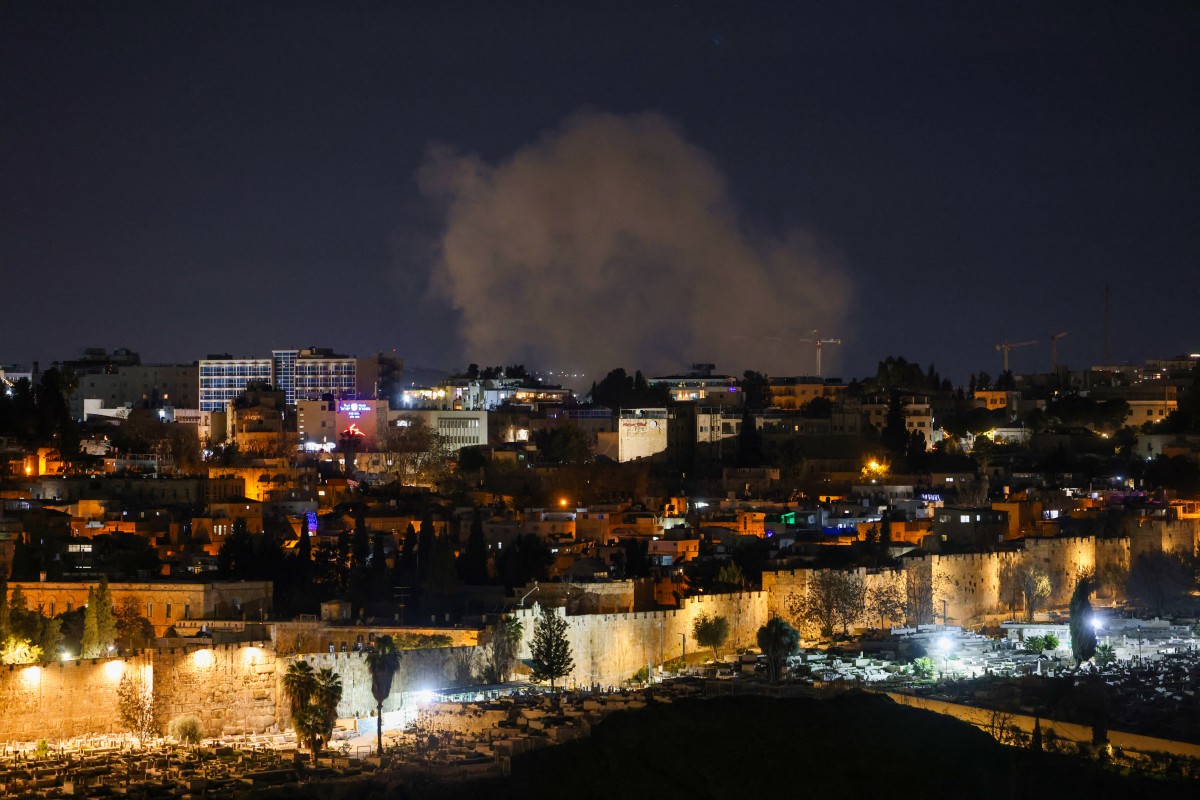
Smoke rises from an explosion during interception over Jerusalem on March 1, 2026
HAZEM BADER / AFP
The Middle East has entered a new and volatile phase following the joint U.S.-Israeli strikes on Iran and the killing of Supreme Leader Ali Khamenei.
In response, Iran has launched missile and drone attacks across the region. The United Arab Emirates’ defence ministry reported it had “dealt with” 165 incoming ballistic missiles, two cruise missiles, and 541 Iranian drones. In Bahrain, explosions and sirens were reported, with at least two hits near the airport.
Since the conflict began, Iran appears to have expanded its target set from military sites, such as the U.S. Navy’s Fifth Fleet headquarters in Bahrain, to airports and other civilian sites. Iranian foreign minister Abbas Aragchi denied targeting neighbouring Gulf states, telling Al Jazeera that Iran was targeting the presence of the United States in those countries.
Saudi Arabia condemned what it described as blatant and cowardly Iranian attacks targeting the Riyadh Region and the Eastern Province, which it said were successfully intercepted. In Oman, a drone strike hit the commercial port of Duqm.
On March 1st, an oil tanker sailing under the flag of Palau was struck near Oman’s Musandam Peninsula, injuring four people. Authorities warned nearby ships to avoid the area. This marked the first time targets in or near Oman had been hit following Tehran’s retaliatory strikes on Persian Gulf states.
Iran’s Revolutionary Guards also announced missile strikes on Tel Aviv, Haifa, and east Jerusalem, including the targeted strike on a government complex in Tel Aviv and attacks on military and security centres in Haifa. They said Kheibar ballistic missiles were used.
Hezbollah, the Shi’ite group established by Iran’s Revolutionary Guards in 1982, launched rockets and drones against Israel, saying it was avenging “the pure blood” of Khamenei. Israeli Chief of the General Staff Eyal Zamir said Hezbollah had opened a campaign against Israel and was fully responsible for any escalation, warning of prolonged combat.
President Trump said the military operation would continue “until all of our objectives are achieved,” adding that it can “take four weeks or less.” Israeli prime minister Netanyahu said Israel’s strikes on Iran “will increase even more in the coming days.”
UK Prime Minister Keir Starmer confirmed that Britain accepted a U.S. request to use British bases for defensive strikes against Iranian missiles in storage depots or launchers.
Starmer emphasized that the United Kingdom did not take part in the joint U.S.—Israeli airstrikes on Iran on Saturday and added that Britain would not participate in any offensive strikes. However, he stated that Iran had responded with sustained attacks across the region, with missiles striking airports and hotels where British nationals were present.
In Vienna, the International Atomic Energy Agency convened an extraordinary meeting on Iran, stating it was closely monitoring developments and urging restraint to avoid nuclear safety risks.