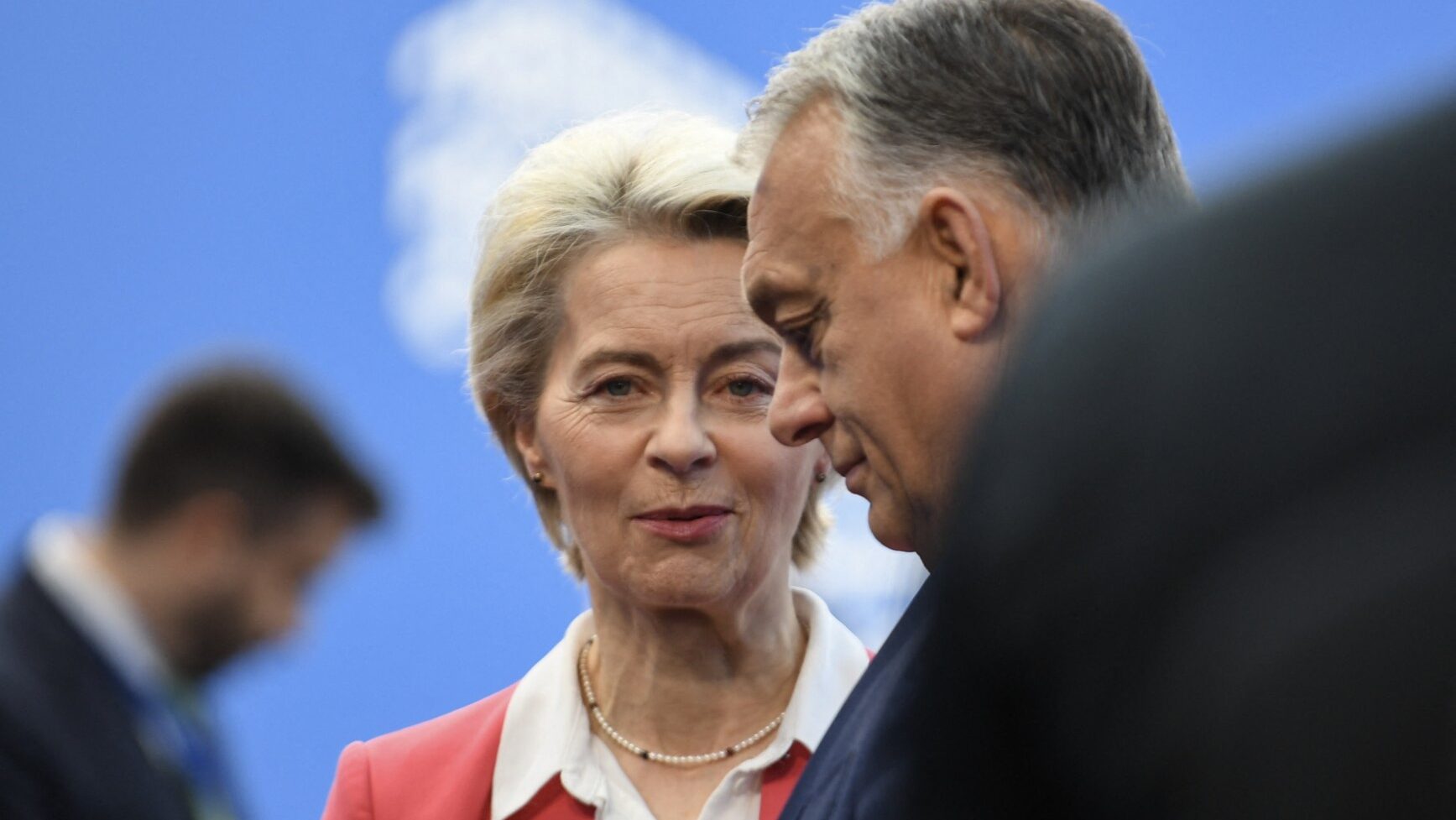
President of the European Commission Ursula von der Leyen is greeted by Hungary’s Prime Minister Viktor Orban upon her arrival for the European Political Community Summit in Budapest, on November 7, 2024.
Ferenc ISZA / AFP
The European Commission has launched its newest attack against Hungary for what it describes as systemic non-compliance with EU media freedom rules designed to guarantee press independence and protect journalists and their sources. The action, initiated with a letter of formal notice, focuses on Hungary’s implementation of the European Media Freedom Act (EMFA) and the Audiovisual Media Services Directive (AVMSD).
EU countries were required to transpose the EMFA by August. Following the deadline, the Commission sent letters to several capitals, including Budapest, flagging shortcomings in implementation. Thursday’s infringement step indicates that the concerns were not resolved.
The Commission describes the EMFA as “a key piece of legislation to protect media freedom, independence and pluralism within the EU’s internal market.” According to the executive, Hungarian authorities interfere with the work of journalists and media outlets “by restricting their economic activities and editorial freedom.”
EU funded NGOs including Reporters Without Borders and Human Rights Watch have also joined the crusade against Budapest and echoed the concerns of Brussels. The Commission underlines that Hungary has not met EMFA requirements on transparency of media ownership, the assessment of market concentration, and the allocation of state advertising. Many believe that these requirements are based on Hungary’s non-favorable view of foreign funded media companies, which Budapest accuses of being a direct foreign interference into internal matters of the country.
As part of the same set of enforcement actions, the Commission has also opened a separate infringement procedure against Hungary over its continued use of the Energy Charter Treaty (ECT) to support investor-state claims within the EU, despite a binding European Court of Justice ruling. Brussels argues that Budapest is in “flagrant breach” of the 2021 “Komstroy” judgment.
Under this background procedure, the Commission says Hungary’s national oil company MOL sought to enforce an arbitration award against “an EU country” before a tribunal in a third country, and that a MOL-controlled company has recently launched a new legal action against another EU member state.
The first case appears to relate to MOL’s request that a U.S. tribunal order Croatia to pay a €222 million award linked to a cancelled investment previously found to involve bribery. Although the EU formally withdrew from the ECT in June, its 20-year sunset clause leaves room for continued claims until 2045.
For the media-related infringement, Hungary now has two months to respond to the Commission’s concerns. Should the reply prove unsatisfactory, the next steps could include a reasoned opinion and, ultimately, referral to the Court of Justice of the European Union, which has the authority to impose financial penalties. Last year, the Court fined Hungary €200 million for non-compliance with EU asylum rules.