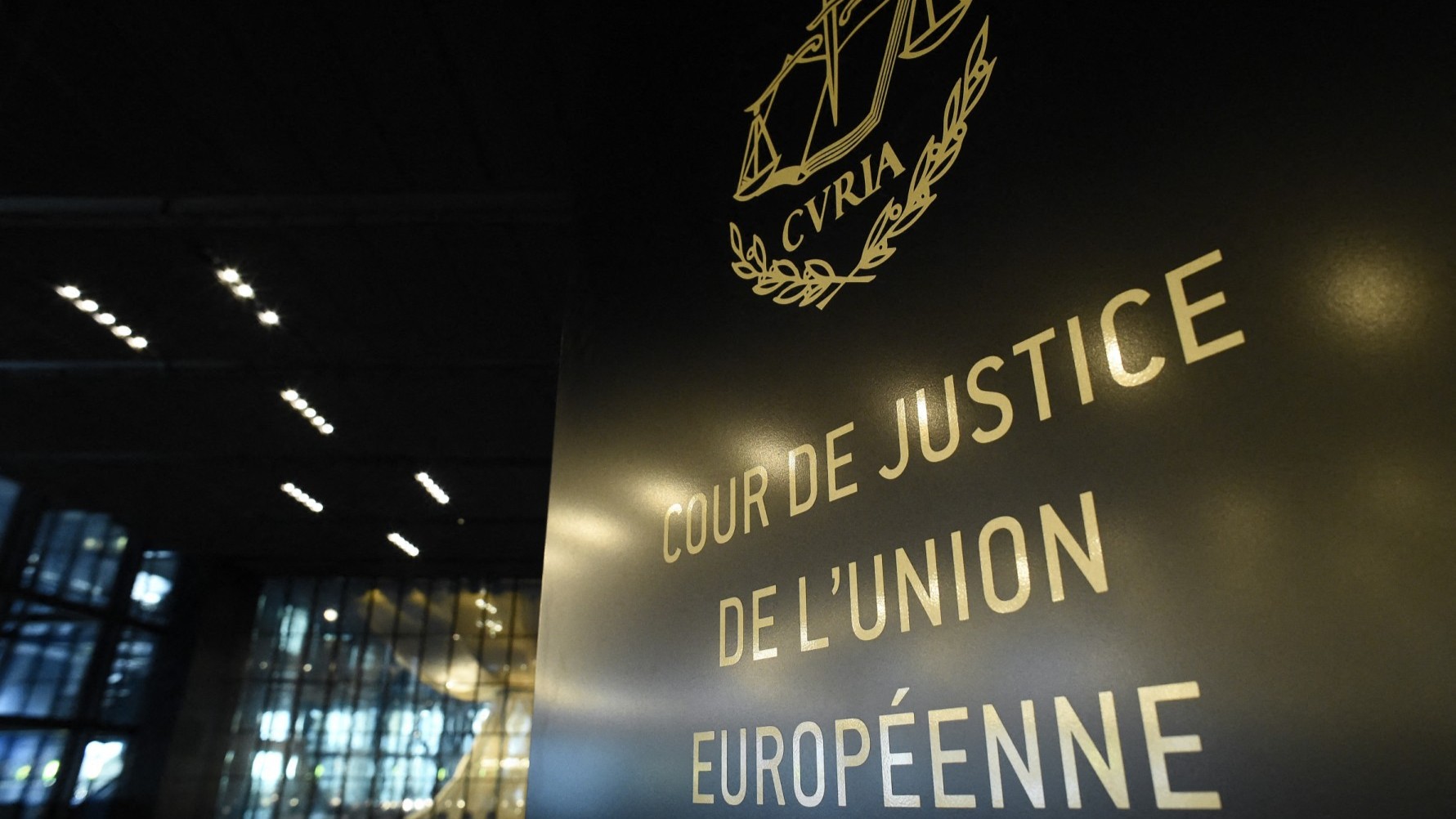
The sign of the Court of Justice of the European Union in Luxembourg
JOHN THYS / AFP
A fresh legal opinion from the EU’s top court has intensified accusations that Brussels is using financial and legal instruments to exert political pressure on Hungary, just weeks before the country heads to the polls.
On Thursday, February 12th, Advocate General Tamara Ćapeta advised the Court of Justice of the European Union (CJEU) to annul the European Commission’s 2023 decision to release around €10 billion in EU funds to Hungary, arguing that the move lacked sufficient justification and that reforms were not yet “effectively being applied.”
While the opinion is non-binding, it sets the tone for the court’s ruling, which is due in coming months.
The case was brought by the European Parliament, which accuses the Commission of unlawfully releasing funds in December 2023, allegedly in exchange for Prime Minister Viktor Orbán lifting his veto on opening EU accession talks with Ukraine.
However, then-Justice Commissioner Didier Reynders acknowledged that Hungary had implemented all the required judicial reforms, and the Commission had no other options but to hold up its end of the bargain.
Sources close to the EU executive noted that Hungary had created an independent integrity authority, reformed judicial procedures, and strengthened internal control mechanisms.
Despite this, the European Parliament (EP) launched legal action against the Commission in March 2024, a move that many in Budapest interpret as an attempt to keep funds away from Hungary regardless of compliance—using EU funds as a political weapon against a member state that does not comply with the Brussels elite’s progressive ‘values.’
“The script never changes in Brussels,” said Balázs Orbán, the Hungarian prime minister’s political director, reacting to Thursday’s announcement.
The moment a Member State steps off the European elite script, the legal machinery whirs into action. Hungary rejects the political rush to admit Ukraine, and legal pressure follows. Let’s not forget—this is the same Court that fined Hungary €1 million per day for protecting the EU’s external borders against illegal migration. Hungary will not be pressured into decisions that harm Hungarian families. A Brussels-aligned government might fall in line. We won’t. Sovereignty means the right—and the resolve—to say no.
Brussels continues to withhold more than €18 billion in additional funds, citing concerns over corruption, migration policy, academic freedom, and LGBT legislation. Hungarian officials maintain that these issues reflect ideological demands rather than legal deficiencies.
Critics also point to double standards. After Donald Tusk’s liberal government took power in Poland in 2023 and replaced the conservative PiS cabinet, more than €100 billion in previously frozen EU funds were swiftly released, despite Warsaw implementing few concrete reforms.
The timing of the CJEU’s case is also curious: Hungary will hold parliamentary elections on April 12th, and establishment forces in Brussels and in Western Europe are clearly rooting for Viktor Orbán’s main rival, Péter Magyar’s Tisza Party, which belongs to the Europhile European People’s Party in the EP.
In April last year, Tisza MEP Kinga Kollár said that withholding funds had “strengthened the opposition” by worsening living standards—comments that sparked outrage in Hungary.
Prime Minister Viktor ? Orbán has accused Brussels on several occasions of attempting to engineer a change of government, most recently on the Patrióta podcast.
The advocate general’s opinion has deepened scepticism in Hungary and beyond about whether the EU’s rule-of-law regime is still applied consistently—or has become a tool for enforcing political conformity within the bloc.