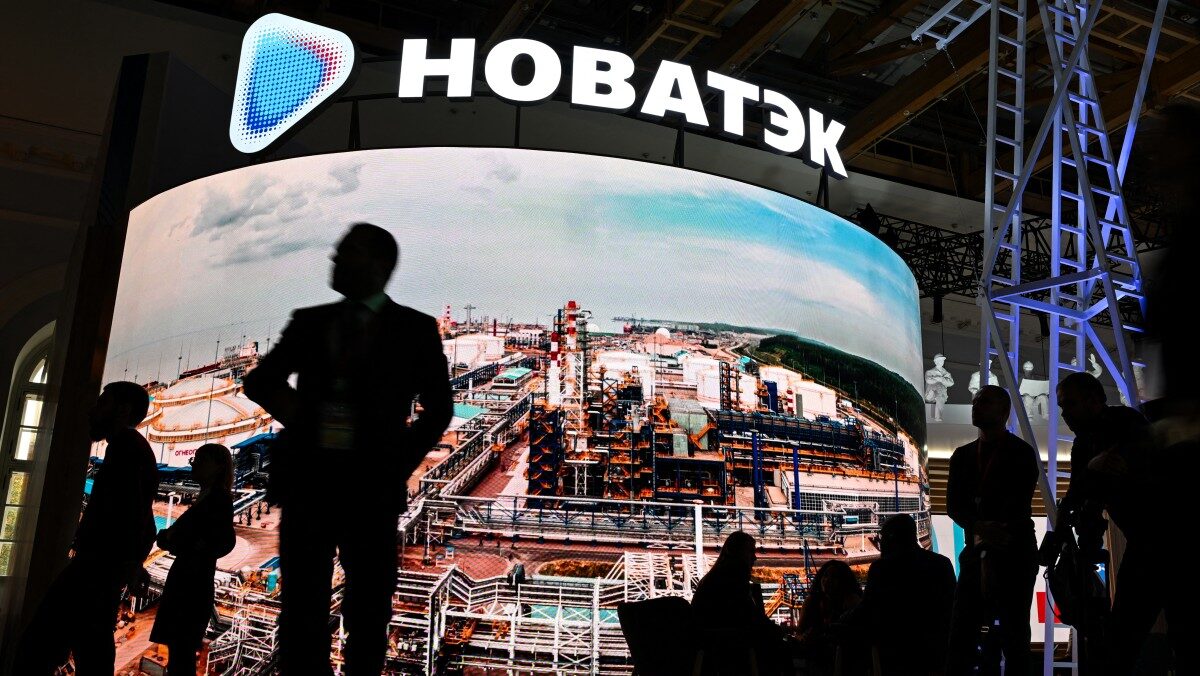
Russia’s liquefied natural gas producer Novatek at the Russian Energy Week forum in Moscow on October 16, 2025.
Olesya KURPYAYEVA / AFP
On Monday, the European Union finally did what it has been promising for years: it put an end date on Russian gas.
After nearly five years of delays, Brussels approved a law that will ban Russian gas from the EU market by 2027, turning a long-standing political pledge into a binding obligation. It is meant to draw a line under a period marked by grand declarations, half-measures and an energy dependence that never fully went away after Russia’s invasion of Ukraine in 2022.
The regulation was passed by a large majority, despite opposition from Hungary and Slovakia, and now leaves national governments with little room to manoeuvre. This time, the decision is not optional.
Before the war, Russia supplied more than 40% of the EU’s gas. By 2025, that share had fallen to around 13%. But even reduced, it still mattered—especially for Germany, whose industrial model was built on cheap energy.
That reality has resurfaced in Berlin. Chancellor Friedrich Merz recently suggested that some form of future re-engagement with Moscow could be considered over time, remarks that caused visible unease in Brussels and were quietly brushed aside by the Commission.
The timetable itself is blunt. Russian liquefied natural gas will be banned by the end of 2026. Pipeline gas will follow before 30 September 2027, with a short technical extension possible if a country struggles to fill storage ahead of winter.
New contracts are outlawed. Existing ones must be scrapped. Companies that fail to comply face fines of up to 3.5% of global turnover. On paper, it is a clean break. In reality, it is a risky one.
The biggest question is cost. Replacing Russian gas largely means buying more U.S. LNG, which industry estimates say can be up to 40% more expensive. That shift sits at the heart of the energy deal between Brussels and Washington, publicly backed by Commission president Ursula von der Leyen and pushed by European Parliament president Roberta Metsola.
The EU is cutting its reliance on Moscow only to take on a new, pricier dependence on the United States—at a time when political change in Washington adds uncertainty over both supply and prices.
Hungary and Slovakia, both of which have said they are prepared to challenge the law in the EU’s top court, see the decision as a warning sign. Brussels relied on energy and trade law to bypass national vetoes, signalling that it is willing to force compliance even if it deepens divisions inside the bloc. For the most exposed countries, the options are few and the costs higher.
Ending Russian gas marks a point of no return for European energy policy. It hardens the EU’s stance against Moscow and reinforces its alignment with Ukraine. But it also sharpens unresolved questions about competitiveness, economic sovereignty and who ultimately pays.
After years of hesitation, the EU has finally shut the door. What remains unclear is whether European voters are ready for the bill.