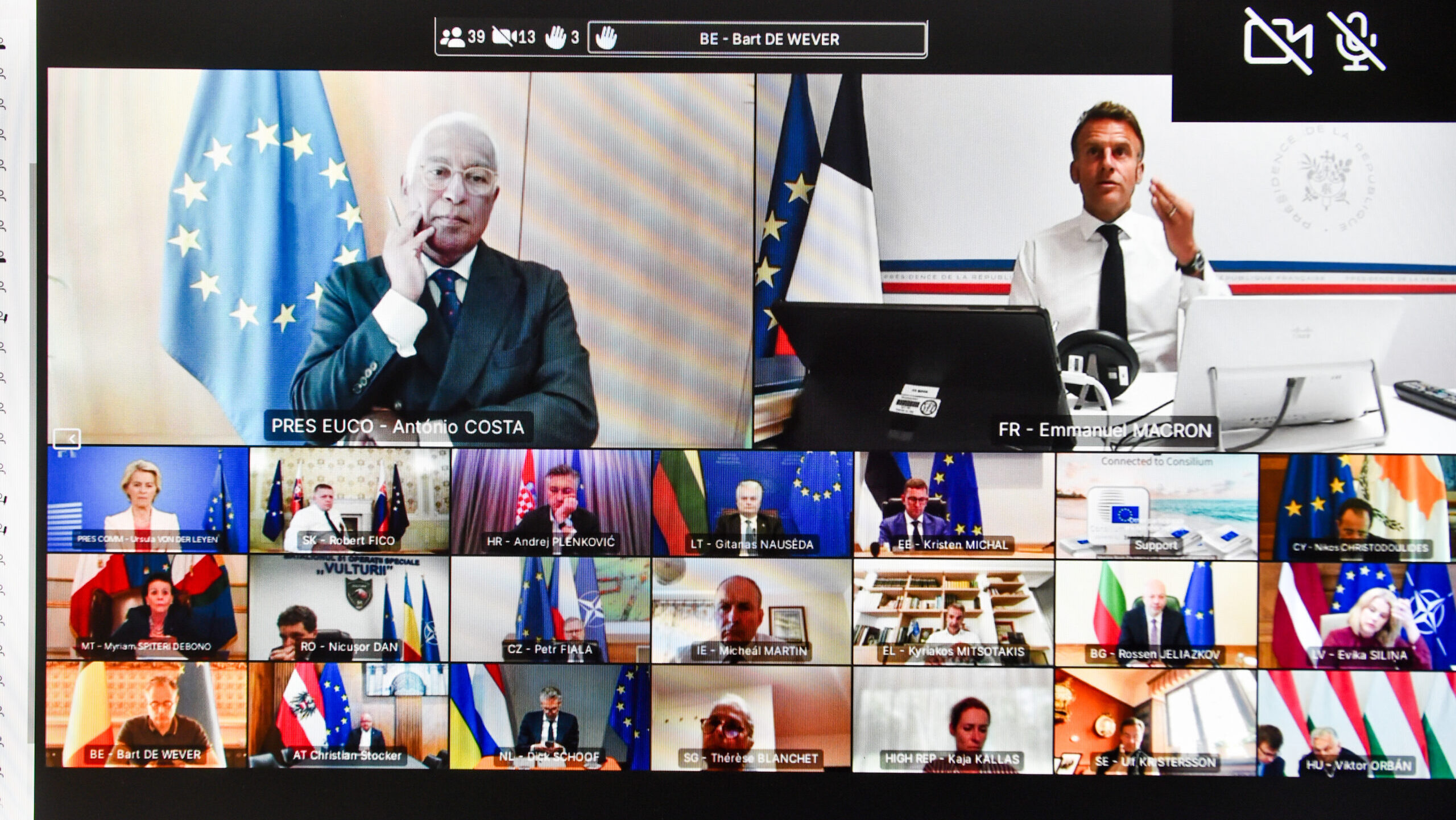
EU leaders’ virtual summit on Tuesday, August 19th
© European Union, 2025
Leaders of the 27 EU countries, as well as EU Council President António Costa, EU Commission President Ursula von der Leyen, and foreign affairs chief Kaja Kallas, held a virtual summit on Tuesday, August 19th, to discuss the next steps after Monday’s White House summit.
According to Costa, the primary objective of the meeting was to discuss possible scenarios for security guarantees offered to Ukraine within a potential peace deal that could emerge from the U.S.-led diplomatic initiative.
“Now is the time to accelerate our practical work to put in place a guarantee similar to NATO’s Article 5 with continued U.S. engagement,” Costa told EU leaders over the video call.
While Costa refers to NATO’s mutual defense clause, the actual level of protection in the minds of EU leaders remains unclear, with the discussion instead focusing on maintaining a strong Ukrainian military and providing additional EU peacekeepers.
According to officials familiar with the summit, European countries are hoping to draft a “skeleton framework”—a blueprint of potential security guarantees—over the next week before a follow-up call with Washington.
After a separate meeting of the ‘Coalition of the Willing,’ also on Tuesday, participating countries said that “planning teams” would meet their U.S. counterparts in the next few days to coordinate the process.
Although nothing substantial had been agreed on yet, a broad consensus seems to be emerging around three points: a well-equipped and well-armed Ukrainian army (paid for by European taxpayers); a multinational “reassurance force” on the ground, made up of European troops; and some form of U.S. backing, although details are very vague about this one.
President Trump was clear on Monday that he would commit neither more weapons—unless Europe pays for them—nor U.S. ground forces to the peacekeeping effort, but he’s open to a U.S. “presence” in Ukraine, which would “probably” entail air support.
While there is broad agreement about the idea of a peacekeeping force in Ukraine, there are few countries that seem to be willing to participate in the effort. So far, only France and the UK have indicated that they would be up for the task, while other relative heavyweights, such as Germany and Italy, have opted to stay silent on the issue. Poland, which has NATO’s third-largest military, now the largest one in Europe, has said it would rather keep its forces inside the country in fear of direct Russian aggression.
It’s more likely that instead of the “reassurance force” made up of tens of thousands of troops floated by the UK, the final peacekeeping contingent will be more like an “observer force,” made up of a few thousand troops at best, acting similarly to peacekeepers in Kosovo and Bosnia.
At the same time, Tuesday’s meeting was an important turning point in terms of Europeans finally acknowledging the reality, even if they wouldn’t say so in public, Hungarian PM Viktor Orbán suggested on X.
According to Orbán, the meeting confirmed that the EU’s “isolation-based” strategy against Russia has failed, and that Brussels now accepts that there is no solution to the war on the battlefield, but only through diplomatic talks, which Hungary has been treated as the enemy for saying since mid-2022.
That is also why Hungary will continue to keep its initiative for a Russia-Europe summit on the agenda. The country was also tapped as a potential host of a follow-up trilateral peace summit between Presidents Trump, Putin, and Zelensky.
Furthermore, the meeting also confirmed that EU membership does not provide any security guarantees in itself; “therefore, linking membership with security guarantees is unnecessary and dangerous,” Orbán wrote, hinting that Brussels may try to interlink the two issues to justify accelerating Ukraine’s accession process.
The leaders of the 27 member states of the European Union held a meeting today.
— Orbán Viktor (@PM_ViktorOrban) August 19, 2025
1. It has been confirmed that the danger of a third world war can only be reduced through a Trump-Putin meeting.
2. It has been confirmed that the isolation-based strategy has failed.
3. It has been… pic.twitter.com/iMMLPaaKCw