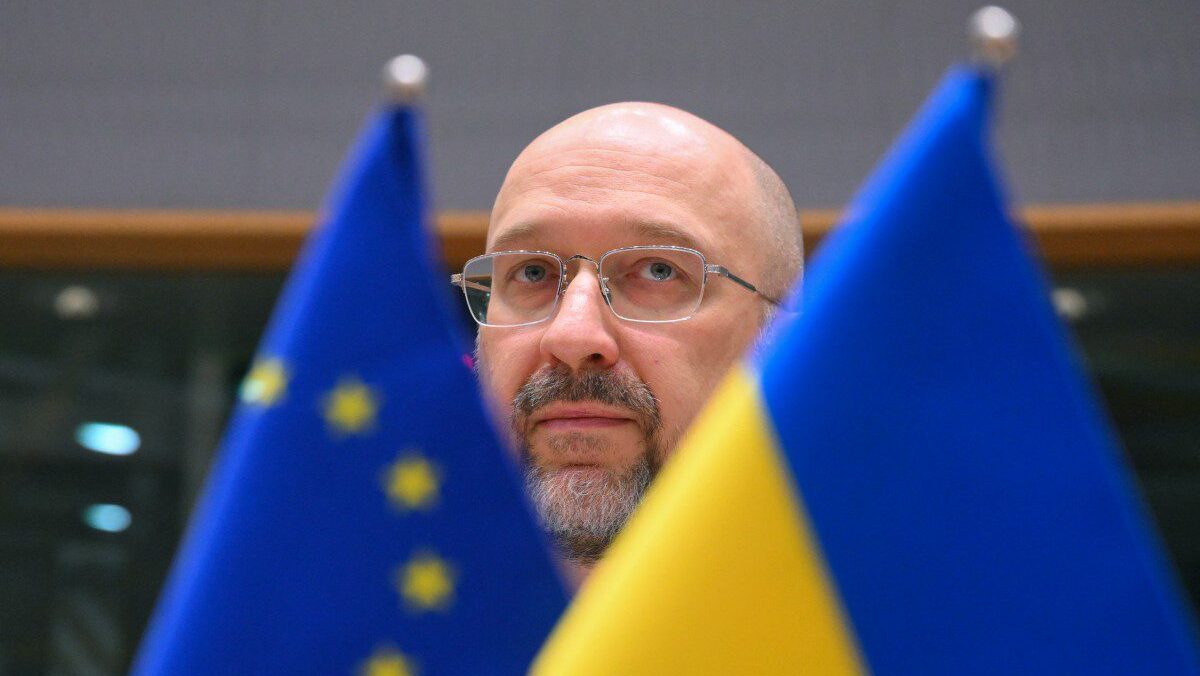
Ukraine’s Prime Minister Denys Shmyhal at the EU-Ukraine meeting with High Representative of the European Union for Foreign Affairs and Security Policy Josep Borrell and European Commissioner for Neighbourhood and Enlargement Olivér Várhely in Brussels.
Photo: JOHN THYS / AFP
As Ukraine’s Prime Minister Denys Shmyhal met with the EU’s top diplomat Josep Borrell on Wednesday to discuss his nation’s future EU membership, behind the scenes, Brussels insiders are tempering expectations.
While Borrell announced that the European Council would discuss “how to further speed up” Ukraine’s accession in their Thursday meeting, one EU official, speaking anonymously, told Politico,
Let’s be honest: nobody wants to talk about this before the European elections.
In the last couple of months, Eurocrats have been thrown into a state of panic as farmers entered into open revolt against their draconian environmental regulations and rising fuel costs—as well as cheap Ukrainian agricultural imports, which had greatly undercut the prices of EU farmers’ produce.
Given that making Ukraine a member of the bloc would automatically bring it into the common market, cheap Ukrainian foodstuffs flooding the EU could become an albatross around campaigning Brussels politicians’ necks once more.
“Talking about less subsidies for European farmers is not something you’d want to put on your campaign slogans—or give as electoral ammunition for the far right,” an anonymous official told Politico, using a term weaponized to discredit the legitimate political opposition of the agricultural community.
It is then no surprise that talk of EU enlargement—which would also include Moldova, Georgia, and six Western Balkan countries, has faded into the background. Already a month ago, Commission President Ursula von der Leyen told reporters about Ukraine’s accession:
We are still working on the negotiation framework. … My best guess is that it will not be ready before the European election.
Bringing war-battered Ukraine into the bloc would have broader implications. As an EU member, it would have one of the lowest GDPs, meaning it would need so-called ‘cohesion-funding’—a transfer of funds to the country from the richer regions.
An internal note from the Council of the EU last fall indicated that, under that scenario, an estimated €186 billion in EU funds would flow to the country over seven years.
Future enlargement would mean all current EU countries “will have to pay more and receive less,” the document added.
Ukraine’s future membership of NATO is even more in doubt.
While Ukraine’s foreign minister Dmytro Kuleba said on Tuesday that he was working to secure “a strong and far-reaching step” towards membership at the military alliance’s Washington summit in July, the U.S. ambassador to NATO, Julianne Smith, said last month that she does not expect the alliance to issue a membership invitation to Ukraine at that time.
A mutual assistance clause (Article 5) lies at the heart of the alliance and is viewed as the main reason why Ukraine cannot join NATO while in conflict with Russia, as this might immediately pull the alliance into the conflict.