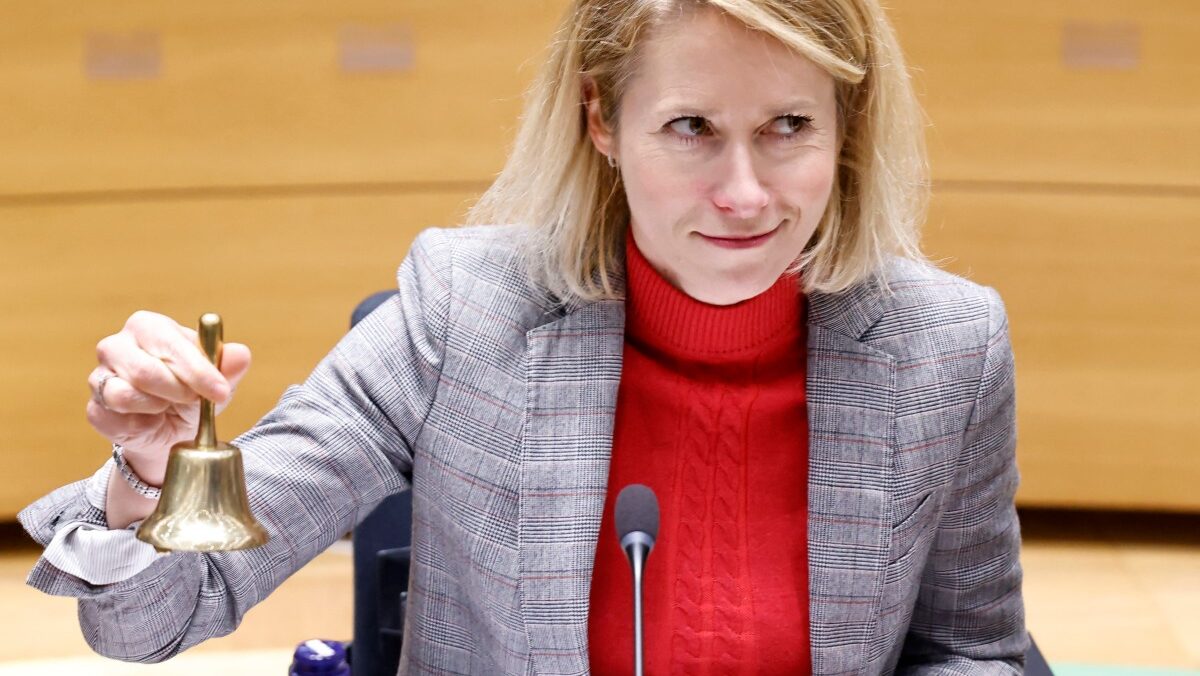
EU High Representative and Vice-President for Foreign Affairs and Security Policy Kaja Kallas rings the bell to launch a EU Foreign Affairs Council meeting at the EU headquarters in Brussels on January 29, 2026.
SIMON WOHLFAHRT / AFP
The European Union establishment has spent the duration of the war in Ukraine refusing to engage in talks with Vladimir Putin. It has also been shut out of U.S.-led peace negotiations, including the latest between Kyiv and Moscow officials, only occasionally being told what has already been decided by others.
Yet now it feels it has the authority to put forward a list of demands for the Kremlin to fulfil for the conflict to come to an end.
Top EU diplomat Kaja Kallas told reporters on Tuesday that “everybody around the table, including the Russians and the Americans, needs to understand that you need Europeans to agree” on the terms for peace. So far, they appear not even to have considered Brussels’ position.
Then, despite being on the back foot, Kallas revealed that the EU is about to make demands of its own, stressing, “We also have conditions.”
And we should put the conditions not on Ukrainians, who have been already pressured a lot, but on the Russians.
Henrik Larsen, from the Centre for European Policy Analysis, jibed that such comments mean it is “no wonder the EU is marginalised in the peace negotiations.”
Even some of those supportive of Brussels’ view are concerned that this approach could delay peace. American author Robert Morton said he was “glad” about the laying down of conditions, while also expressing “hope they tie them to real security guarantees. Otherwise it’s just hitting pause, not ending the war.”
Reports say the EU will demand the return of all Ukrainian children abducted during the war and, more controversially, limitations on Russia’s armed forces. Officials will use Russian assets frozen in Europe as leverage in potential talks.
But simultaneous claims Russia is close to capturing key towns in southern and eastern Ukraine will undoubtedly weaken the effectiveness of such arguments. The New York Times reported on Tuesday that three possible captures “would give Russia an urban foothold to base troops and organise logistics for future offensives, as well as new leverage in U.S.-mediated peace talks.”
Polling also suggests that as Ukrainians grow more weary—as indeed they are bound to if yet more land is taken—they become more willing to trade some land for peace.
Kallas said she will be proposing a list of demands to EU governments in the coming days, adding, “If we don’t stand up for anything, there’s no point for us to be around the table.”