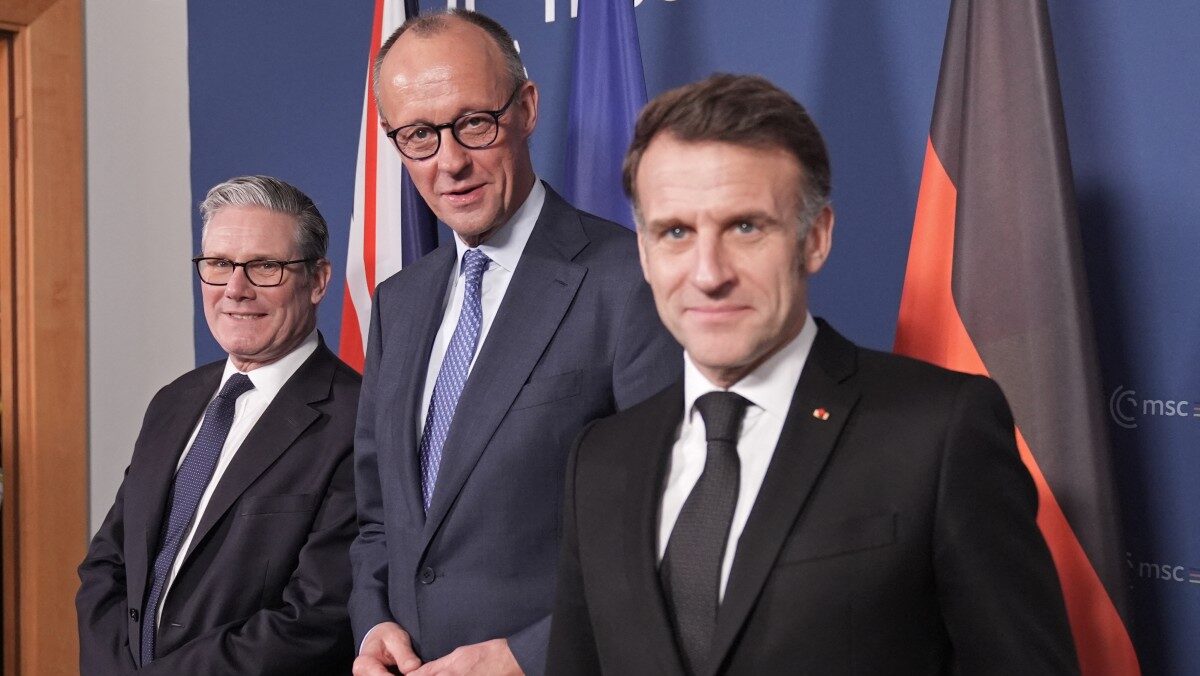
Keir Starmer, Friedrich Merz, and Emmanuel Macron during the Munich Security Conference on February 13, 2026
Stefan Rousseau / POOL / AFP
As missiles fly in the Middle East and Western forces brace for further escalation with Iran, the real decisions are being taken in London, Paris, and Berlin—not in Brussels.
While EU leaders gather to “consider” a common position, Europe’s major military powers are already coordinating with Washington and preparing for possible action. Once again, when conflict intensifies, it is national governments—not EU institutions—that move first.
Yesterday, EU foreign ministers held an emergency videoconference convened by the bloc’s foreign policy chief, Kaja Kallas, to discuss the crisis. The official statement called for restraint and respect for international law.
But France, Germany, and the United Kingdom have already signalled they are ready for “defensive and proportionate” military action against Iran, without giving details on timing or scope.
In a joint declaration, Paris, Berlin, and London said they could act “to destroy Iran’s capacity to launch missiles and drones at their source,” confirming close coordination with the United States and regional allies.
Even Britain’s dithering prime minister, Keir Starmer, has announced that the United Kingdom will allow the United States to use British bases for operations targeting Iranian military infrastructure.
My update on the situation in the Middle East. pic.twitter.com/DvsOVcTDMy
— Keir Starmer (@Keir_Starmer) March 1, 2026
He also confirmed that British fighter jets have intercepted Iranian attacks and said London’s involvement could grow if Gulf partners request further support.
Tensions rose further after a drone strike targeted the British base at Akrotiri in Cyprus. Although no casualties were reported, security was raised to its highest level—a reminder that European forces are directly exposed as the crisis deepens.
France, which maintains military facilities in the region, confirmed that a naval base in Abu Dhabi was struck by drones, though without casualties. President Emmanuel Macron said France stands ready to deploy the necessary means to protect its allies if asked.
Germany has also hardened its tone. Chancellor Friedrich Merz questioned whether years of sanctions and warnings toward Tehran had achieved results and said now is not the time to “lecture” partners. On Tuesday, March 3, he will travel to Washington to meet President Donald Trump, with the Iran crisis expected to feature prominently.
Spanish Prime Minister Pedro Sánchez has focused on calls for de-escalation and adherence to international law, steering clear of any suggestion of direct military involvement.
Se puede estar contra un régimen odioso y, a la vez, contra una intervención militar injustificada y peligrosa.
— Pedro Sánchez (@sanchezcastejon) March 1, 2026
Apelo nuevamente a la desescalada inmediata, al respeto al derecho internacional y la urgencia de retomar el diálogo.
Ahí estará España. Y ahí debe estar Europa. pic.twitter.com/mWYTmD7jWG
By contrast, Italian Prime Minister Giorgia Meloni has convened security meetings and strengthened protection for sensitive sites, placing priority on safeguarding Italian citizens and national interests.
Italy maintains troops in the region and has prepared evacuation plans. While Rome is not openly backing offensive action, it is taking practical steps to protect its personnel and assets.
The crisis once again exposes a basic reality: in matters of war and peace, sovereign states will put their own interests first. The European Union can issue statements and hold emergency meetings, but it does not command armies or control military bases.
Decisions about deployments, interceptions, and potential strikes are being made in national capitals—and those decisions will shape Europe’s role in this conflict far more than any declaration issued from Brussels.