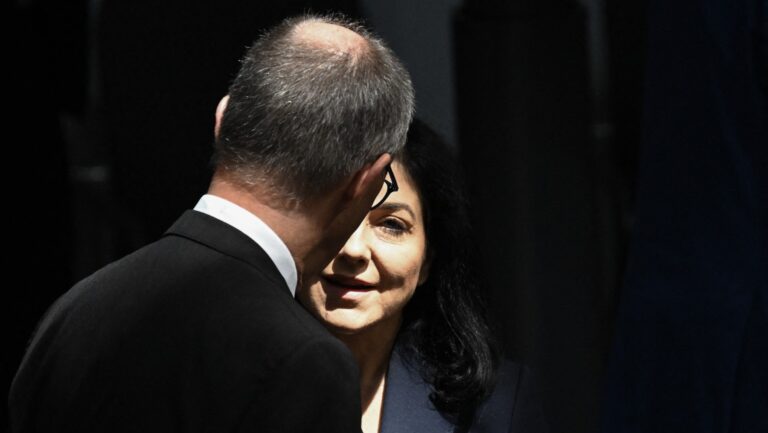
Ursula von der Leyen and Anthony Albanese at Parliament House in Canberra on March 24, 2026.
DAVID GRAY / AFP
The EU has struck a major free trade deal with Australia, scrapping almost all tariffs—but once again putting Europe’s farmers on edge.
The agreement, finalised on Sunday, has already raised concerns in several Member States, particularly in the agricultural sector, which fears being exposed to increased competition in the name of industrial competitiveness and geopolitical strategy.
The Commission has agreed to open quotas for farm products seen as most at risk, including beef, lamb, sugar, rice, and certain dairy goods—albeit with volume limits and safeguard clauses.
Among the figures drawing the most attention is the opening of around 30,000 tonnes per year of Australian red meat, part of it tariff-free, a modest amount globally but significant in markets already under pressure from rising costs and stricter environmental rules.
The treaty removes more than 99% of tariffs between the two economies and, according to Commission estimates, will save European companies around €1 billion a year in customs duties.
Brussels also expects EU exports to Australia to grow by up to 33% over the next decade, in a trade relationship that already exceeds €47 billion in goods and more than €38 billion in services.
Australia offers a stable market with strong purchasing power and regulatory standards broadly aligned with those of the EU, making it an attractive destination for European exporters in sectors such as automotive, machinery, financial services, and technology.
The agreement also opens access to Australian public procurement and removes most remaining barriers for industrial goods—long-standing priorities in the negotiations.
Officials in Brussels stress that the agricultural quotas are limited and include safeguards that would allow imports to be restricted if the European market is disrupted. But the concern is not only economic—it is also political.
In recent years, trade deals with partners such as Canada, New Zealand, and Mercosur have triggered the same criticism: industry and services gain most of the benefits, while farmers carry a disproportionate share of the risk.
That tension has intensified since 2023, when protests by farmers across Europe exposed growing pressure on the sector from rising costs, environmental rules, and global competition.
Against that backdrop, even limited concessions in new trade agreements are seen by many as further evidence that Brussels is prioritising market access over protecting domestic agriculture.
Beyond trade, the agreement has a clear strategic purpose. Australia is a major supplier of lithium, rare earths, nickel, and copper—materials essential for batteries, defence systems, electronics, and the energy transition.
The EU, still heavily dependent on external suppliers—particularly China—has been trying to secure more reliable sources.
The deal removes tariffs on most of these materials and allows European companies to invest more easily in mining and processing projects in Australia, reducing supply risks.
The agreement also deepens cooperation in security, defence, cybersecurity, and technology. Both sides signalled that Australia could take part in European research programmes such as Horizon Europe.
Australia is one of the world’s most important producers of critical raw material.
— Ursula von der Leyen (@vonderleyen) March 24, 2026
In contrast, Europe is one of the world’s major users.
So today, we agreed on four major projects, covering production of rare earths, lithium, and tungsten.
And we also agreed to launch… pic.twitter.com/USg1L4Ahm1
But the deal highlights divisions within the EU. Countries such as Germany, the Netherlands, and those in northern Europe see clear gains for exporters of industrial goods and services.
By contrast, France, Ireland, Spain, and Italy remain focused on the impact on farming sectors such as livestock, sugar, and rice.
For the Commission, securing approval for the agreement will require balancing those competing interests—opening markets abroad without triggering the kind of domestic backlash that has stalled previous trade deals.