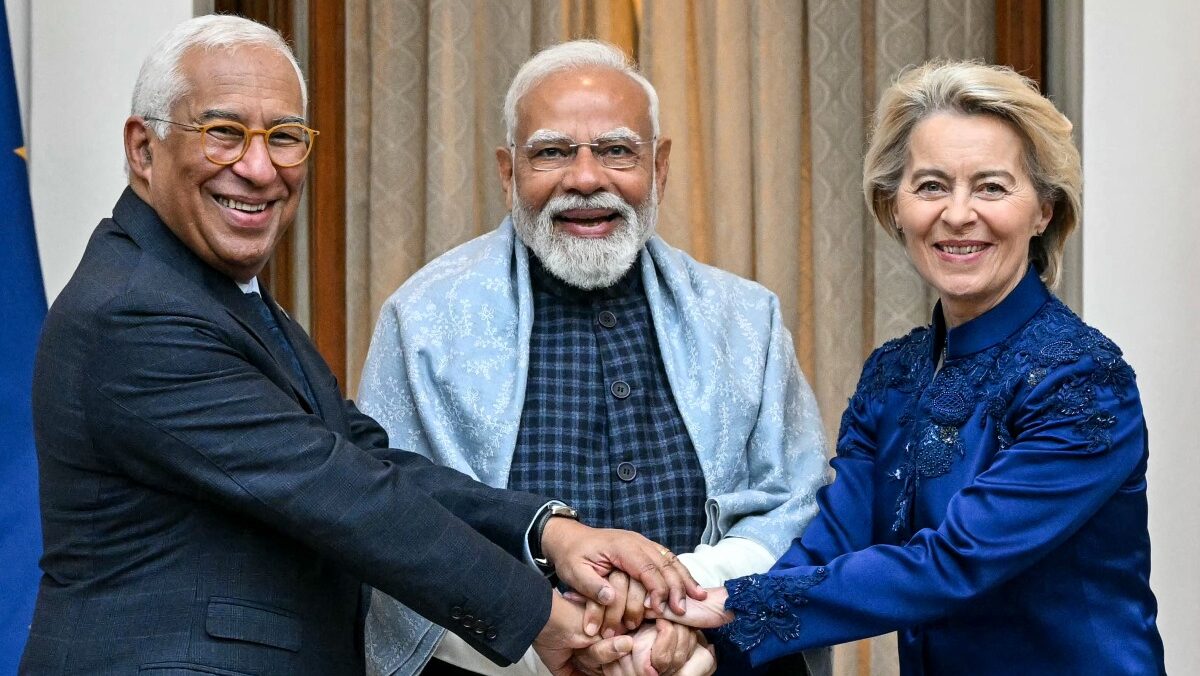
India’s PM Narendra Modi (C) with European Commission president Ursula von der Leyen (R) and European Council president Antonio Costa
Sajjad HUSSAIN / AFP
The European Union’s long-awaited trade deal with India is being celebrated in Brussels as a major economic and geopolitical win. But tucked away behind the headlines is something far more politically explosive: a quiet expansion of legal migration into Europe.
This is not just about tariffs and exports. The EU–India package also opens new routes for Indian students, professionals, and workers to live and work across Europe—at a time when migration remains one of the most sensitive issues in European politics.
Alongside the trade pact sits a separate migration deal, wrapped into what Brussels calls a broader “strategic partnership” with India. EU officials insist the arrangement is sensible and necessary: attract skilled workers while improving cooperation on illegal migration and returns. India, meanwhile, has been far more direct, presenting the deal at home as a breakthrough that makes Europe more accessible to its citizens.
So what does this mean in practice?
Indian students are set to receive longer, multi-entry visas, extended post-study work permits—reportedly up to three years—and faster processing. Highly skilled workers and researchers gain access to fast-track residence permits, easier family reunification, and smoother intra-company transfer routes, allowing Indian firms to post staff to EU offices for several years. Even seasonal and shortage-occupation workers, including in agriculture and hospitality, are drawn in through quotas and “circular migration” schemes.
To manage this flow, the deal quietly puts a whole migration system in place. It includes cooperation on recognising skills and qualifications, as well as plans for a European Legal Gateway Office in India—a one-stop office designed to guide applicants straight into EU migration schemes before they even reach Europe. Supporters call this orderly. Critics see migration policy being designed outside national borders.
Much of this is justified under “Mode 4” trade rules—Brussels jargon for letting foreign workers come to Europe temporarily to do specific jobs. On paper, these postings are limited and short-term. In reality, they create labour-migration channels that sit outside traditional immigration caps and political promises to reduce numbers.
Once signed at EU level, these commitments apply across every EU country, whether governments like it or not. National leaders are left with very few ways to change course—even as public concern over migration continues to grow.
That is where the controversy bites. Critics argue that Brussels is reshaping national migration policy through trade negotiations carried out far from public scrutiny. Temporary or not, the arrival of thousands of additional service providers and “shortage workers” has real effects: pressure on wages, tougher competition for jobs, and growing strain on social cohesion, increasingly felt by the middle class as well.
The Commission says expanded legal routes will be balanced by tougher cooperation on returns. Yet Europe’s recent record inspires little confidence. Enforcing returns has long been one of the weakest points of EU migration policy, and sceptics doubt controls will materialise once legal routes are in place and businesses start to rely on them.
Beyond economics lies a deeper problem: trust. At a time when many governments campaign on restoring control over borders, embedding migration commitments in trade deals risks deepening public cynicism. It feeds the sense that decisions with major social consequences are being settled quietly, through backroom bargaining, rather than open democratic debate.
This is not an argument against trade with India. But it is a warning. When trade policy becomes a back door for migration policy, transparency suffers and consent erodes. If Brussels wants public backing for ambitious global deals, it must be honest about what they really involve—especially when they touch one of Europe’s most politically charged issues.