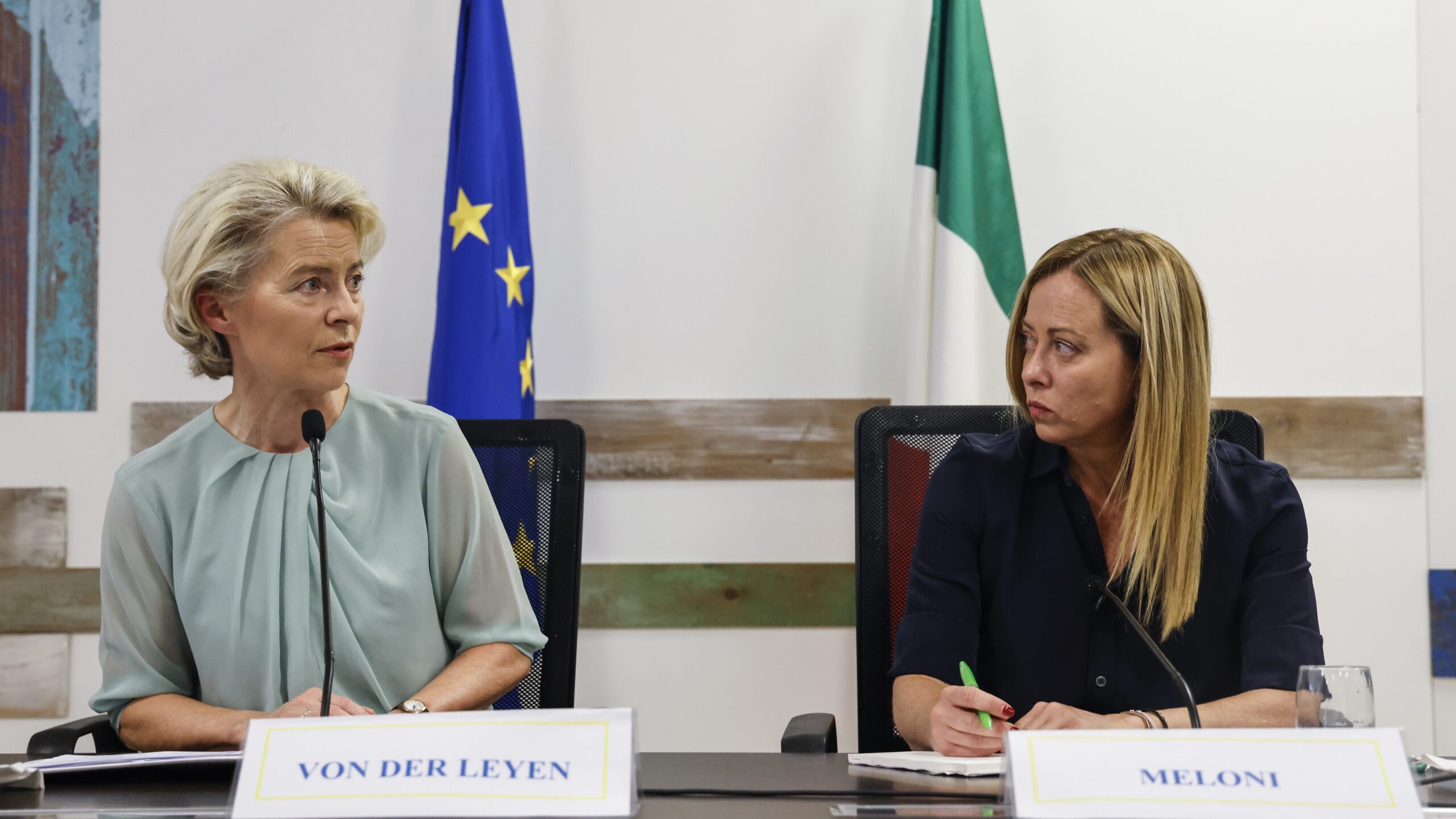
Ursula von der Leyen and Giorgia Meloni on September 17, 2023 in Lampedusa, Italy
© European Union, 2025, CC BY 4.0, https://commons.wikimedia.org/w/index.php?curid=137753914
The Italian government’s response to Brussels’ trade deal with the U.S. was a little more neutral than those of its European counterparts, praising the avoidance of a trade war while promising—as Deputy Prime Minister and Foreign Minister Antonio Tajani put it—to “evaluate all the details.”
But analysis by Italy’s Svimez research association already suggests that the details are bad.
Forecasters said the deal, which sets a 15% tariff on most European products exported to the U.S. in exchange for massive purchases of American energy and military equipment worth more than €1.13 trillion, could result in a 14% reduction in Italy’s exports.
This amounts to €8.6 billion every year and, Svimez added, could see 103,000 full-time jobs lost. The north would be hit especially hard, suffering 68.32% of the overall export reduction that will hit the region’s industrialised areas.
The impact would reportedly be less severe were pharmaceuticals to be excluded from duties, but it is not at all clear that U.S. President Donald Trump will allow this to be the case.
As concerns about the expected impacts of this deal mounted even among pro-Brussels figures, Deputy Prime Minister Matteo Salvini joked that they had become “more sovereignist than me.” Now, he said,
It is clear to everyone that there is something … that needs to change in Brussels. This EU and this European Commission are a problem for Italian businesses.
Leggo dotte analisi di giornalisti che fino a ieri mi accusavano di sovranismo perchè mettevo in dubbio la saggezza di Ursula von der Leyen e adesso sono più sovranisti di me.
— Matteo Salvini (@matteosalvinimi) July 29, 2025
La Lega, con coerenza, non ha mai votato per Von der Leyen. Ora, che ci sia qualcosa e qualcuno da… pic.twitter.com/Frr25SHoSi
Germany’s Friedrich Merz also warned that the deal will “substantially damage” national finances, while French Prime Minister François Bayrou accused European Commission chief Ursula von der Leyen of “submission.”
Figures released on Wednesday also showed that the Italian economy contracted by 0.1% in the second quarter of this year, as did Germany’s.