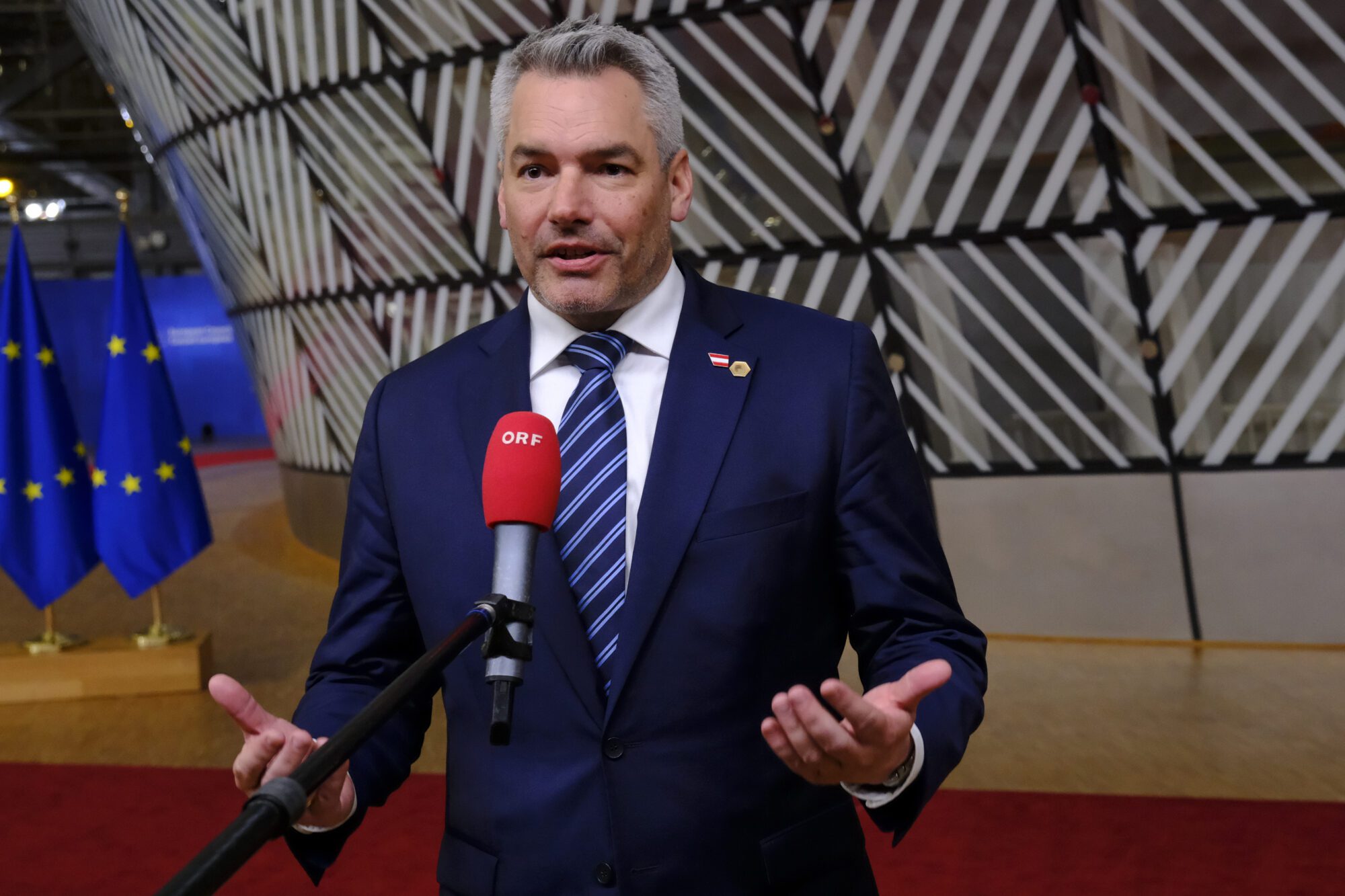
Austrian Chancellor Karl Nehammer led the effort to accommodate neutral countries when formulating security guarantees to Ukraine at the European Council Summit on June 29th, 2023.
EU member states with established military neutrality refused to sign off on a statement promising the bloc’s “future security commitments” to Ukraine on the first day of the EU Council (EUCO) Summit on Thursday, June 29th, forcing the leaders to revise the text and give them exemptions.
Austria was the loudest critic of the provision that would have committed the entire bloc to the long-term defense of Ukraine—possibly even by force—mainly as a deterrence against further hostilities after the war ended.
The two other neutrals—Ireland and Cyprus—also made it clear that any concrete commitments to the security of Ukraine on behalf of the entire bloc are incompatible with their historical non-alignment.
“It is clear to us as neutral states that [these commitments] cannot exist in this way,” Austrian Chancellor Karl Nehammer said.
In the end, the final statement that was adopted by all member states had to be watered down to include the possibility of opt-outs for those whose neutrality might get in the way.
After detailing the EU’s commitment to Ukraine’s sovereignty and promising sustained financial and military support “for as long as it takes,” the statement describes the controversial security guarantees as follows (italics added to indicate the concession):
The European Union and Member States stand ready to contribute, together with partners, to future security commitments to Ukraine, which will help Ukraine defend itself in the long term, deter acts of aggression and resist destabilization efforts. In this regard, they will swiftly consider the modalities of such contribution. These commitments will be taken in full respect of the security and defense policy of certain Member States and taking into account the security and defense interests of all Member States. The European Council will remain seized of the matter.
The language of the conclusion is vague for a reason. It’s clearly designed to accommodate both the more hawkish member states—by allowing for a full range of instruments, including military engagement—but remain acceptable to others as well, by saying that the actual decision on the “modalities” will be taken together when there is a need for it.
Furthermore, the way the concession to neutral countries is phrased—the word “policy” is broader than just constitutional neutrality—indicates that not only those neutral countries, but practically any of the others, can also take advantage of the option if particular member states don’t want to partake in any joined action that’s deemed too risky.