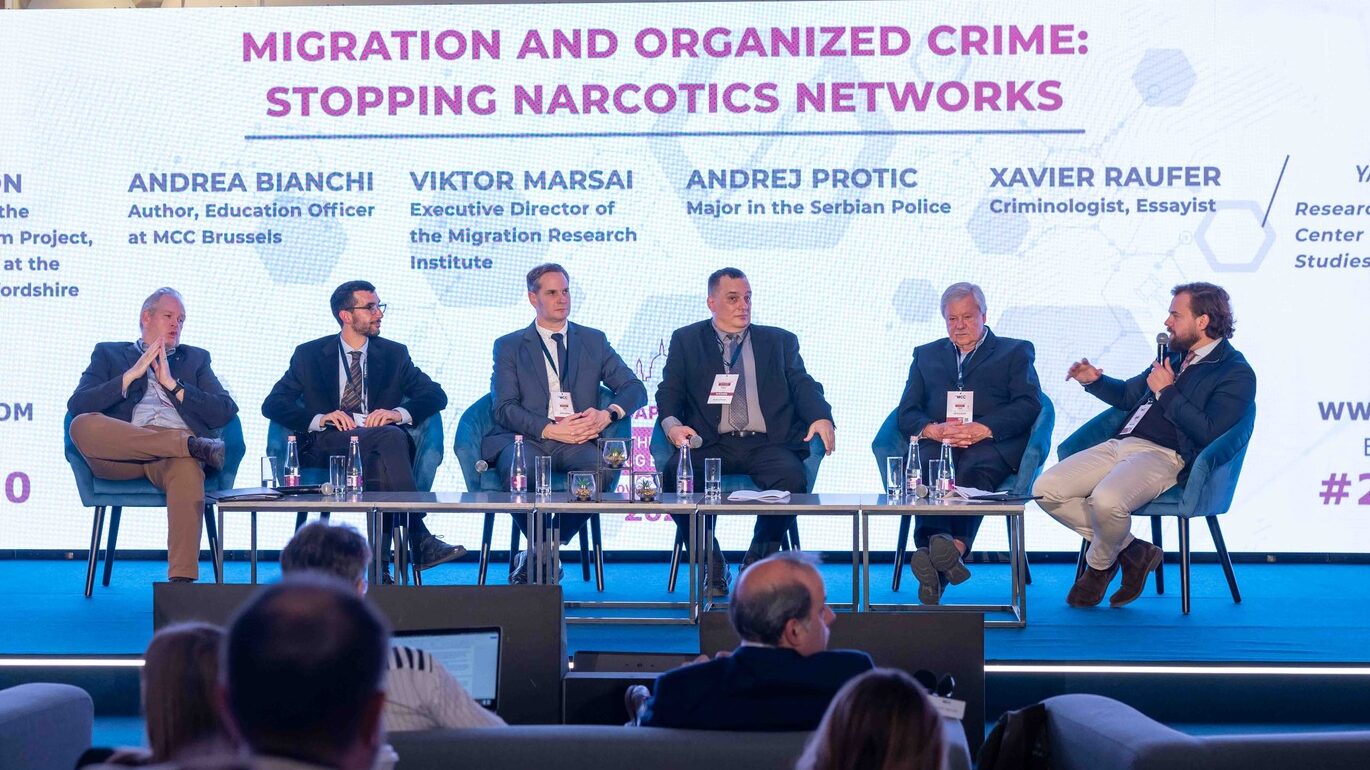
The expert panel at MCC Budapest’s Summit on the Global Drug Epidemic, Budapest 19 November 2025
Mathias Corvinus Collegium – MCC on Facebook, 19 November 2025
Europe is dangerously behind in confronting a global drug trade that is expanding, accelerating, and increasingly intertwined with migration and organised crime—this was the overarching warning issued by experts at the MCC Summit on the Global Drug Epidemic, held in Budapest.
French criminologist and former Europol adviser Xavier Raufer captured the tone bluntly. “Our state apparatus is like an old lady with rheumatism,” he told the audience, criticising the EU’s slow-moving decision-making process. Even when Brussels identifies a priority, he said, after four or five years “they have a wonderful plan, but they are much too slow.”
Raufer argued that Europe has the intelligence and capacity to disrupt migration routes exploited by smugglers but lacks the political will. Satellite data can track migrant movements across Africa, he said, yet “at the European level they do nothing … if you are the witness of someone preparing a crime, and do nothing, you become an associate.”
The link between migration and narcotics was examined in detail by Ian Acheson, senior advisor at the Counter Extremism Project. In the United Kingdom, he said, the surge in illegal crossings has exposed migrants to recruitment, coercion, and debt bondage.
While 99% of the UK’s 3.8–4.25 million net population increase between 2015 and 2024 came legally, some 151,000 illegal arrivals—moved by organised crime across the English Channel—are now “prey to criminality.” Albanians, he noted, are “vastly over-represented” in wholesale cocaine and heroin imports and constitute 12% of Britain’s prison population, where drug infiltration—including a 770% rise in drone deliveries—is “destroying the possibility of rehabilitation.”
Acheson also criticised Frontex, arguing that the EU border agency “effectively shepherds illegal migrants” across the Mediterranean, becoming part of a wider human-trafficking pipeline instead of preventing migrants from entering the continent.
Viktor Marsai, executive director of the Migration Research Institute in Budapest, argued that drug trafficking, people smuggling, and terrorism now form a single system he called “caravan terrorism,” with jihadist groups using profits to fund attacks. Attempts by the French army to disrupt these networks in Mali, he said, triggered backlash in regions where “millions of people make money from different kinds of smuggling.”
Andrea Bianchi of MCC Brussels pointed to Europe’s geography—including routes through Western Sahara and Iberia—which enables Moroccan mafia networks to funnel cocaine and synthetic drugs into the continent.
Western Europe’s drug markets are booming, especially in Belgium, the Netherlands, and France, where migrant-linked gangs are responsible for shootings and street violence.
Right-wing governments such as Viktor Orbán’s in Hungary and Donald Trump’s in the United States advocate tougher enforcement, while liberal-led countries insist the ‘war on drugs’ is futile. As we recently reported, Germany’s cannabis legalisation has coincided with a near-doubling of cannabis-induced psychoses.
The message from Budapest was clear: the global drug epidemic is reshaping societies, eroding family stability, fuelling criminality and—without urgent, coordinated action—threatening to overwhelm Western institutions.