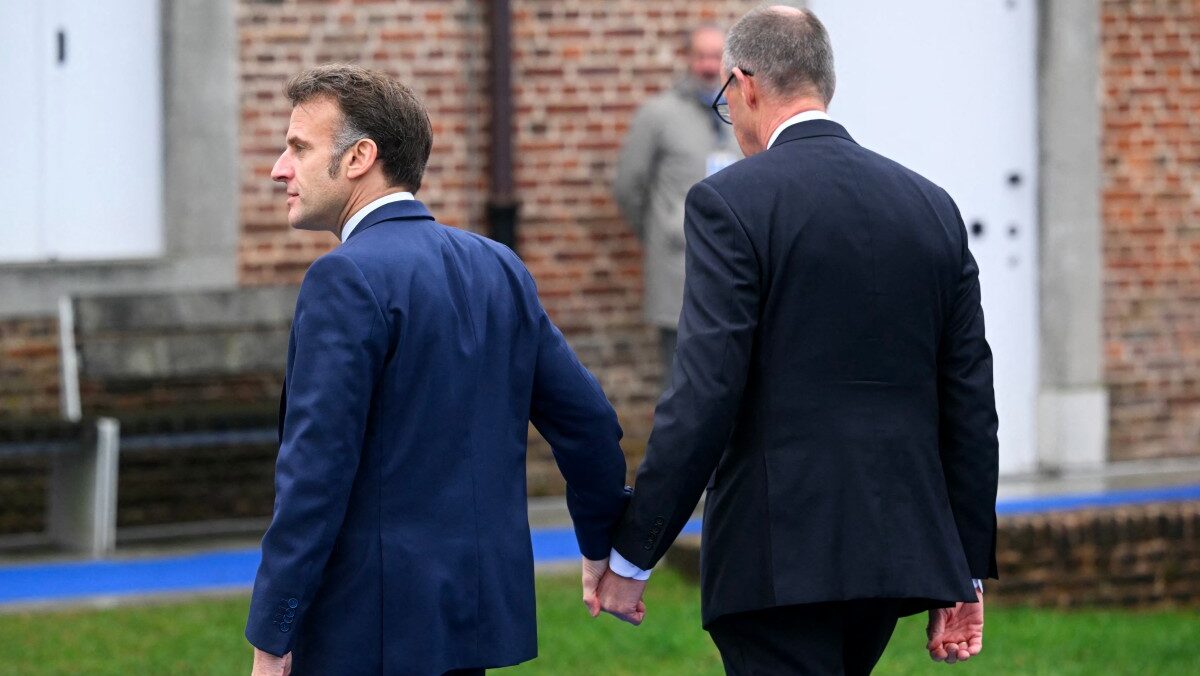
Emmanuel Macron and Friedrich Merz
NICOLAS TUCAT / AFP
French and German officials revealed over the weekend that they have begun talks on bolstering Europe’s nuclear deterrent, as Poland’s government called for the country to establish a deterrent of its own.
Leaders cite an increasingly aggressive Russia—and rising doubts about whether Washington would always come to Europe’s defence. But whether this talk will be followed by action remains to be seen.
One ‘expert group’ quoted by the press said ahead of this year’s Munich Security Conference that “Europeans can no longer outsource their thinking about nuclear deterrence to the United States.”
German chancellor Friedrich Merz later confirmed that he had held talks with French president Emmanuel Macron, while stressing discussions were “strictly embedded in our nuclear participation within NATO” and will “not create zones of divergent security in Europe.”
We must now spell out how we want to organise this in a European way—not as a substitute for Nato, but as a self-supporting strong pillar within the alliance.
European officials have generally been supportive of this news. Latvia’s Foreign Minister Baiba Braže described nuclear deterrence as a “prominent subject” at this year’s conference, and Estonia’s Deputy Defense Minister Tuuli Duneton said “we are always open to discuss.”
Keir Starmer, prime minister of the UK, which has its own (faltering) system of nuclear deterrence, added that he was “enhancing our nuclear cooperation with France.”
But in Spain, Socialist PM Pedro Sánchez argued that “nuclear rearmament is not the right way” of keeping Russia at bay.