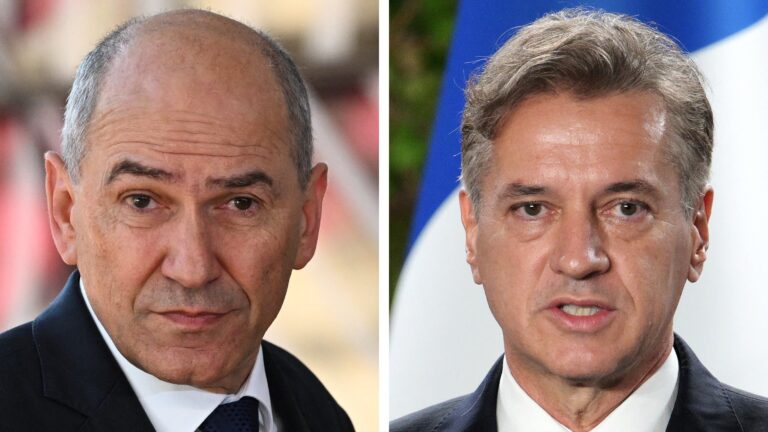
German President Frank-Walter Steinmeier (R) welcomes Ukraine’s President Volodymyr Zelensky
RALF HIRSCHBERGER / AFP
Europe enters one of its most decisive weeks since Russia’s invasion of Ukraine, as dozens of leaders meet with Ukrainian President Volodymyr Zelensky in Berlin, amid growing U.S. pressure to move toward a negotiated end to the war.
German Chancellor Friedrich Merz will host the talks, beginning with a bilateral meeting with Zelensky before an expanded session brings together France, Britain, key EU and Nordic leaders, and NATO Secretary-General Mark Rutte.
Diplomatic sources say the central goal is to “close ranks” around a European-led peace plan, after a 28-point draft drawn up by the United States and Russia triggered a strong backlash across EU capitals. That plan called for territorial concessions and limits on Ukraine’s ability to defend itself.
At the same time, Brussels remains locked in a tense debate over the use of frozen Russian assets to finance a €210 billion loan intended to sustain Ukraine over the coming years.
Finnish President Alexander Stubb said on Sunday that Europe is “closer to a peace agreement than at any point in the past four years,” while cautioning that major gaps remain on long-term security guarantees.
On the eve of the talks, Zelensky said Ukraine is prepared to drop its NATO membership bid if it receives robust security guarantees from the United States and Europe.
The idea was discussed for more than five hours with U.S. envoys Steve Witkoff and Jared Kushner and would offer Ukraine an “enhanced protection” model inspired by NATO’s Article 5, while leaving the final response to any future Russian attack in the hands of the U.S. president.
Ukrainian officials have pushed back against the proposal, seeking to narrow the scope of unilateral decision-making in Washington, as neither side shows signs of softening its core demands.
Trump’s push to accelerate a settlement has drawn skepticism in Kyiv and across Europe, as Moscow and Kyiv continue to hold opposing positions on territory, military limits, and security guarantees.
Analysts note that after nearly four years of war with no decisive gains for either side, the conditions for negotiation may be more favorable now than later. Still, they warn that the sides remain far apart.
Within European diplomatic circles, a minimal compromise is being discussed that would freeze the conflict along the current front line without recognizing sovereignty claims, pair Ukrainian EU membership with armed neutrality outside NATO, and place a moratorium on further alliance expansion into the post-Soviet space.
While Moscow and Kyiv remain far apart, the rapid pace of diplomatic engagement points to a renewed effort by Europe and the United States to restart talks that have been stalled for months.