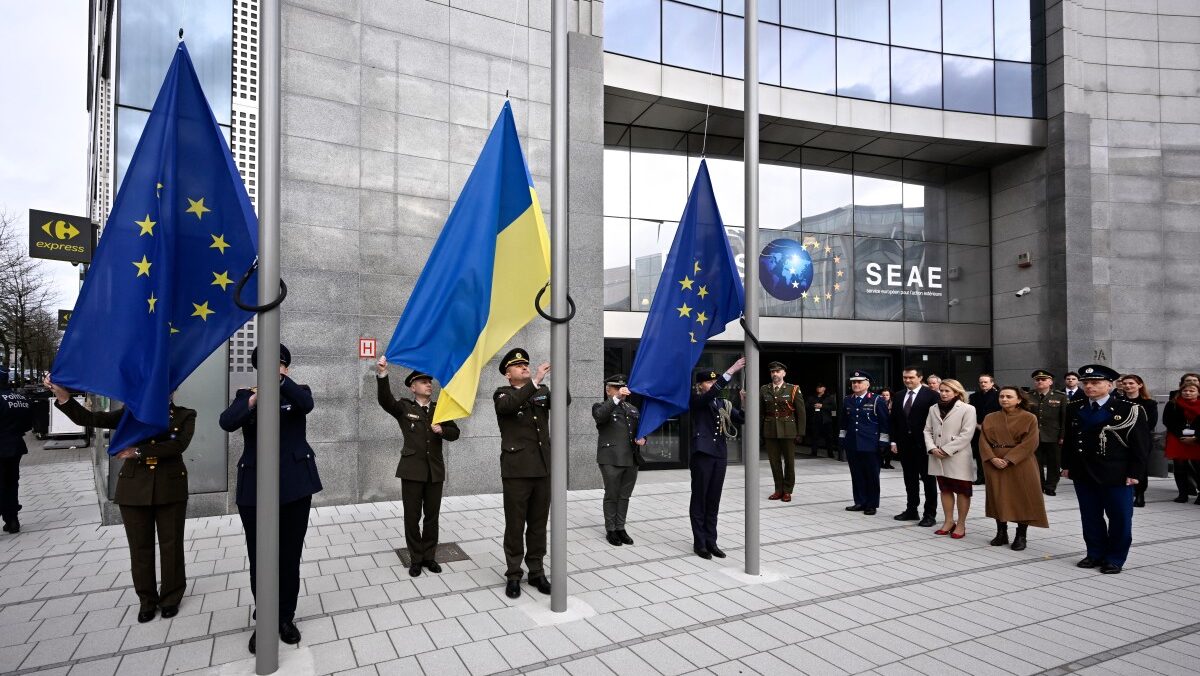
Current Chairman of the European Union Military Committee (CEUMC) Irish Air Corps general General Sean Clancy, Ambassador for the European Union mission of Ukraine Vsevolod Chentsov, EU High Representative and Vice-President for Foreign Affairs and Security Policy Kaja Kallas, and Secretary-General of the European Union’s External Action Service (EEAS) Belen Mart’nez Carbonell stand as the Ukrainian flag is raised in front EEAS building during a ceremony to mark the fourth anniversary of Russia’s war of aggression against Ukraine, in Brussels, on February 23, 2026.
JOHN THYS / AFP
Four years after Russia’s invasion of Ukraine, the European Union no longer projects the image of firm unity that marked the early stages of the conflict.
On Monday, the 20th package of sanctions against Moscow failed to get the unanimous support of the bloc’s foreign ministers, exposing political fissures that have long ceased to be merely anecdotal.
The new package, designed to coincide with the fourth anniversary of the war, was blocked by Hungary and Slovakia, which maintain reservations about the scope of some of the proposed measures, particularly in the energy and maritime sectors.
“Unfortunately, we have not reached an agreement on the twentieth package of sanctions. It is a setback and a message we did not want to send today, but the work continues,” admitted the High Representative for Foreign Affairs and Security Policy, Kaja Kallas, after the Council meeting in Brussels.
In February 2022, the European response was swift and coordinated. Within days, the EU approved sanctions packages that included disconnecting Russian banks from the SWIFT system, restrictions on strategic exports, and the freezing of assets belonging to oligarchs and political officials. The dominant narrative was clear: unity in the face of aggression.
Four years later, the scenario is different. The EU already maintains restrictive measures against nearly 2,700 individuals and entities linked to the Russian regime. The twentieth package sought to expand that list, add new sanctions on companies in the energy and agricultural sectors as well as on Russian banks, and introduce additional mechanisms to prevent sensitive goods from reaching the Russian economy.
However, automatic consensus has disappeared. Each new package now requires prolonged negotiations among capitals with divergent priorities. Countries heavily dependent on Russian energy supplies or more sceptical about the real impact of sanctions have raised the political threshold for each decision.
One of the most controversial points is the ban on all maritime services provided to Russian oil tankers. For a majority of member states, the measure is necessary to close loopholes that allow Moscow to continue exporting crude through third countries. But for other governments, the economic cost and the risk of lack of coordination with G7 partners counsel caution.
Talks among ambassadors continue, but the political deadlock is already a fact. Kallas herself had assured days earlier, from Krakow, that the goal was to adopt the new package on the anniversary and argued that the sanctions “are seriously harming the Russian economy.” Nevertheless, the gap between political declaration and negotiating reality once again became evident in Brussels.
The strain is not only economic; it is also political. Four years of war have put pressure on national budgets, driven up energy prices, and altered internal balances in several member states.
In some countries, public debate no longer revolves exclusively around punishing Russia but also around the accumulated domestic costs.
Hungary has from the outset maintained a critical position on certain energy sanctions, defending the need to preserve its security of supply. The country on Friday evening said it would block a €90 billion EU loan package for Ukraine and vowed to maintain its veto until Kyiv restores Russian oil transit to Hungary via the Druzhba pipeline. The EU Commission has called a meeting of the Oil Coordination Group regarding the issue for Wednesday of this week.
Slovakia has in recent months adopted a more cautious line regarding new restrictions, reflecting changes in its domestic political landscape.
The result is an EU that remains formally committed to economic pressure on Moscow but that increasingly requires more time and concessions to reach agreements. The unanimity required in foreign policy decisions thus becomes a barometer of the bloc’s real cohesion.
The failure to finalise the twentieth package on the planned date sends yet another message to a Brussels that refuses to listen: the inability to agree on new measures projects an image of fatigue and fragmentation.