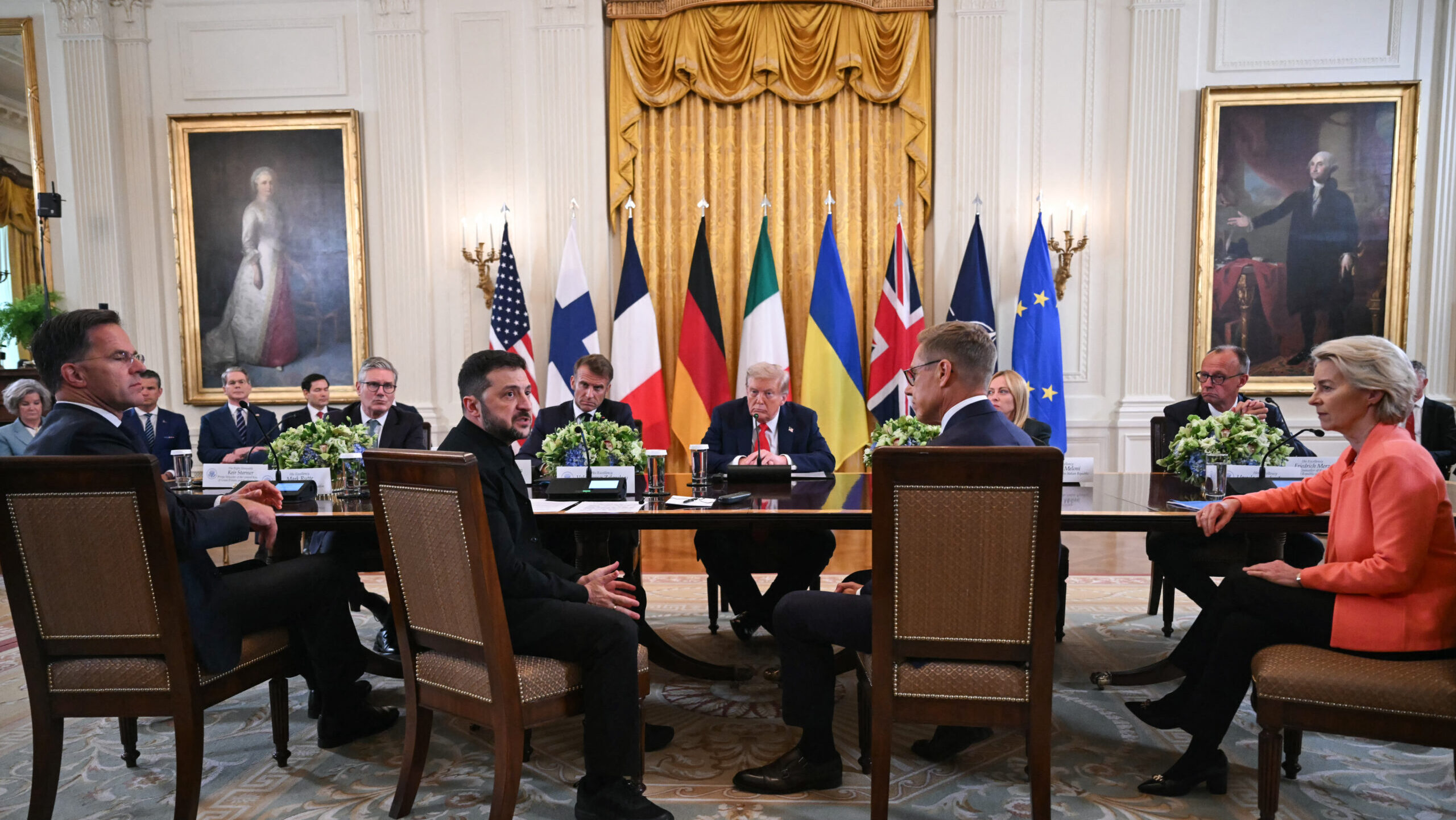
European leaders join Ukrainian President Volodymyr Zelensky in talks with US President Donald Trump on August 18
ANDREW CABALLERO-REYNOLDS / AFP
Donald Trump put himself at the center of Ukraine peace efforts on Monday, hosting Volodymyr Zelensky and seven European leaders at the White House and announcing moves toward direct talks with Vladimir Putin.
In the Oval Office, Trump unfurled a map of Ukraine showing areas under Russian control, signaling that territorial questions—long avoided by Kyiv—may now be on the negotiating table.
Zelensky did not address that directly and instead stressed security guarantees and the release of prisoners and deported children as essential points. On the latter, European Commission President Ursula von der Leyen also spoke, only to be silenced by Trump, who pointed out that “it was not the reason” they were there.
The European leaders came with a coordinated message: without a ceasefire, the credibility of any peace process would be minimal. Friedrich Merz, the German chancellor, put it clearly: “I cannot imagine a next meeting without a ceasefire.” For his part, Macron demanded that Europe be present at the eventual negotiating table, saying Europe’s role must not be sidelined in U.S.-Russia talks.
France also stressed the need for Ukraine to have a strong and modern army as essential for any lasting peace—an army to be built with American and European companies. According to Zelensky, Kyiv is offering to pay 77 billion euros to construct that army. He did not specify how the plan would be financed.
Trump, however, repeated his view that a truce is not immediately necessary. He said talks could proceed even while fighting continues, a stance welcomed by Moscow but opposed by several European leaders.
The core of the discussion was the promise of a system of security guarantees for Kyiv. Trump offered a commitment to imitate NATO’s Article 5, but without admitting Ukraine to the Atlantic Alliance. In other words, collective defense in exchange for giving up full integration. This would exclude Ukraine from NATO membership, a key demand long made by Moscow.
For the first time, Zelensky also said he was ready to discuss “delicate issues, including territorial ones,” in a future meeting with Putin and Trump.
After the first stages of the meeting, Trump interrupted the conversation to call Putin directly. According to the U.S. president himself, the two spoke about preparing a face-to-face meeting between Russia and Ukraine, followed by a trilateral meeting.
The meetings underlined Washington’s leading role in shaping the process, with Europe pushing to secure a place at the negotiating table.
The Twenty-Seven meet today in a videoconference convened by the President of the European Council, António Costa. There, Macron, Meloni, Merz, Starmer, and Stubb will share the details of the day in Washington with the rest of the leaders. The message they intend to convey is clear: Europe wants to be seated at the negotiating table, not just in the official photos.
We are here, as allies and friends, for peace in Ukraine and in Europe.
— Ursula von der Leyen (@vonderleyen) August 18, 2025
This is an important moment, as we continue to work on strong security guarantees for Ukraine and a lasting and durable peace. pic.twitter.com/FFF0Fqcq6y
Von der Leyen summed it up in a message on X: “This is an important moment, as we continue working in favor of strong security guarantees for Ukraine and a lasting and sustainable peace.”
Europe’s leaders will now decide how far they are prepared to go in Trump’s emerging plan for the region.