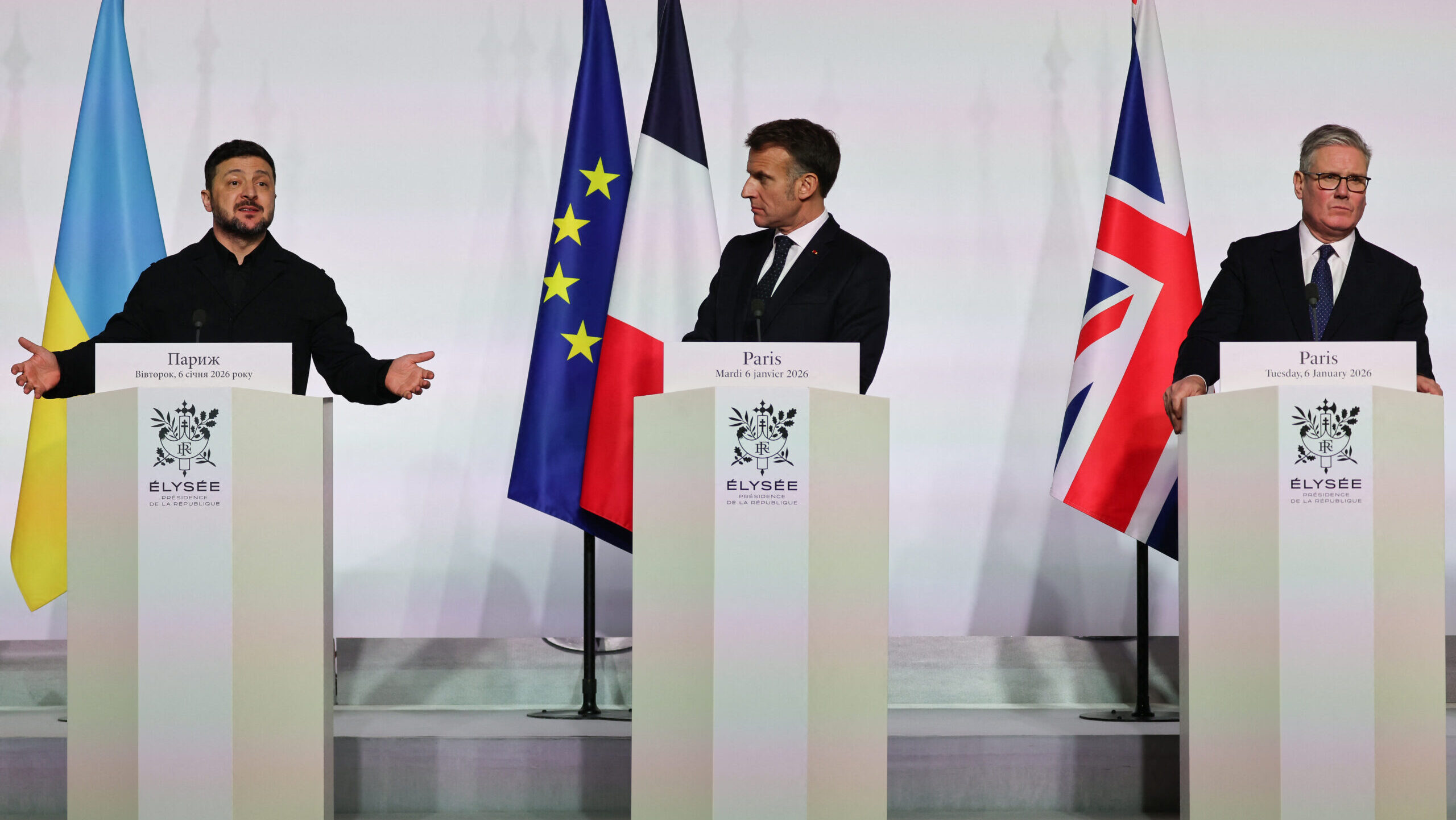
Zelensky with Macron and Starmer at the Coalition of the Willing summit in Paris, January 6, 2026.
Ludovic MARIN / POOL / AFP
Tuesday’s meeting of the so-called Coalition of the Willing in Paris was billed as a major step toward providing “security guarantees” for Ukraine. Yet behind the upbeat statements and staged displays of unity, the summit suggested several European leaders are moving closer to military involvement in the war—despite caution from the United States and opposition from Russia.
Convened by French president Emmanuel Macron and British prime minister Keir Starmer, the gathering brought together representatives from 35 of Kyiv’s allies and, for the first time, included envoys from U.S. President Donald Trump. In Brussels, Washington’s presence was widely interpreted as political support. But the key detail was this: the United States did not sign the final declaration on deploying a potential multinational force in Ukraine.
While Macron and Starmer defended a European force deploying after a hypothetical ceasefire, the U.S. delegation used cautious language. Special envoy Steve Witkoff spoke of “substantial progress” and the need for “durable” guarantees, but stopped short of committing Washington to any automatic military support.
This distinction matters. Earlier drafts had included U.S. backing in intelligence, logistics, and even support if the force were attacked. That language was dropped. What remains is a European-led security plan with vague and conditional U.S. support.
The message is simple: Washington supports the process but does not want to be drawn into an initiative that might escalate into direct confrontation with Moscow. Many analysts see this as reflecting the Trump administration’s desire to keep its options open and avoid new long-term commitments in Europe.
Despite U.S. caution, several European governments went further. France and the United Kingdom confirmed willingness to send troops to Ukraine in a post-ceasefire “guarantee” role, insisting they would not be combat forces. Ukrainian President Volodymyr Zelensky welcomed the move, calling the security framework “practically ready.”
In Spain, Prime Minister Pedro Sánchez surprised observers by opening the door to sending Spanish troops as part of a European contingent. Until now, his government avoided the issue. The shift comes without clear agreement in Parliament or strong public support. Sánchez’s left-wing partners, who opposed past military interventions, remain reluctant, fearing damage to their credibility.
Other countries set firm limits. Germany ruled out any deployment on Ukrainian soil. Poland rejected sending troops and offered only logistics. Italy said guarantees should remain political, inspired by NATO’s Article 5, but without boots on the ground.
Hungary was the loudest critic. Prime Minister Viktor Orbán accused Brussels of “deciding to go to war against Russia,” and warned that deploying European troops would cross a red line. He said Hungary would not finance or militarily support Kyiv and argued Europe’s strategy threatens EU unity.
The Kremlin immediately reiterated its opposition to any NATO military presence in Ukraine, even under the label of a “guarantee” force, and warned of consequences. In Moscow’s telling, Western plans turn Ukraine into a permanent military platform against Russia.
The summit raises tough questions. Can Europe sustain a mission without clear U.S. backing? Who would manage escalation if forces were attacked? For now, several governments are pushing ahead with a strategy that remains blurred and promises still more talk than reality.