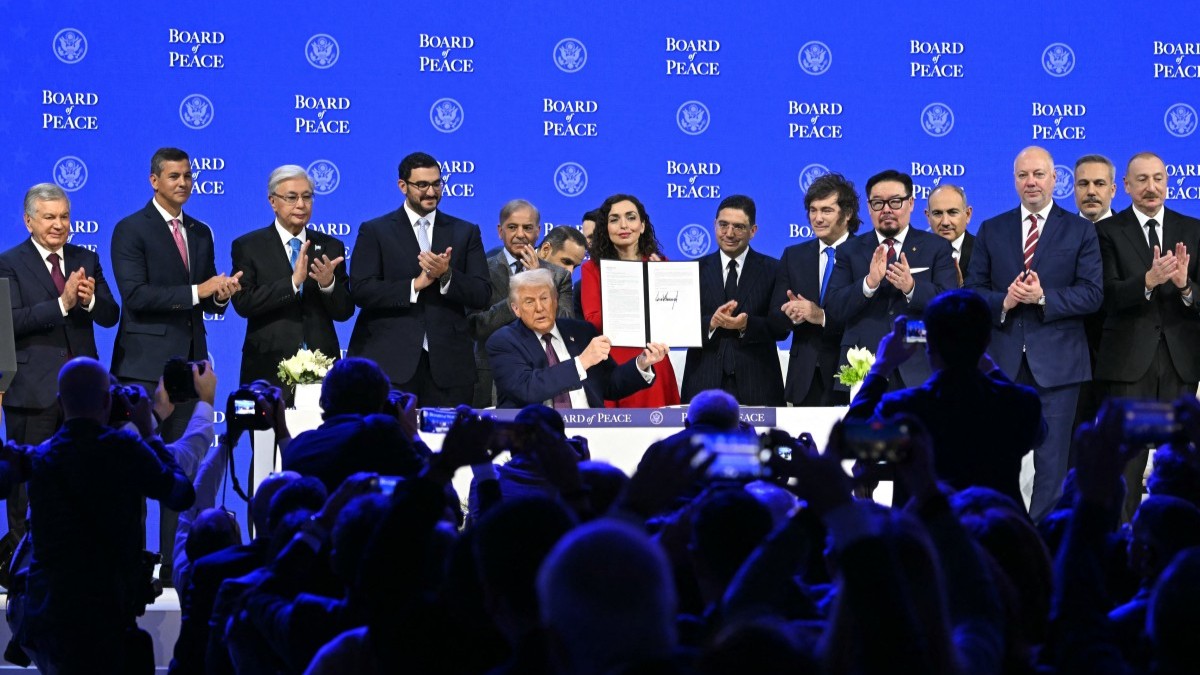
Donald Trump (sitting) and the members invited to the board hold a signed founding charter at the Board of Peace meeting during the World Economic Forum (WEF) annual meeting in Davos on January 22, 2026.
Fabrice Coffrini / AFP
Since welcoming Donald Trump’s Gaza peace plan last November, Western European leaders—mostly, though not all, establishment—have got cold feet about one of its key points, the establishment of a ‘Board of Peace.’
So when the president carried out a signing ceremony in Davos this morning, on January 22nd, the stage was quite noticeably not graced with Europe’s most recognisable mainstream figures. Instead, among those present were Pakistan’s Prime Minister Shehbaz Sharif, Argentinian President Javier Milei, Turkey’s Foreign Minister Hakan Fidan and Armenian PM Nikol Pashinyan. Hungary’s Viktor Orbán was also present, after accepting Trump’s “honourable invitation” on Sunday, as well as Bulgaria’s former Prime Minister Rosen Zhelyazkov.
The two main factors that appear to have prompted caution from other European leaders are the possible inclusion of Russia’s Vladimir Putin, who said he is considering an invite from the U.S., and the broadening scope of the Board, initially set up just to oversee changes in Gaza yet now intended by Trump—who will reportedly hold “an absolute veto” in the group—to “build” what he described on Thursday as “an everlasting and glorious peace for the whole region of the world” (emphasis added).
Leaders fear this broader remit could result in the body undermining the United Nations—a fear that caused French President Emmanuel Macron to say ‘no’ to membership earlier this week.
UK Labour Prime Minister Keir Starmer also held off on accepting a place on the Board on Thursday, over concerns about Putin’s possible participation. His Foreign Secretary, Yvette Cooper, said Britain “won’t be one of the signatories today,” but did not rule out saying ‘yes’ further down the line.
A rejection has also come in from Sweden, and will reportedly do so from Germany.
In Italy, officials claim that membership would violate the national constitution—in the Board’s current form, at least. Not that there have yet been any suggestions that its arrangement could alter.
Leaders are no doubt also displeased with the more than $1 billion (€0.85bn) cost of permanent membership. Countries that don’t foot this cost can join for free for three years, instead.