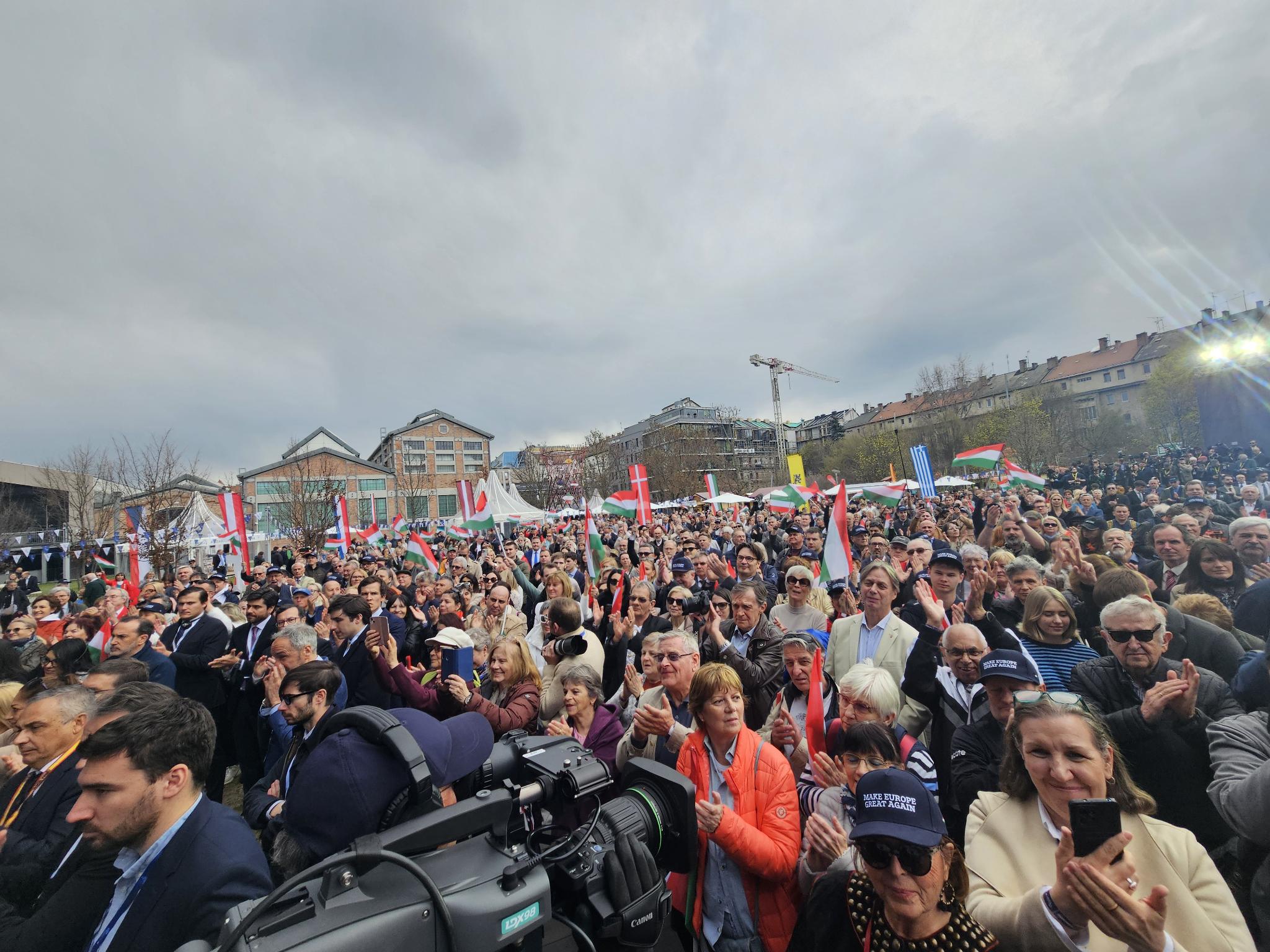
Attendees of the Patriots’ Grand Assembly in Budapest’s Millenáris Park on March 23, 2025
@tomvangrieken on X, March 23, 2026
Leaders of Europe’s conservative and patriotic parties gathered in Budapest on Monday, March 23rd, for the first “Patriots’ Grand Assembly,”, a high-profile summit aimed at reshaping the political direction of the European Union ahead of upcoming elections across the bloc.
Hungarian Prime Minister Viktor Orbán hosted the event, presenting it as a historic moment in which patriotic parties unite to defend national sovereignty and challenge the EU’s liberal mainstream.
📍 1st Patriots’ Grand Assembly – Budapest@MLP_officiel, @matteosalvinimi, @geertwilderspvv, @Santi_ABASCAL, @petr_macinka, @krzysztofbosak, @tomvangrieken, @SlesersAinars, @MartinHelme, @_KingaGal, @UdoLandbauer, @Guillaume_Bigot
— Orbán Viktor (@PM_ViktorOrban) March 23, 2026
Europe’s patriots, united. pic.twitter.com/jaZXfuZg60
In his keynote speech, Orbán declared that the movement’s ambitions were explicit: to “take over the leadership of the European Union” and transform it into “an alliance of sovereign nations.”
He argued that by the end of the decade, Europe could be politically “recoloured” along national-conservative lines, calling it “the greatest political rearrangement in the EU’s history.”
Orbán also warned against Ukraine’s accession to the bloc, saying it would import war and impose unsustainable financial burdens on member states.
The Hungarian leader, facing elections on April 12, accused Brussels and Kyiv of seeking to influence Hungary’s domestic politics, but predicted a decisive victory for his government.
1st Patriots' Grand Assembly – Budapest https://t.co/R1vMRX4C1U
— Orbán Viktor (@PM_ViktorOrban) March 23, 2026
In her speech, the French Rassemblement National Rally’s Marine Le Pen described Hungary as a “symbol of resistance” against external pressure. She praised Orbán as a “visionary” and “pioneer,” expressing confidence that nationalist forces could move beyond a blocking minority to form a majority within EU institutions.
Italy’s deputy prime minister Matteo Salvini struck a similarly combative tone, calling Orbán “a true hero” and vowing to dismantle an overreaching Brussels bureaucracy. Salvini also criticiszedcriticising both billionaire George Soros and Ukrainian President Volodymyr Zelensky for interfering in Hungary’s internal affairs.
From Spain, VOX leader Santiago Abascal lauded Orbán’s resistance to EU pressure and migration policies, adding: “I would like to ask you not to let Brussels’ puppets take away everything you have achieved so far. All of Europe looks with envy at the safety of your streets, while, for example, the streets of Spain are becoming increasingly less safe.”
Dutch politician Geert Wilders, leader of the Party for Freedom (PVV), described Hungary as a “beacon” of sovereignty and urged voters to back Orbán to preserve national independence.
Other contributions, including video messages from Czech Prime Minister Andrej Babiš and Austrian FPÖ leader Herbert Kickl, echoed calls for stronger national control, opposition to migration, and resistance to Brussels’ centralisation efforts.
The summit concluded with the adoption of the “Patriots’ Budapest Proclamation”, an appeal to Europeans calling for a return to a looser union of nation states. The document rejects the idea of a European superstate, opposes further transfers of sovereignty, and calls for stricter migration policies, protection of national industries, and the defence of cultural and energy autonomy.
The Budapest meeting underscores the growing confidence of right-wing movements across Europe—and signals their intention not merely to disrupt, but to govern.