An airplane of the Danish Air Force leaves the airport of Nuuk, Greenland, on January 20, 2026.
JONATHAN NACKSTRAND / AFP
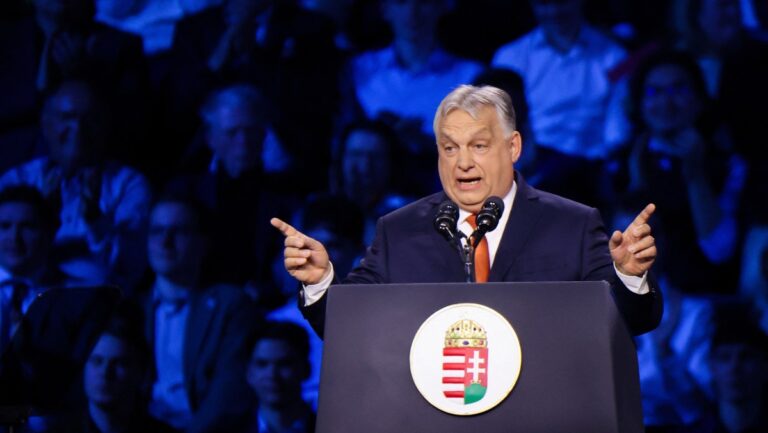
Hungary has blocked the creation of a joint European Union statement on Donald Trump’s Greenland plans, insisting—in the words of Prime Minister Viktor Orbán’s political director—that this is “a NATO-internal matter, not an EU competence.”
Even if Budapest had not stepped in, it would be hard to imagine the formation of a coherent message, since European leaders have responded to Trump’s claim he must have “complete and total control” of the Island in totally different ways.
After Washington threatened over the weekend to impose new tariffs on several European countries over their opposition to U.S. plans regarding Greenland, Brussels diplomats revealed they were considering retaliatory measures.
Germany—which has previously echoed Hungary’s line that the control of Greenland is a NATO rather than an EU issue—and France in particular say that Brussels should prepare a trade “bazooka” to strike back at Washington if tariffs are imposed. Belgian Prime Minister Bart De Wever also said on Tuesday that “we must respond to this; there’s no point in being soft anymore.”
Belgian Prime Minister Bart De Wever on Trump:
— Clash Report (@clashreport) January 20, 2026
We must respond to this; there’s no point in being soft anymore.
If someone says, “I want to take NATO territory from you, or else I’ll start a trade war,” then we will start a trade war. pic.twitter.com/dKHehsBp7v
But UK Prime Minister Keir Starmer has urged against this approach, describing it as “the wrong thing to do.”
A trade war is not in our interests and therefore my first task is to make sure we don’t get to that place which is what I’m focused on at the moment.
Noting on Monday that other countries, including Italy, aren’t keen on the move, Euractiv also suggested that “Europe appears more inclined to keep the bazooka on the shelf.”
Commission President Ursula von der Leyen has, for her part, stressed that “Arctic security can only be achieved together,” in contrast to President Trump, who appears to believe he can ensure security unilaterally.
But a recent statement from Slovak Prime Minister Robert Fico inferred that VDL’s message does not really matter, since, as he put it, “world leaders do not take the EU fully seriously, and this can be attributed to our nonsensical climate targets and our suicidal migration policy.”
PHONE CALL WITH GERMAN FEDERAL CHANCELLOR F. MERZ AFTER THE MEETING WITH THE U.S. PRESIDENT
— Robert Fico 🇸🇰 (@RobertFicoSVK) January 19, 2026
Dear friends,
just a few minutes ago I finished a phone call with German Federal Chancellor Friedrich Merz @bundeskanzler regarding the serious international situation. Above all, I… pic.twitter.com/4d1McrHvoL